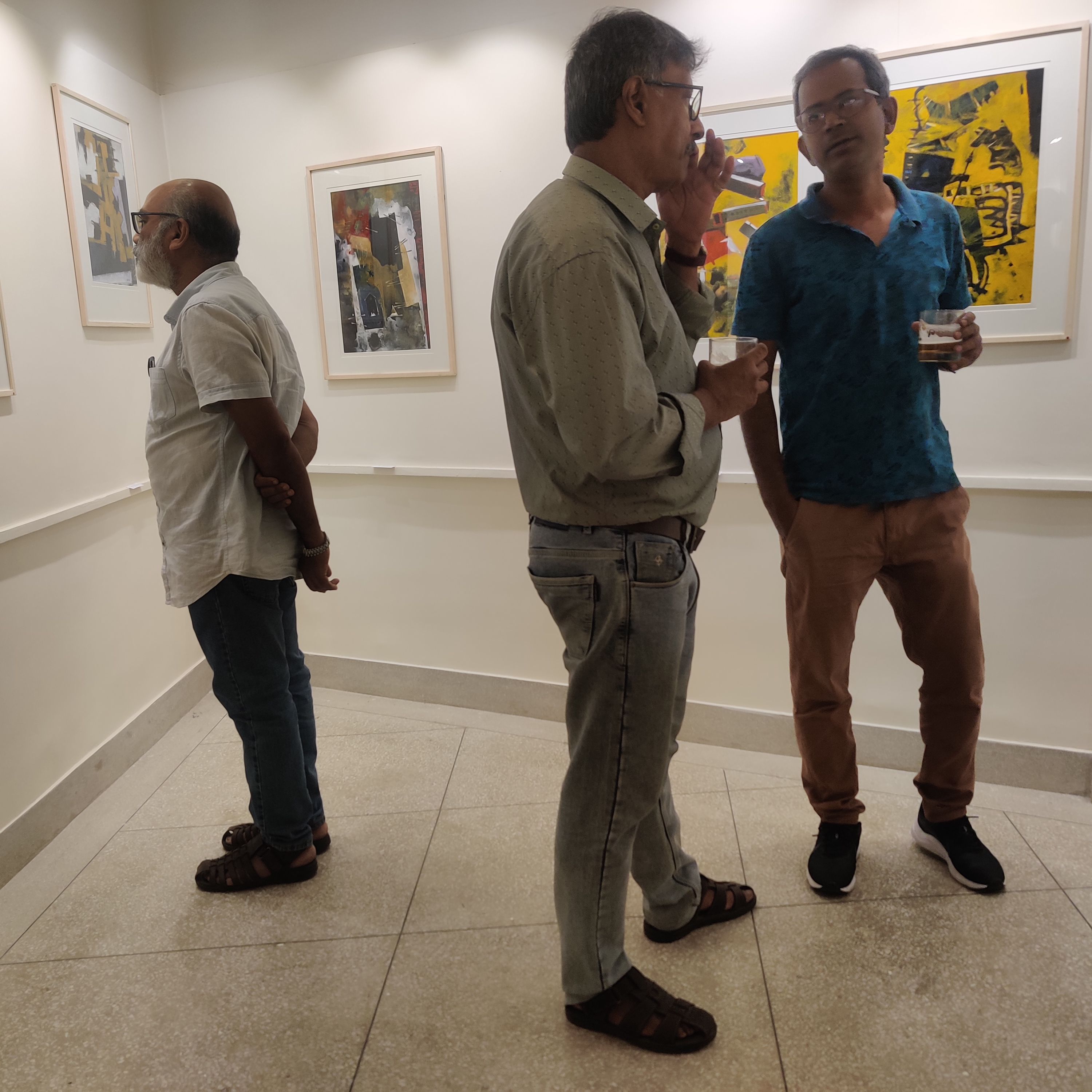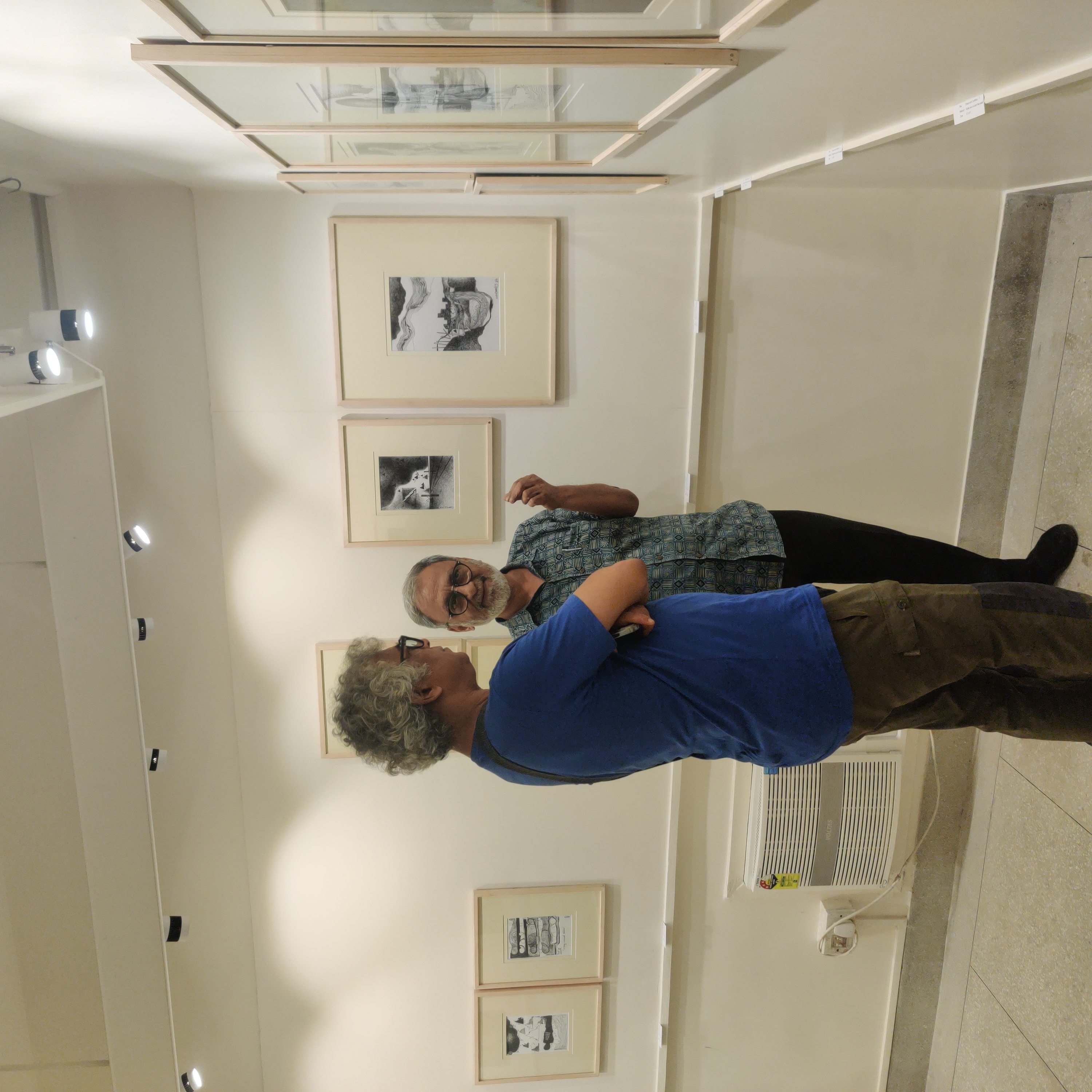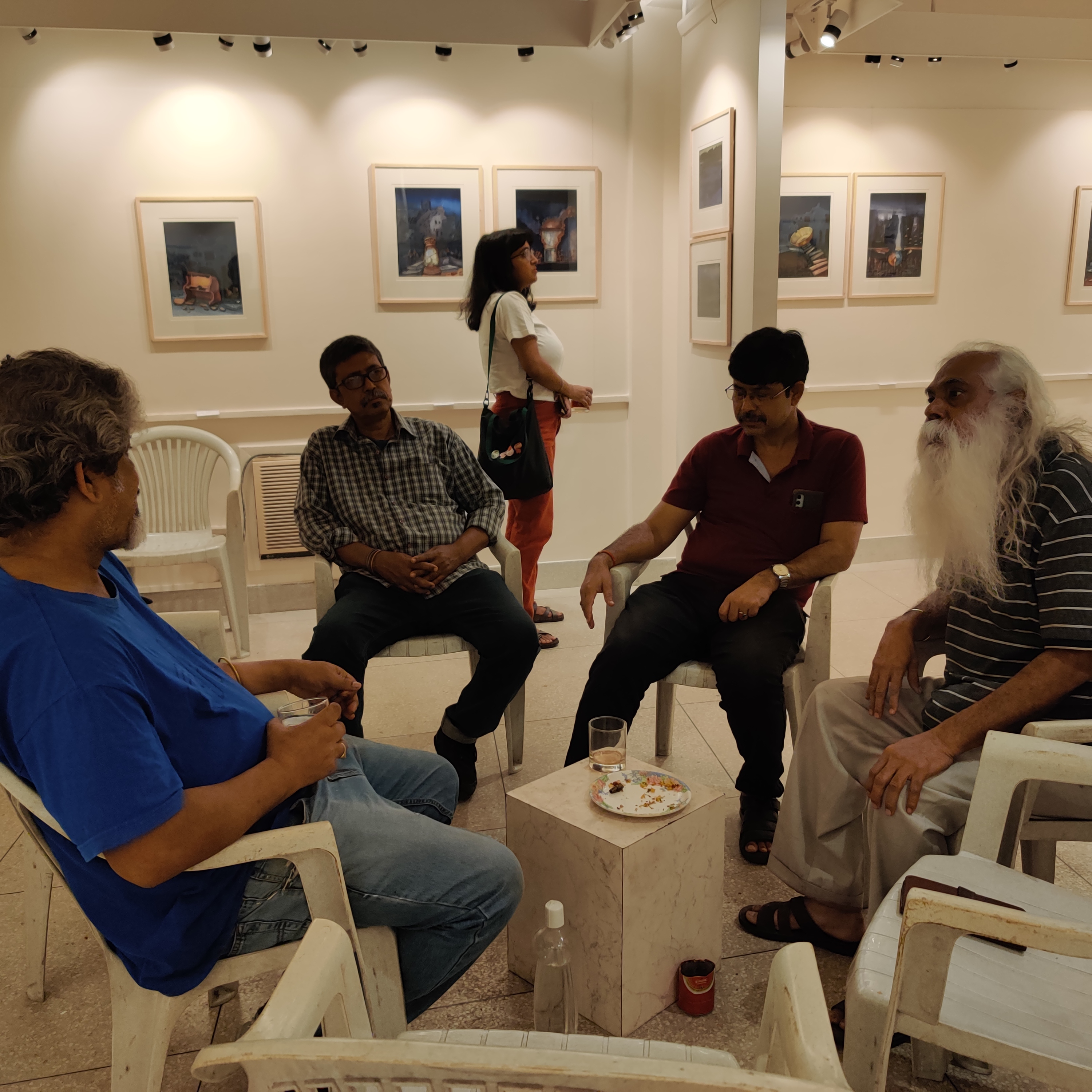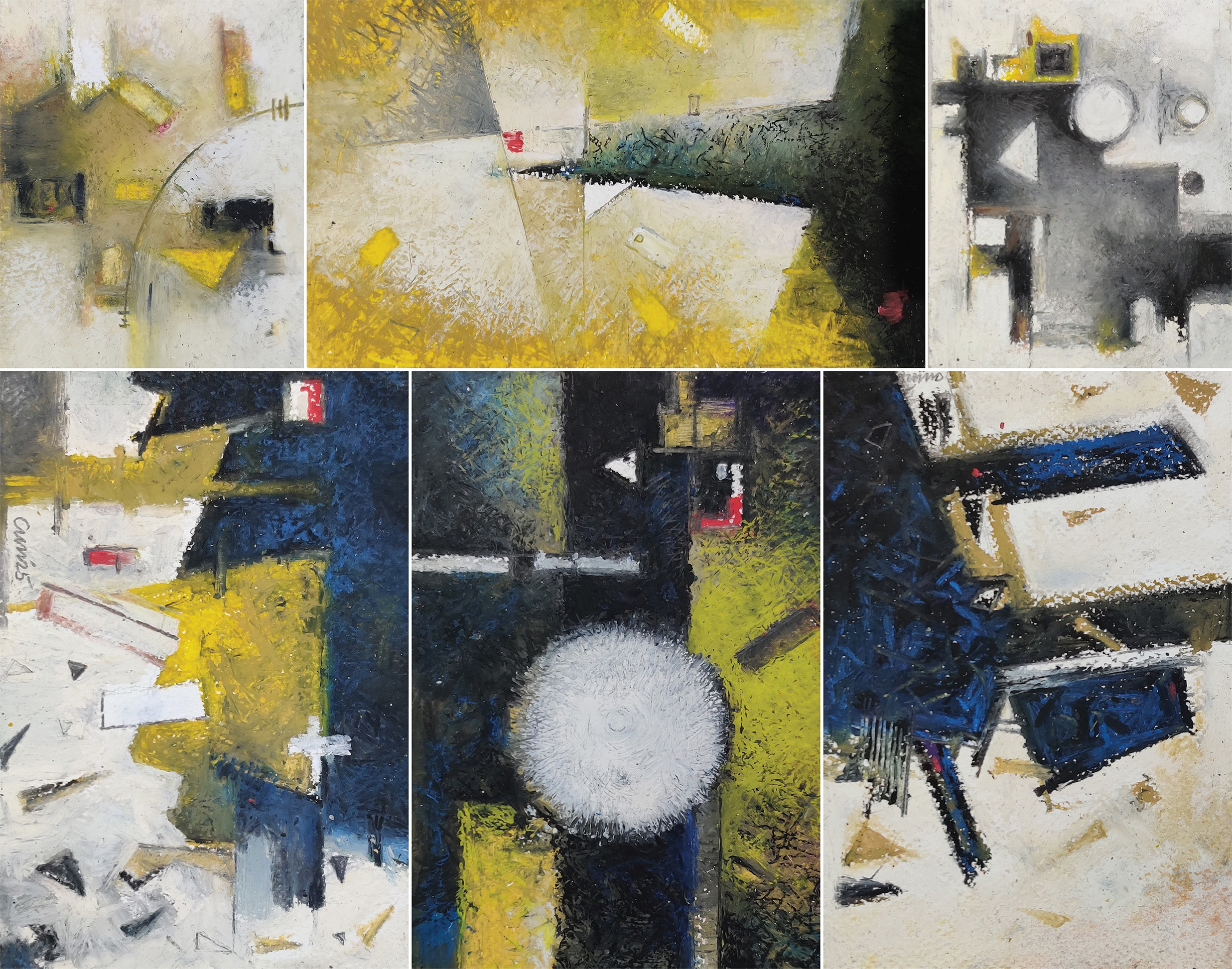
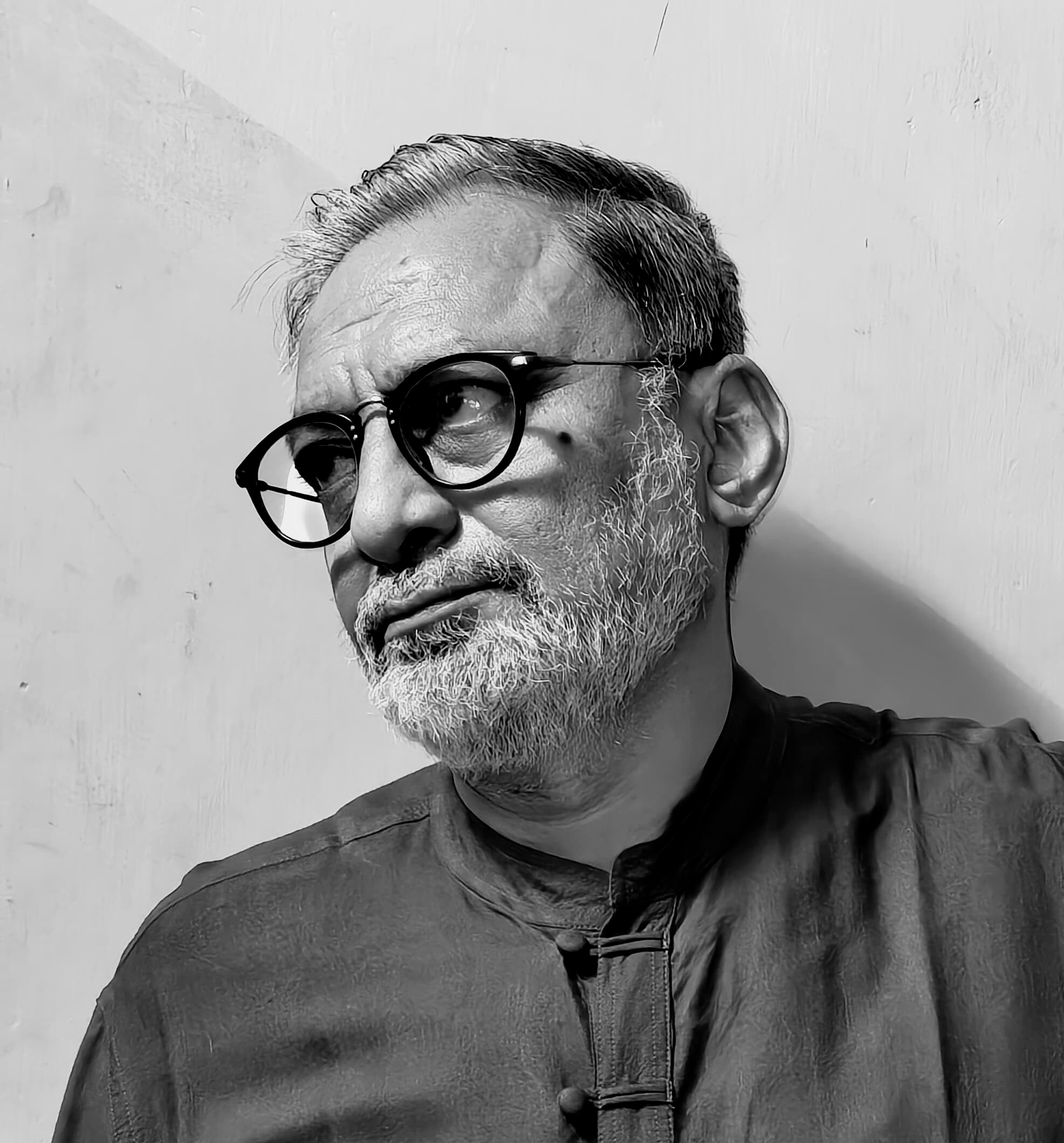
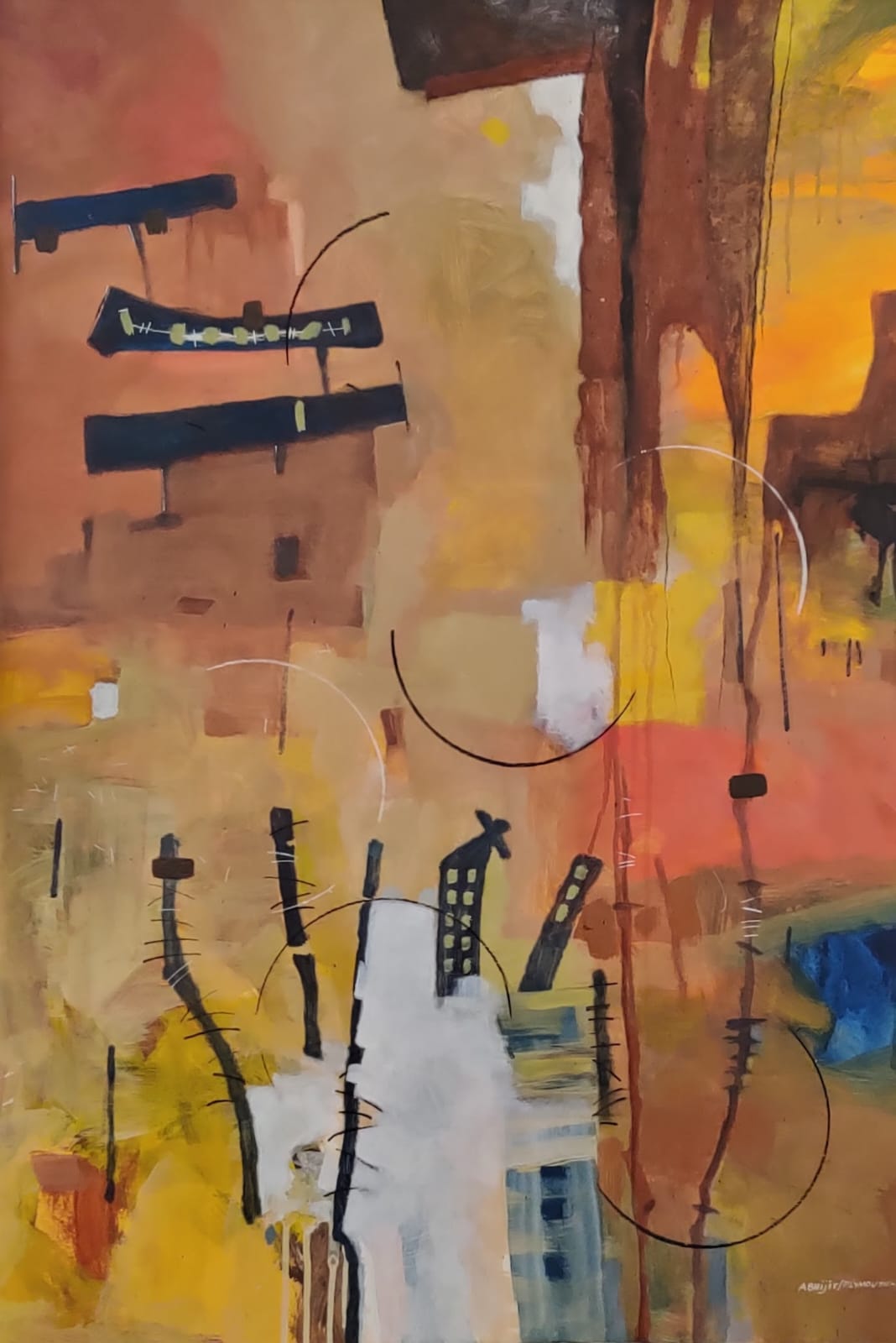
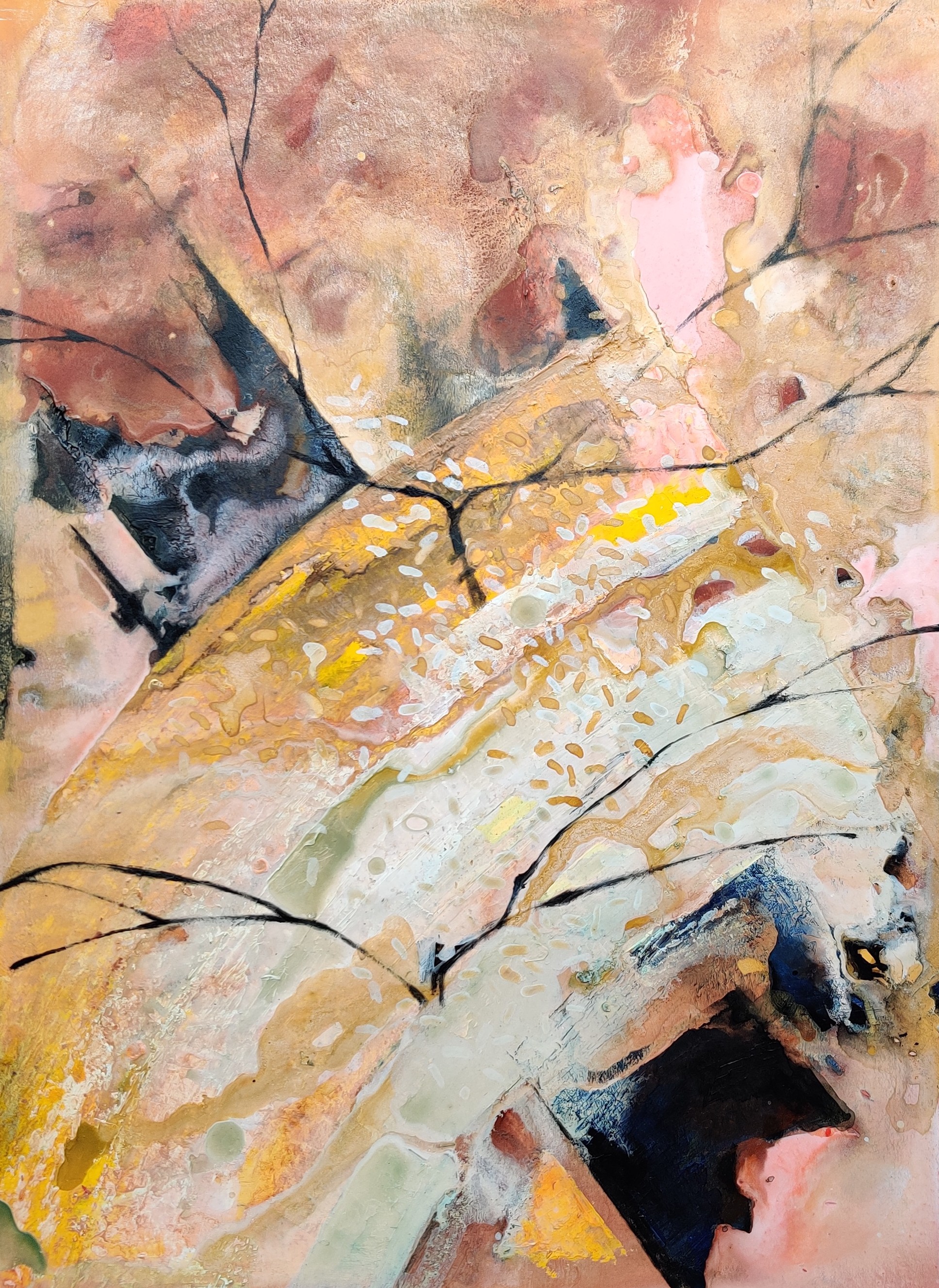
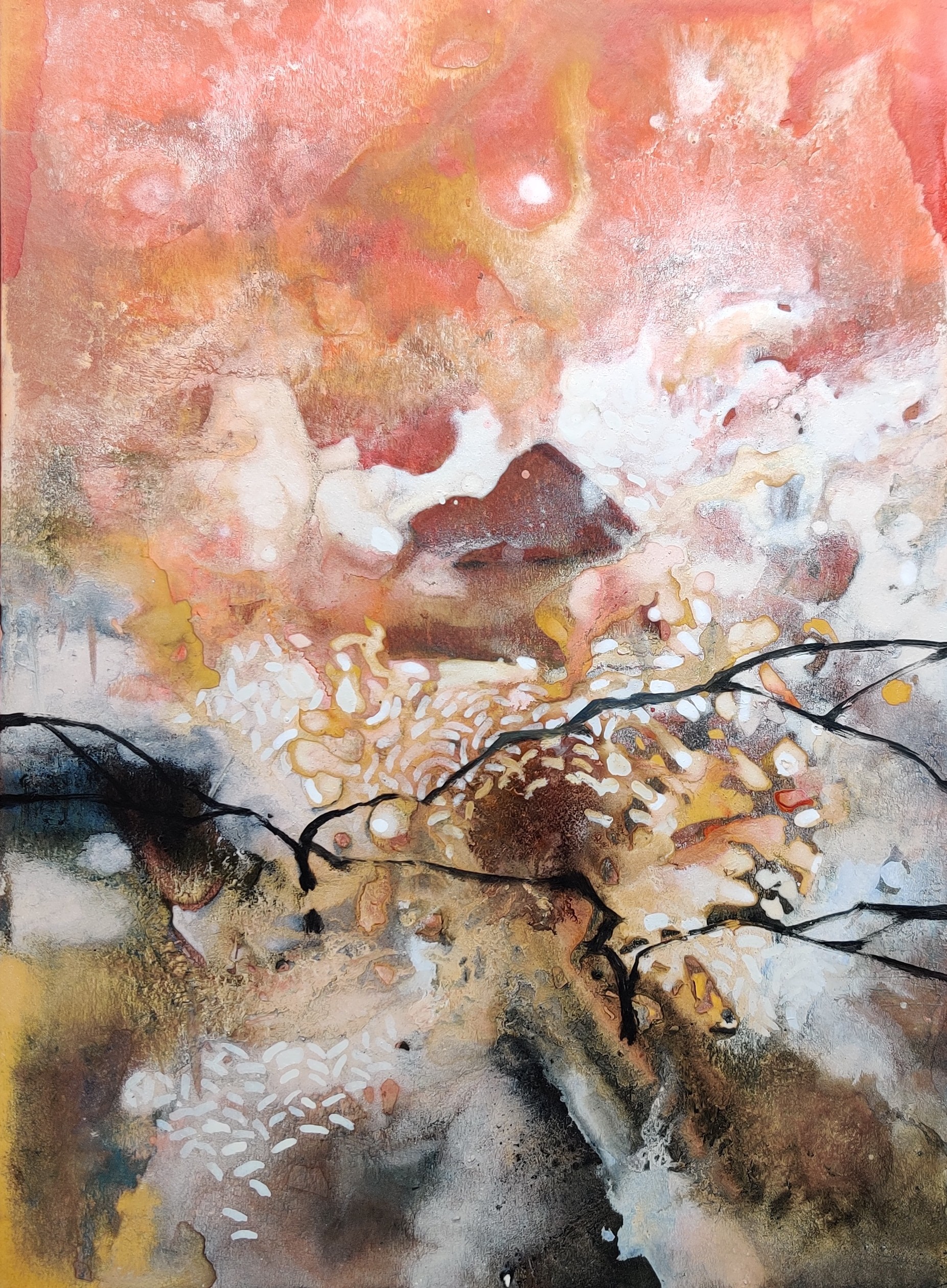
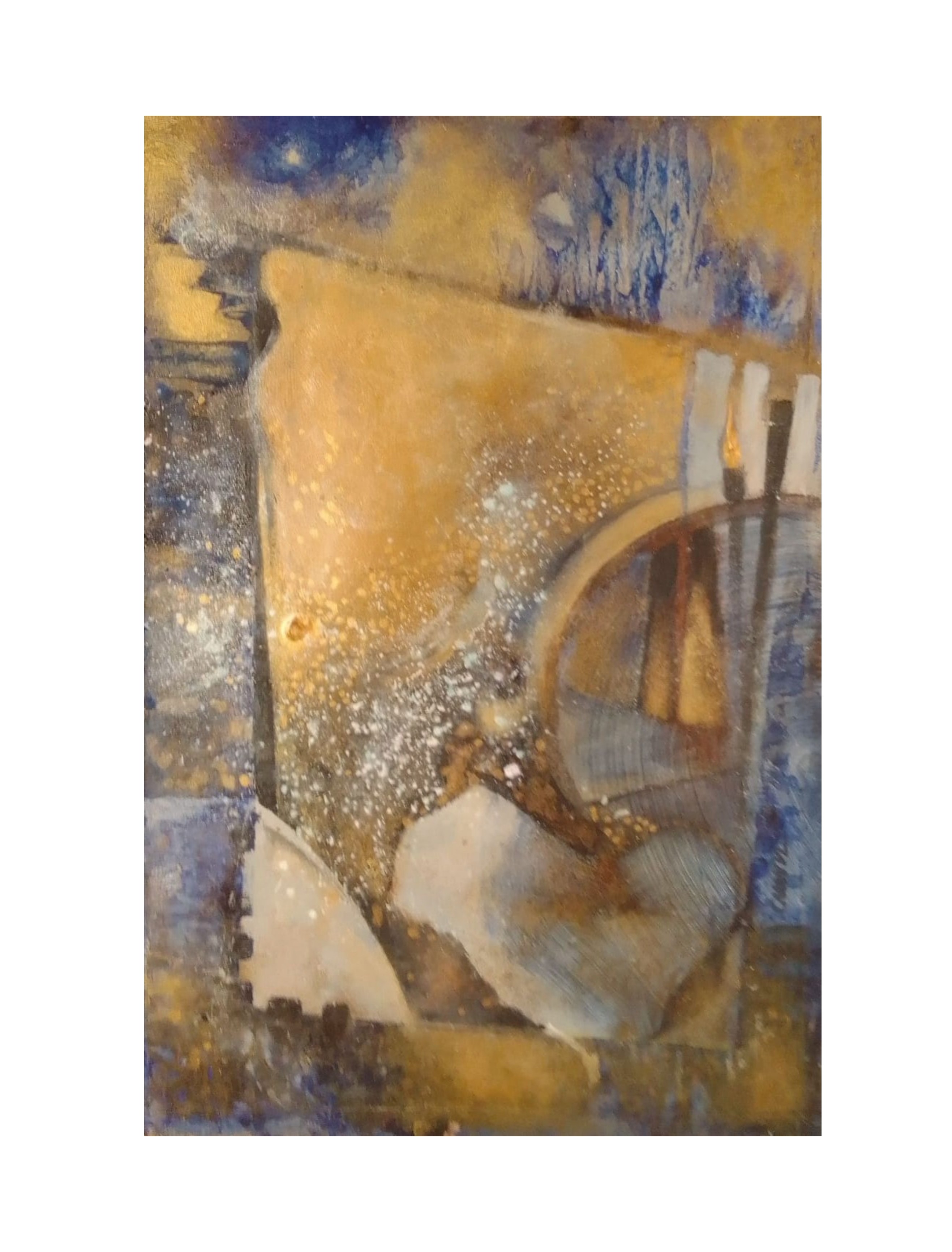
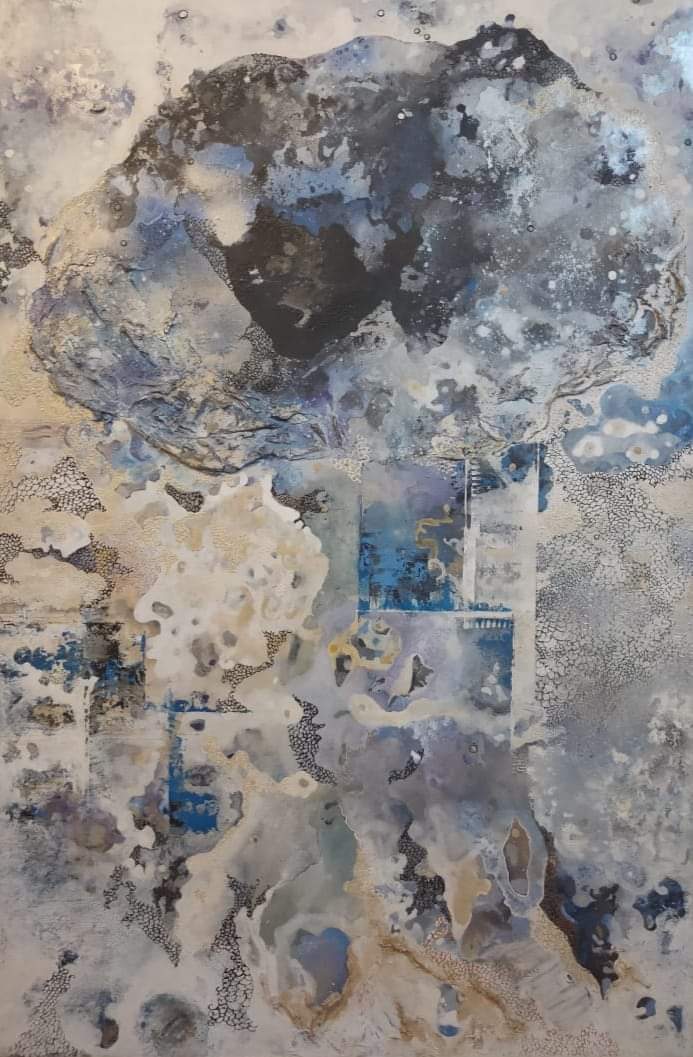
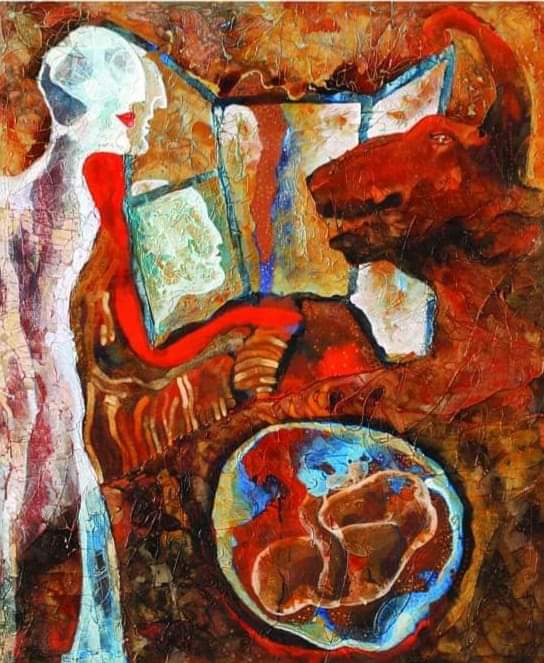
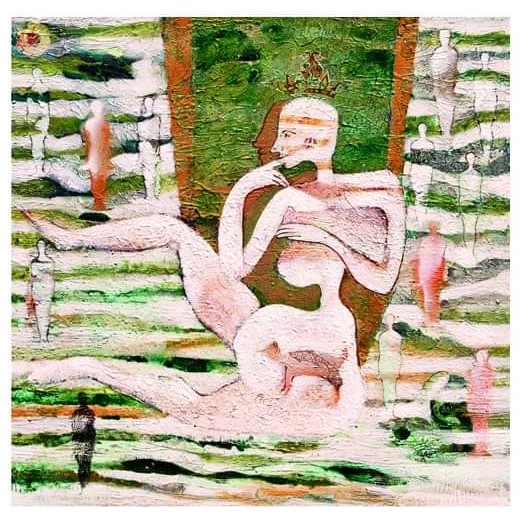
Abhijit Mitra, born in 1961, is a Kolkata, India-based artist and painter with four decades of experience. He translates the complexities of structural elements into a captivating visual language, evident in each of his works.
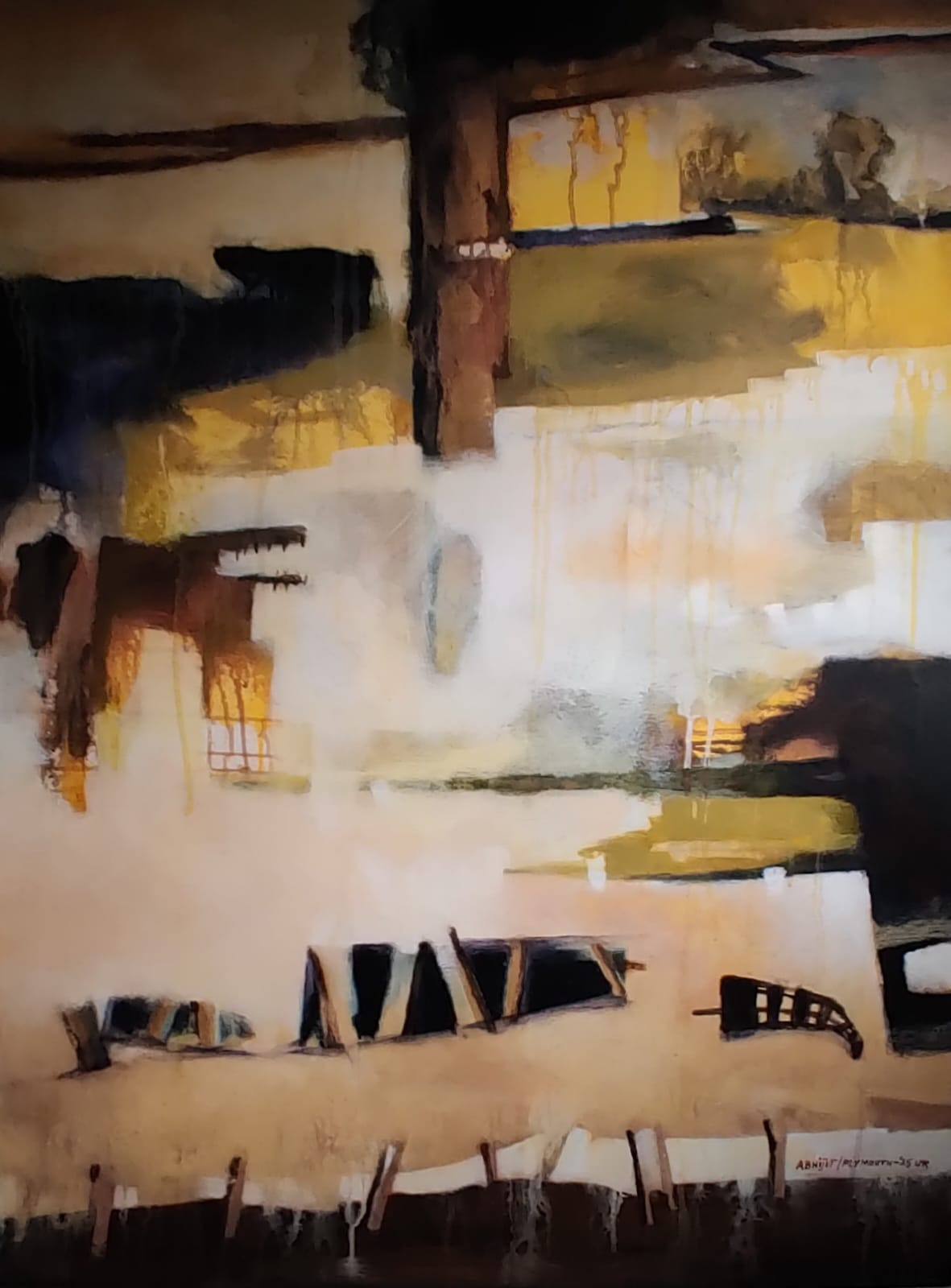
Recent Work
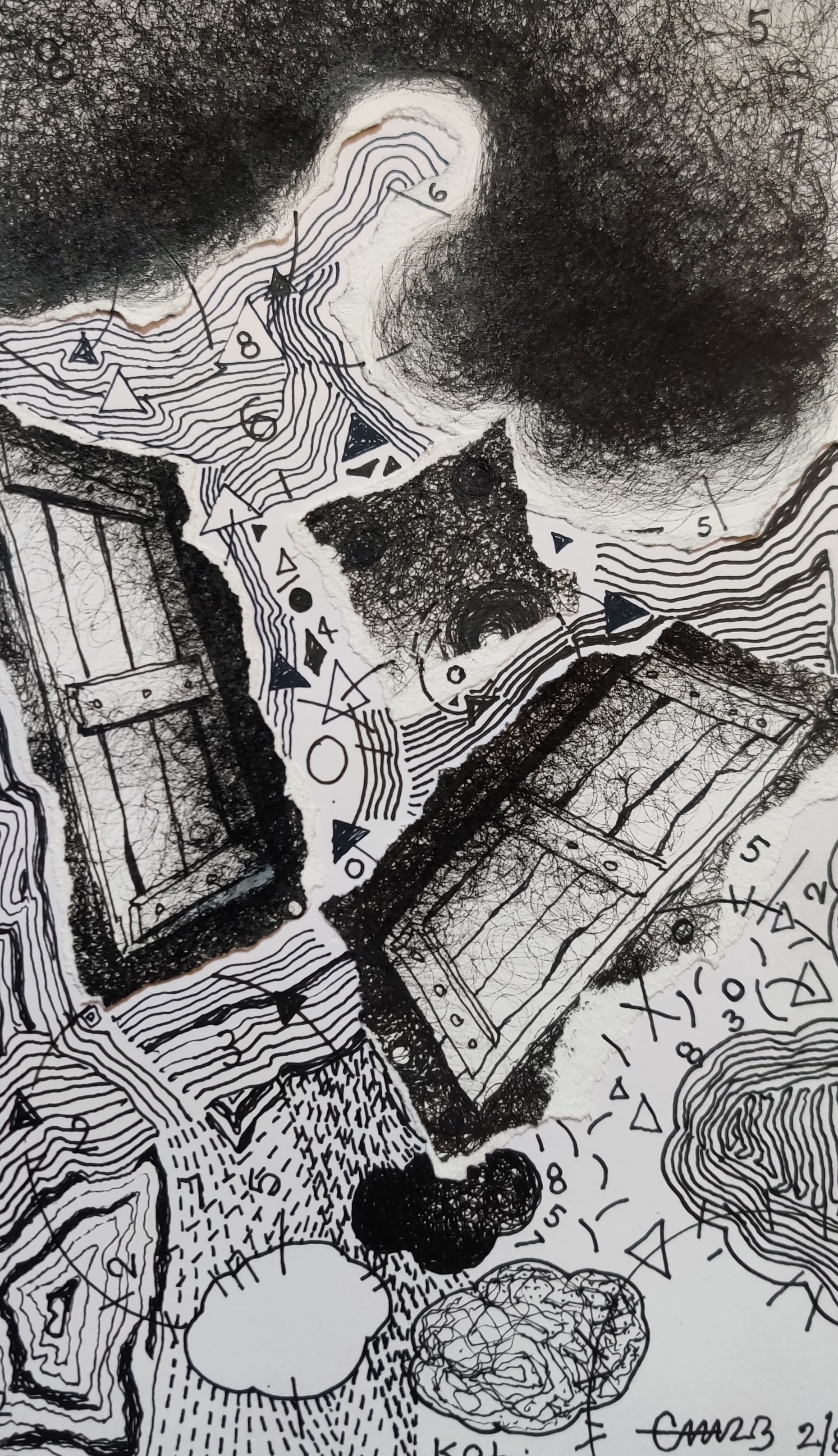
2020-2024
2015-2020
2010-2015
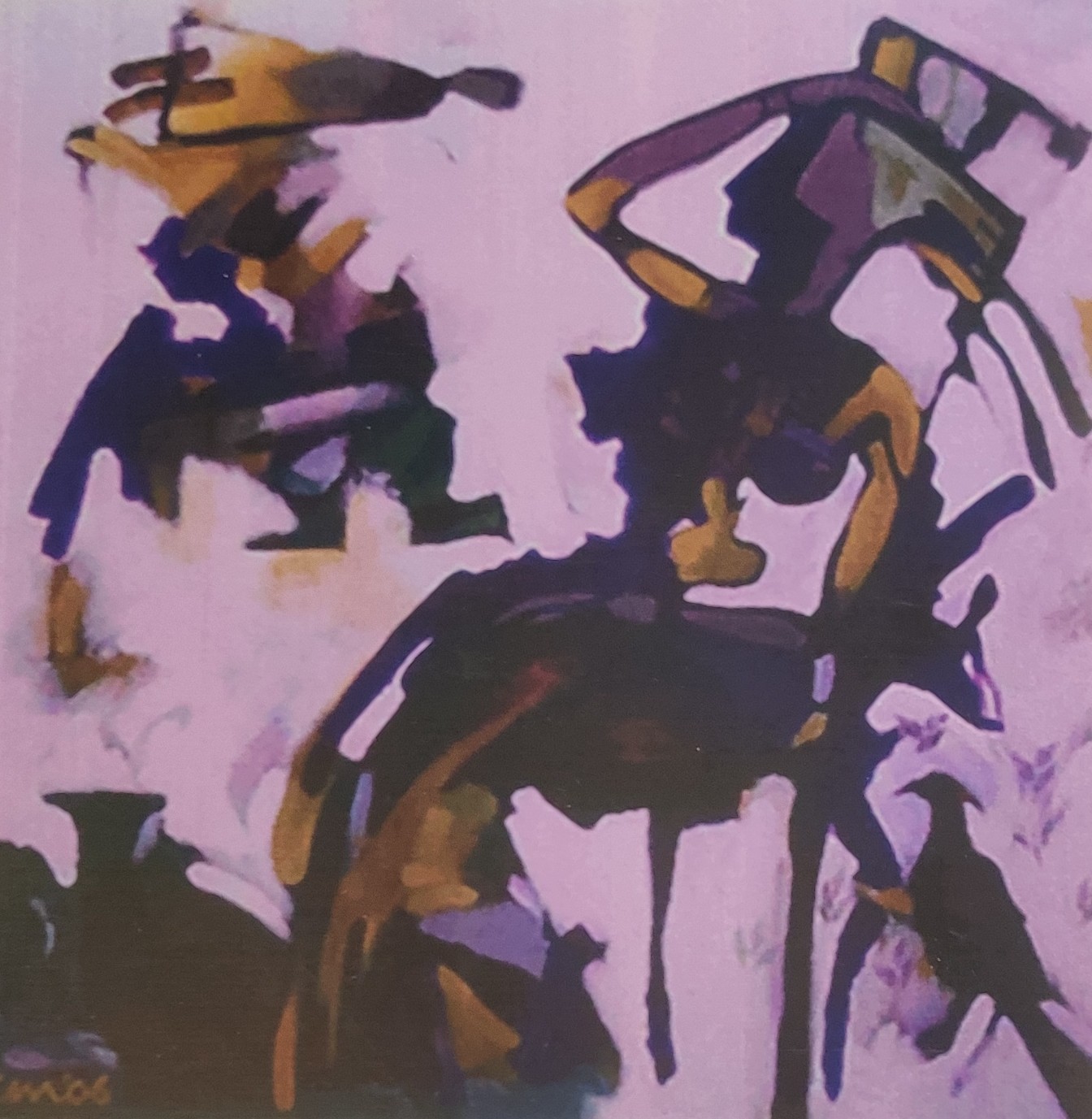
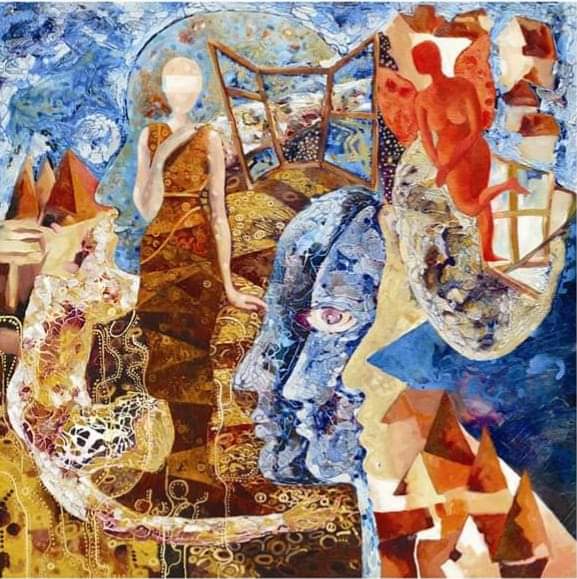
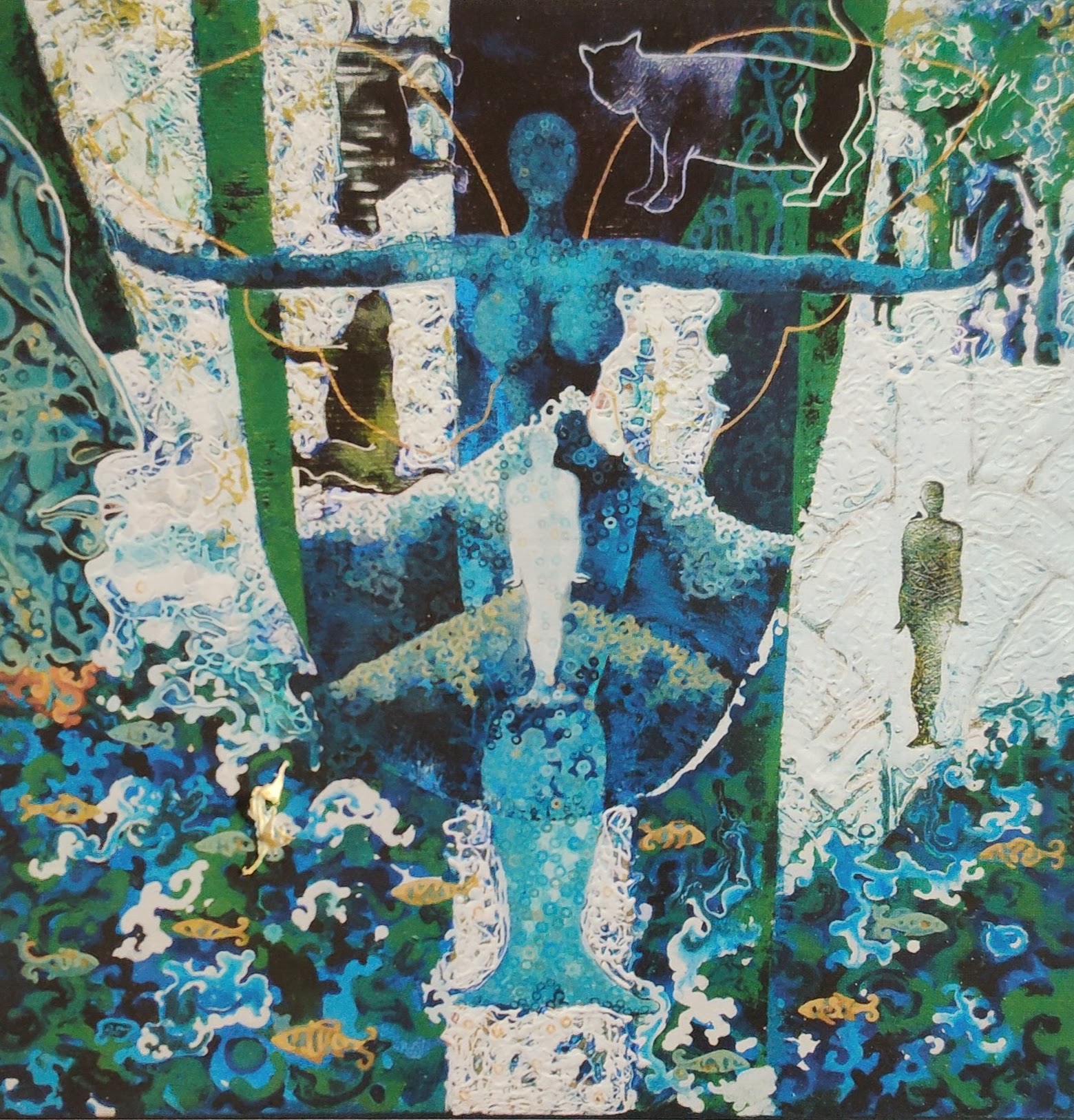
2005-2010
Early
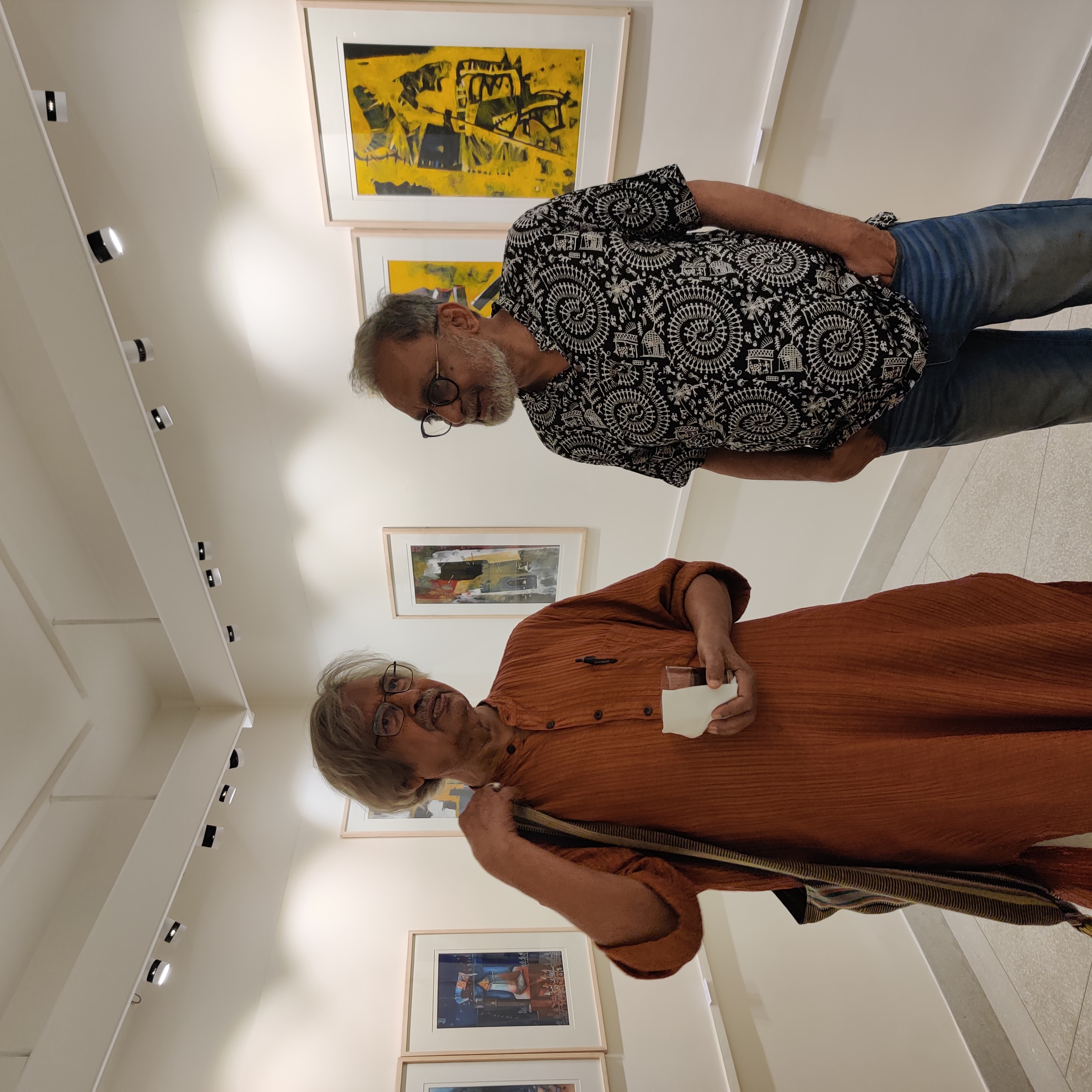
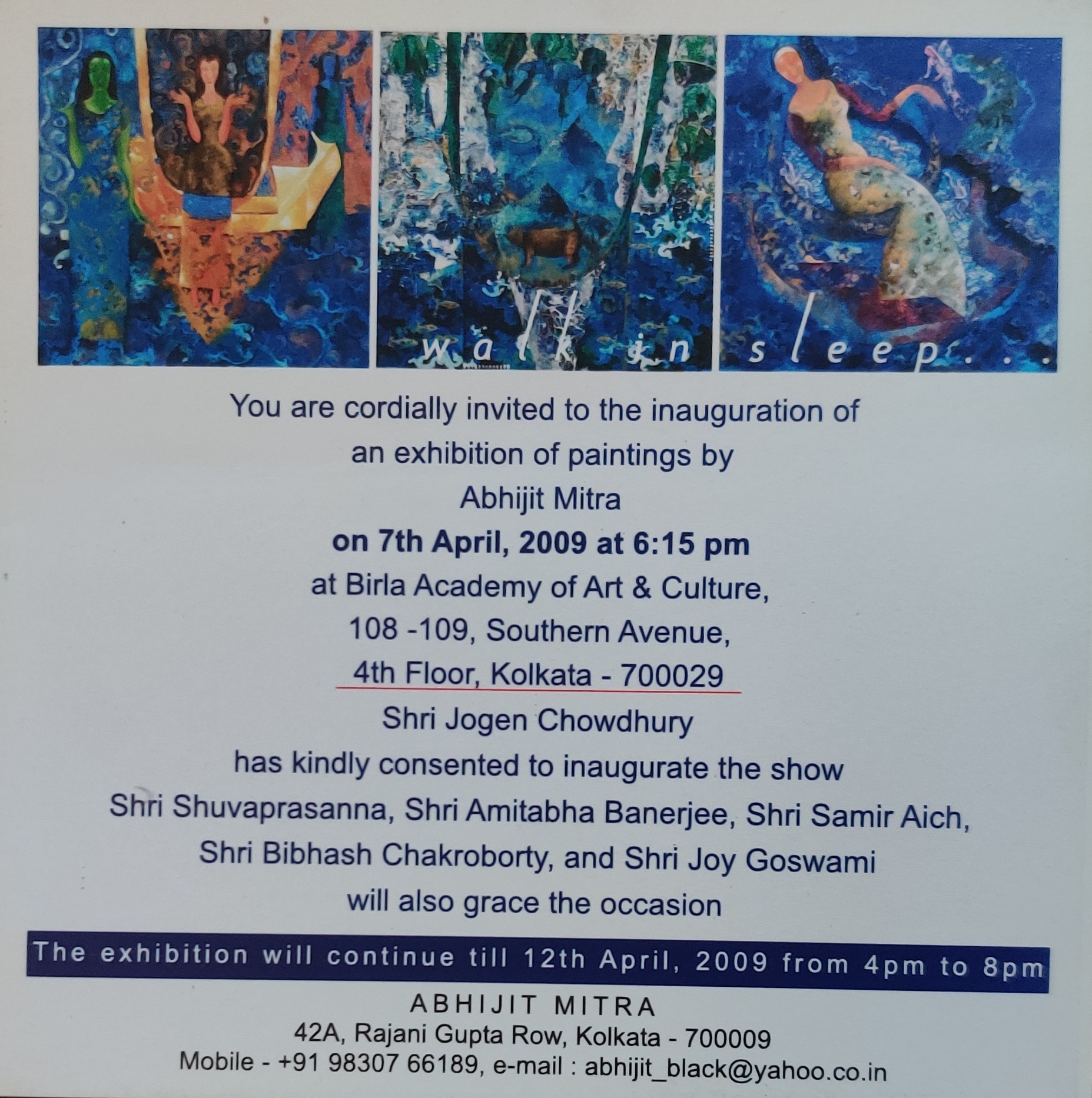
7th April, 2009
Read More৩০শে মার্চ, ২০২৪
Read More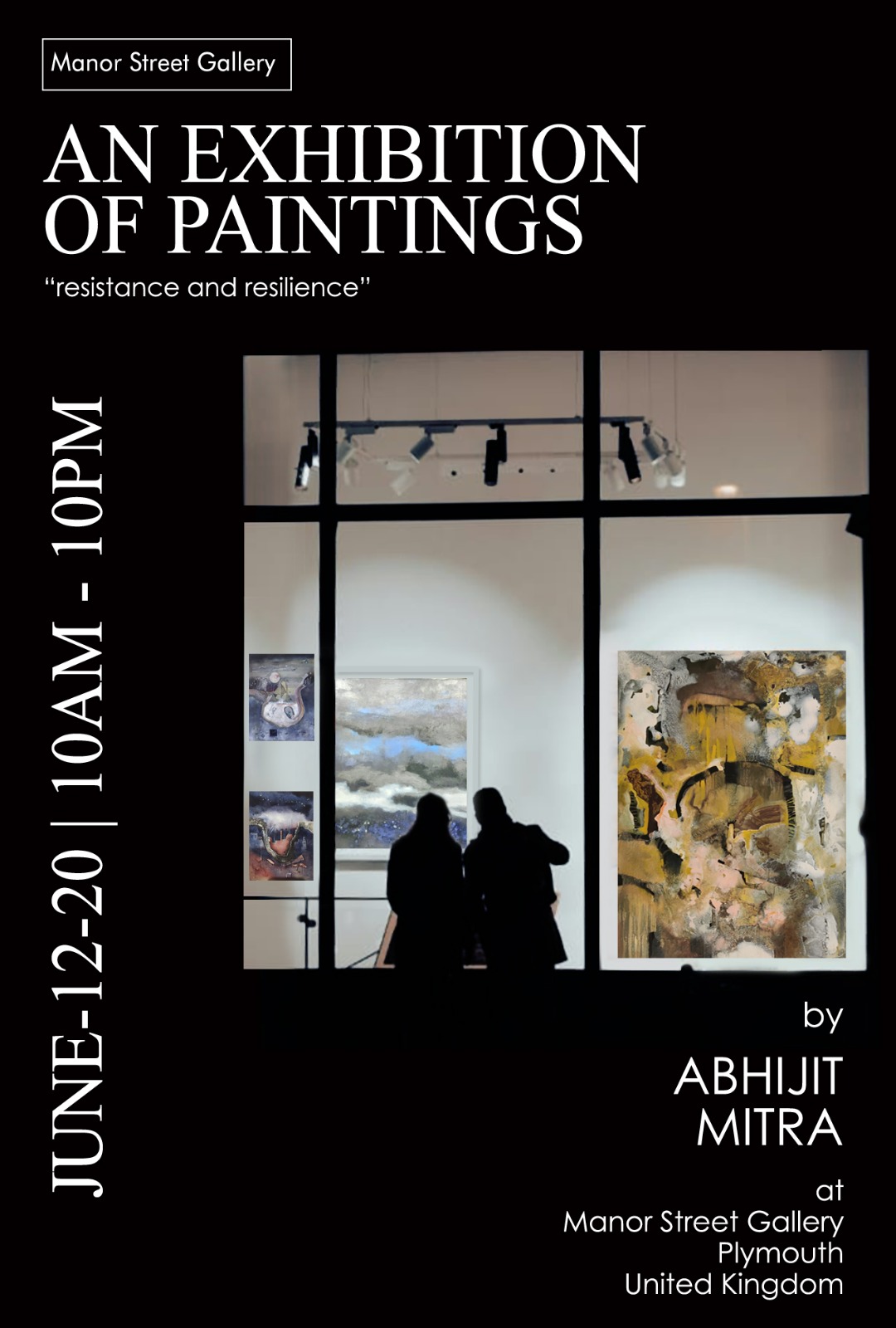

Today all art is modern. The transition from seeking to create a distinctively Indian art and the search for authenticity and identity is now almost over. Though it sometimes raises its head under the patronage of conservative and fundamentalist forces in different parts of the world, including India, such ideologically motivated art has never passed aesthetic or ethical standards. There are different ways of doing modern art and being modern. Modern art emerged with the emergence of the idea of the unbounded, free and equal rational individual pursuing, on the one hand, his self-interest and, on the other, an agent of free imaginative power. This gave rise to the idea of the mad and creative genius passionately pursuing any of the arts. Bourgeois art celebrated this individual, especially its inner life, be it joyousness or alienation, loneliness or existential suffering. This disembodied idea of the self was a patriarchal construct and became a crucial subject of modern art. However, women were seen as bodies to be admired or desired. Hence, the universal celebration of the female nude in modern art.
Over time, internal critiques of modern bourgeois art appeared, which critically engaged with the modern world and its principal ways of representation and seeing the world. There are varied strands of this critical engagement with modernity and modern art. The most celebrated painting of this genre is Picasso’s Guernica, which was done in response to the bombing of civilians in the small town of Guernica in the Basque region of Spain. It was one of the most powerful images in modern art representing the wanton violence and the tragic fate of humans. The human body became the target of state or ideologically inspired mass violence. The inner sorrows of the disembodied self turns pale in the face of the spate of global genocidal violence. Somnath Hore’s contribution to make the suffering of the embodied self a central motif of his art has been pioneering. Francis Bacon too focussed on, what he called, “the brutality of fact”, in his disturbing images of the horror of the human situation. Feminist artists have frontally subverted the canons of bourgeois art, which saw women as passive and disciplined bodies opening up to the male gaze.
Richard Brettell has argued that art is not so much a way of representation as it is a way of seeing the world. This is particularly true of modern art. Artists want to free themselves of conventional ways of seeing the world and want to take a fresh look. There are three major ways of seeing the world, first empirical, that is, what appears to our senses. There is another way of seeing, which is conceptual or structural. It tries to fathom the underlying structures and processes of what appears to our normal sight. With the help of symbols, pictorial metaphors and other devices, the world is critically interrogated. The third way of seeing is an ethically normative vision arising out of a sense of responsibility towards the world and a commitment to justice. In this way the artist creates his own language, by trying to see the world in different ways. Imagination and intellectual insights both play vital parts in this exercise. This makes art thoughtful and passionate at the same time. Writing about art is an exercise in both interpreting the art work and its language as well as a critical and creative engagement with the thoughts and ideas embedded in any work of art.
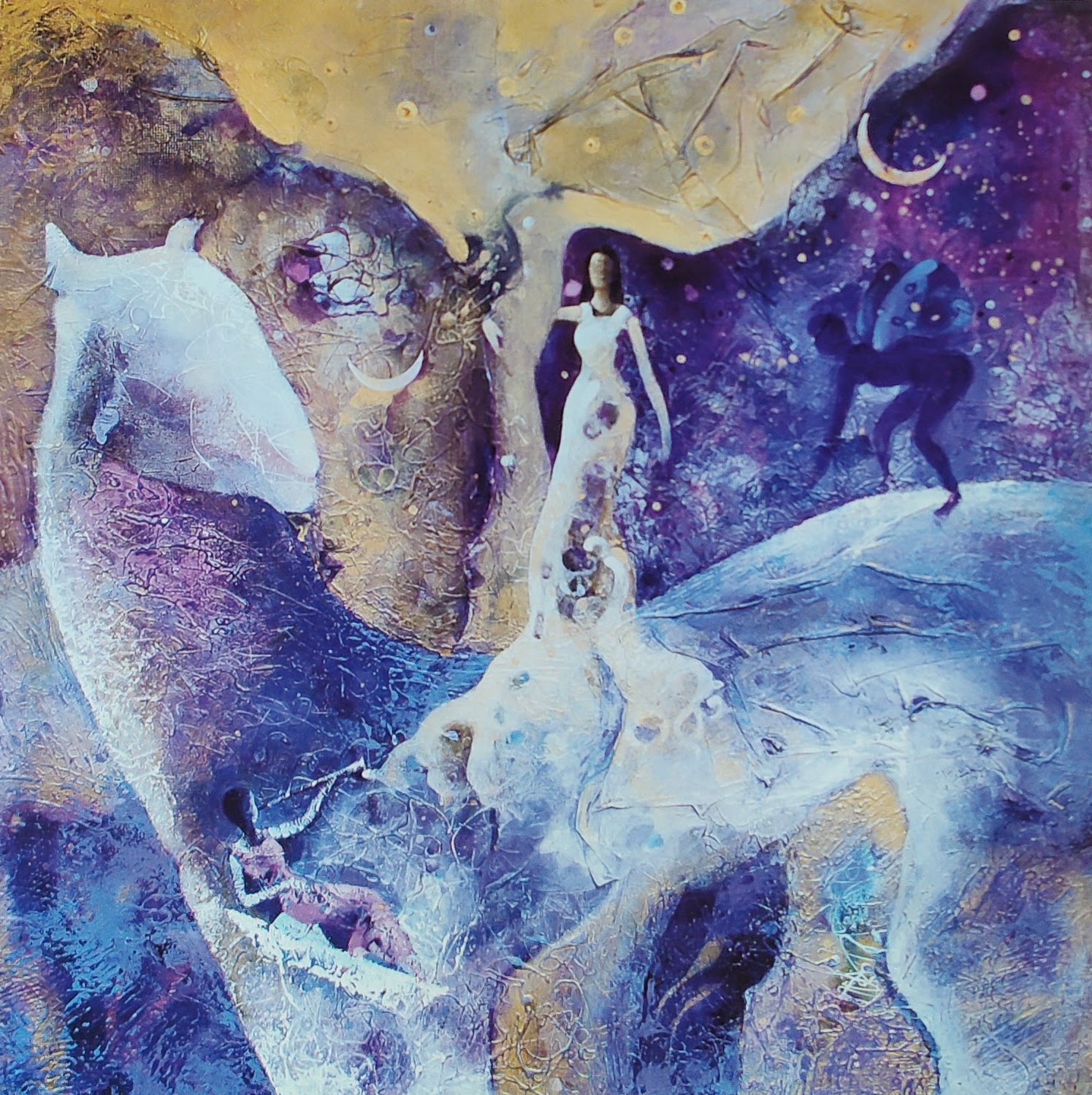
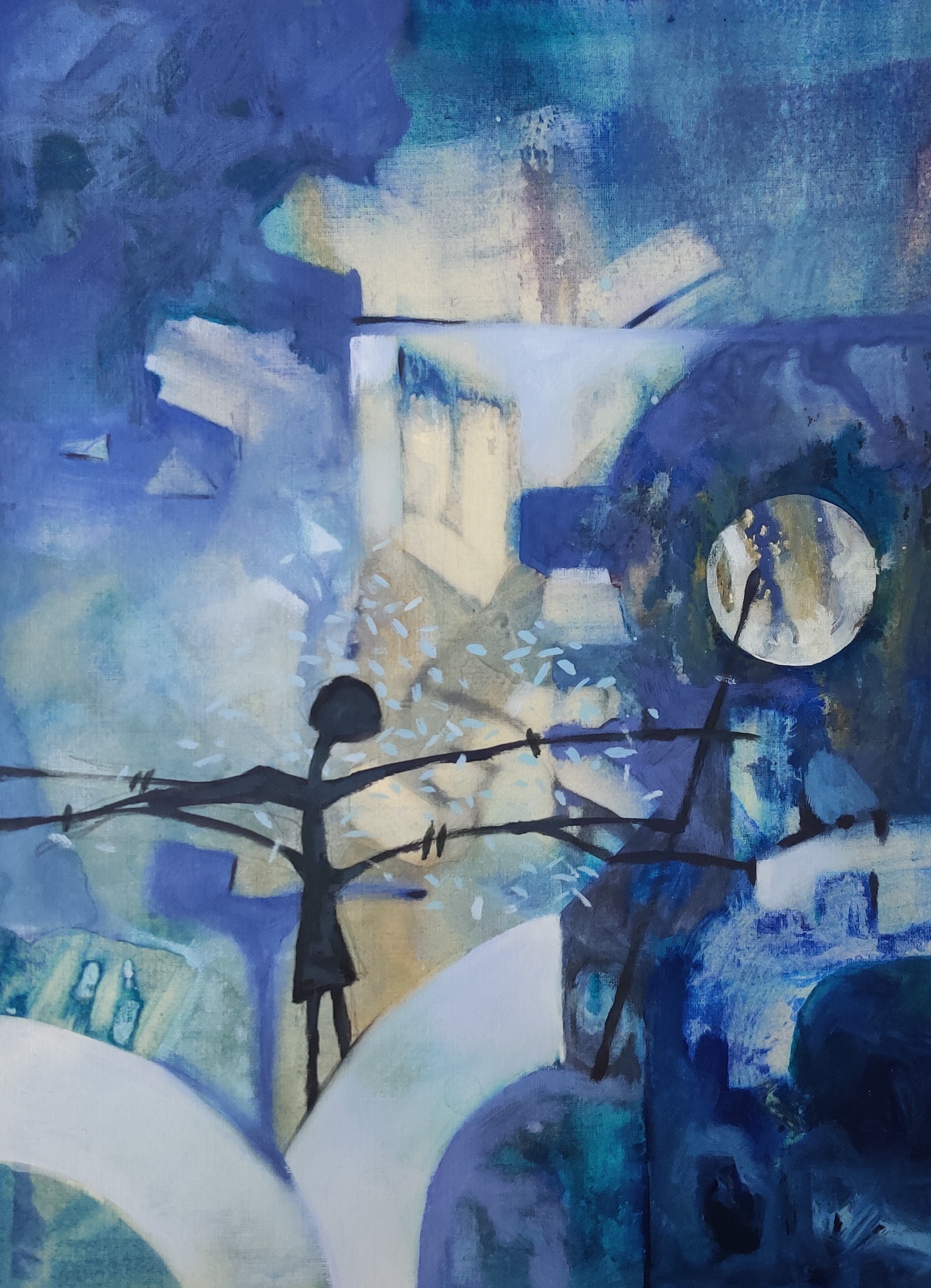
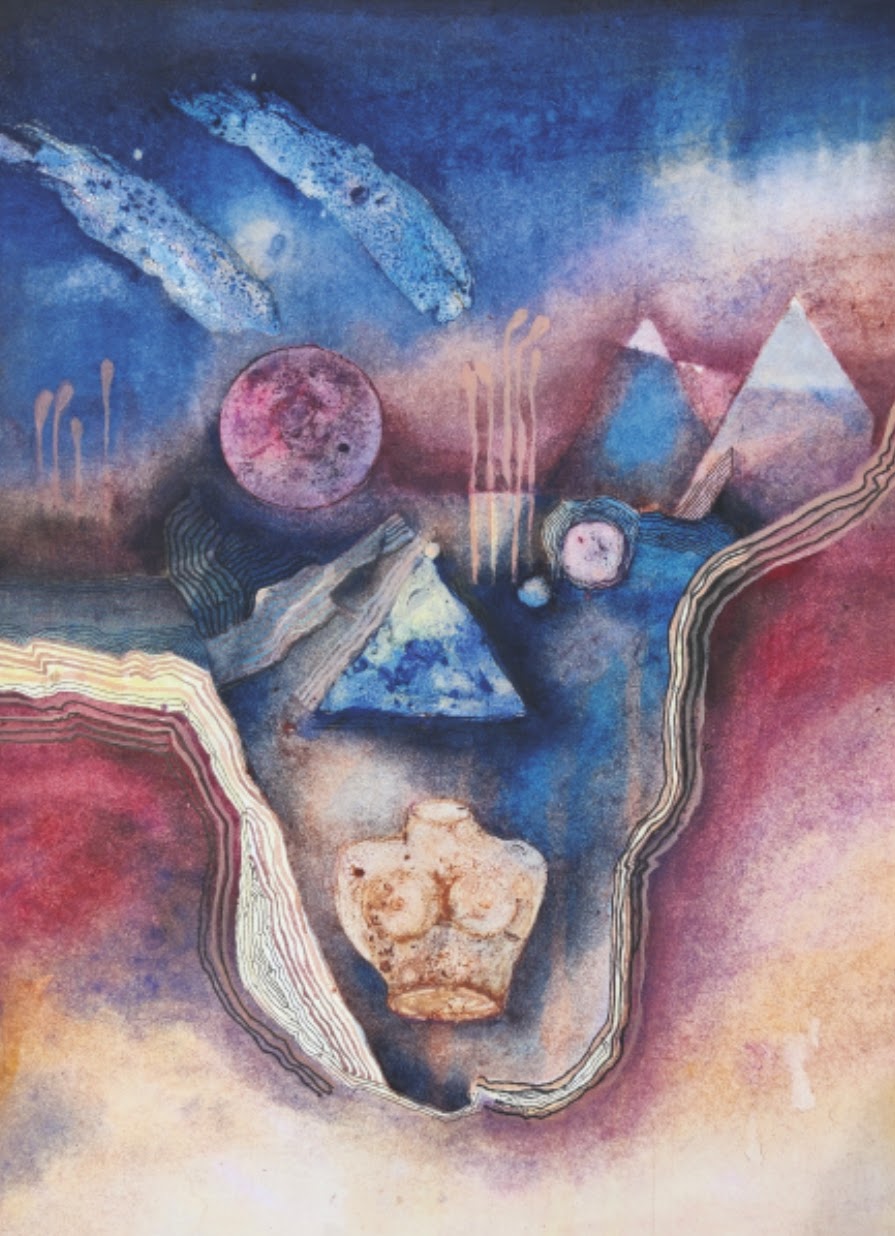
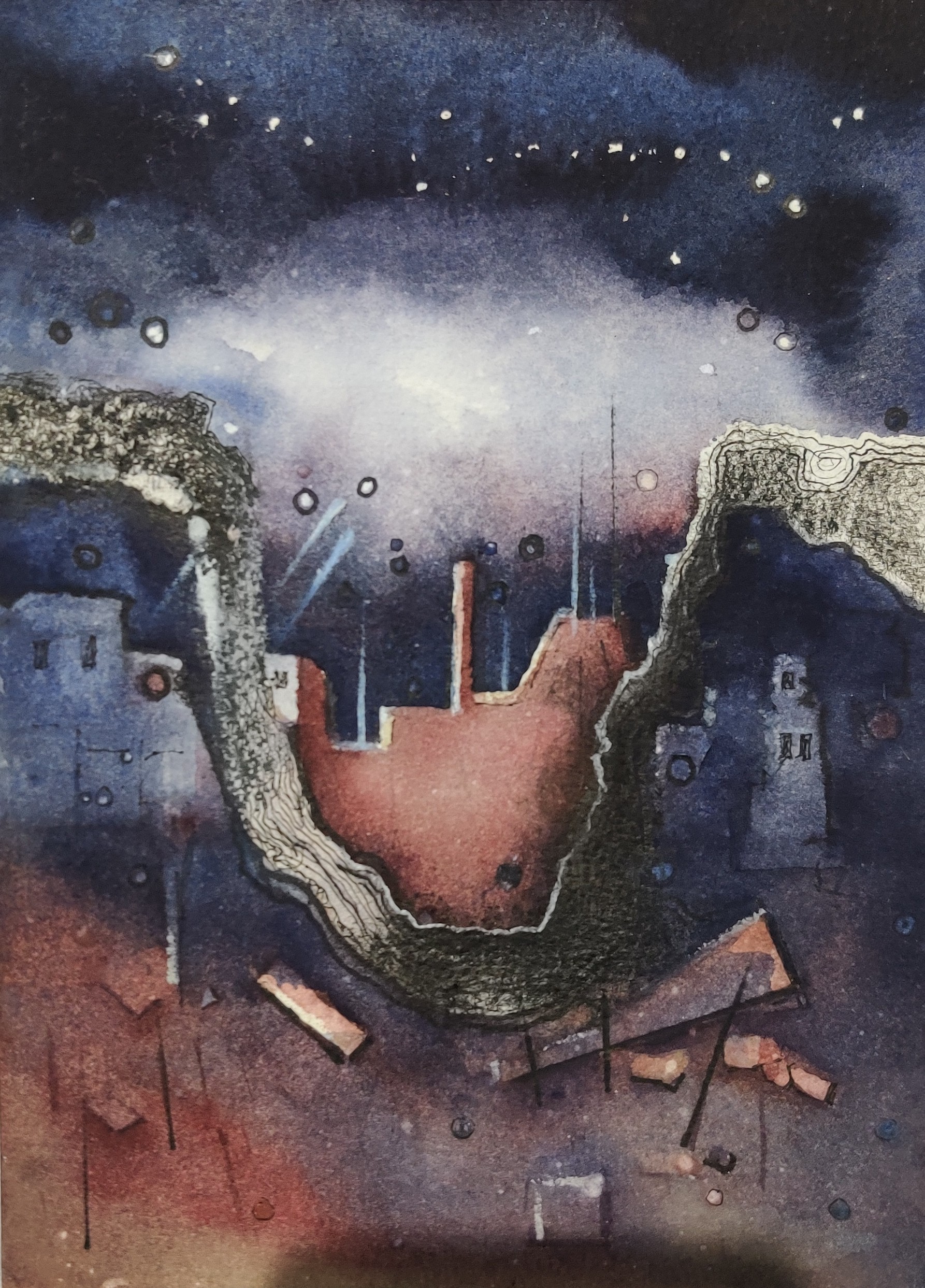
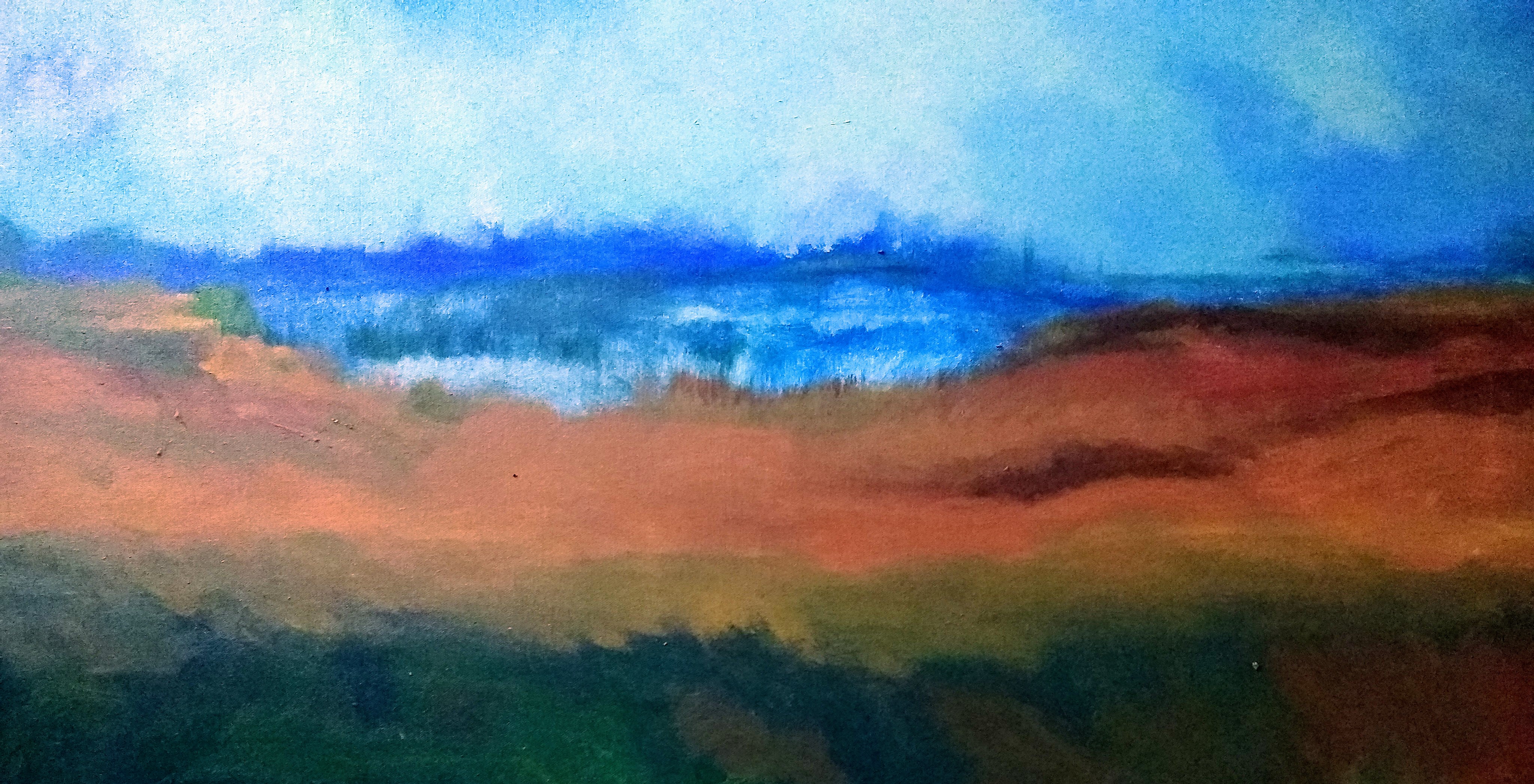
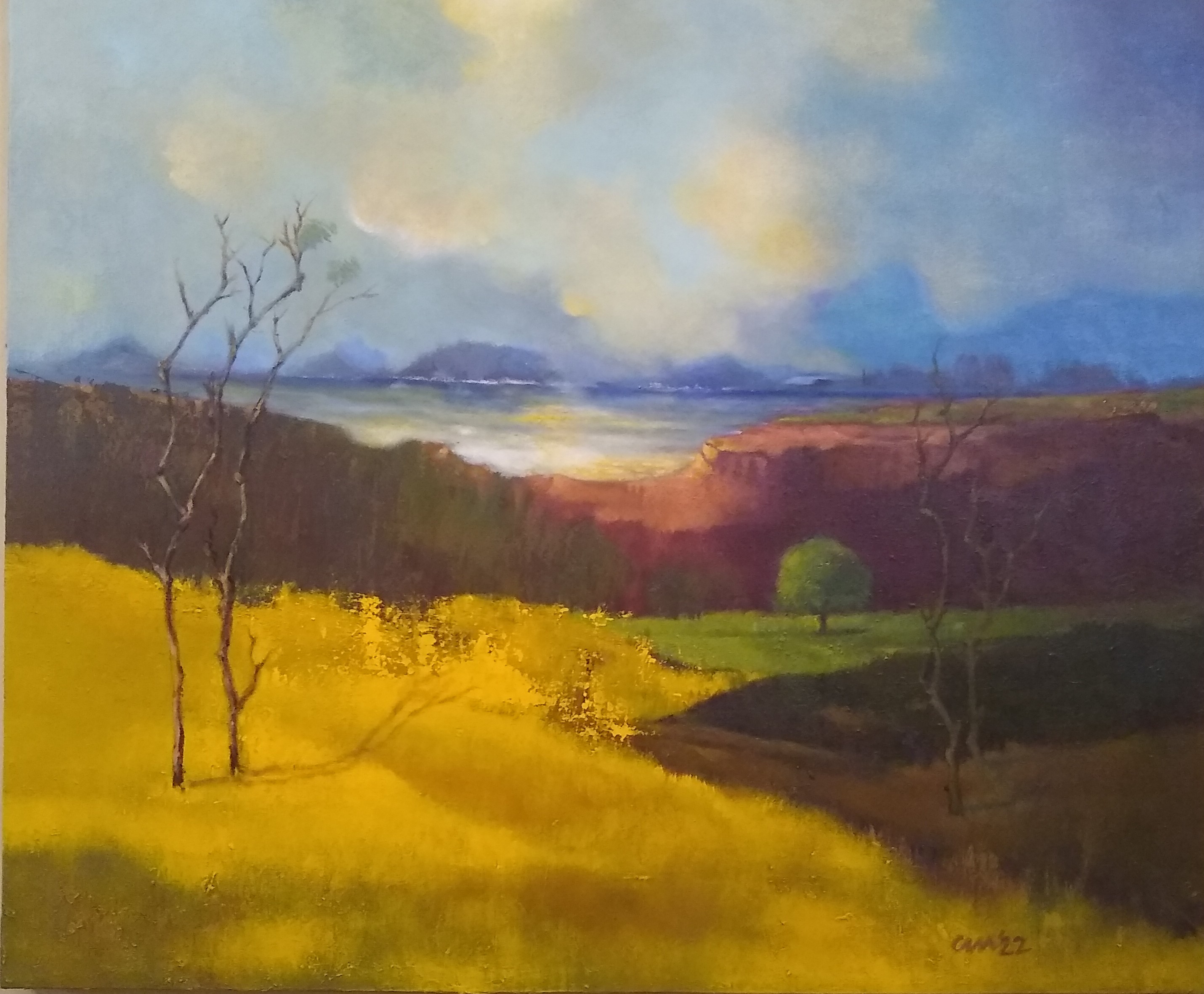
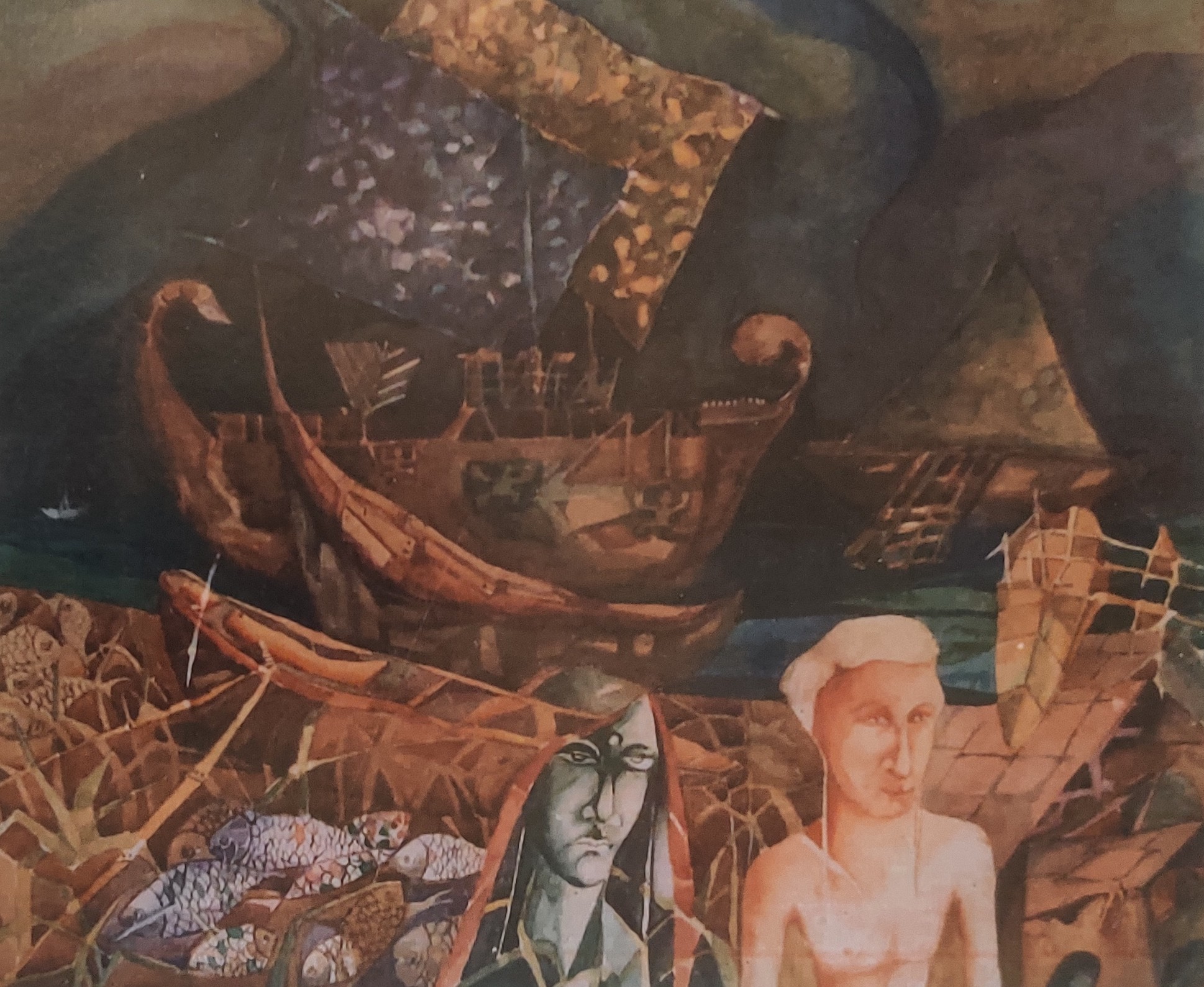
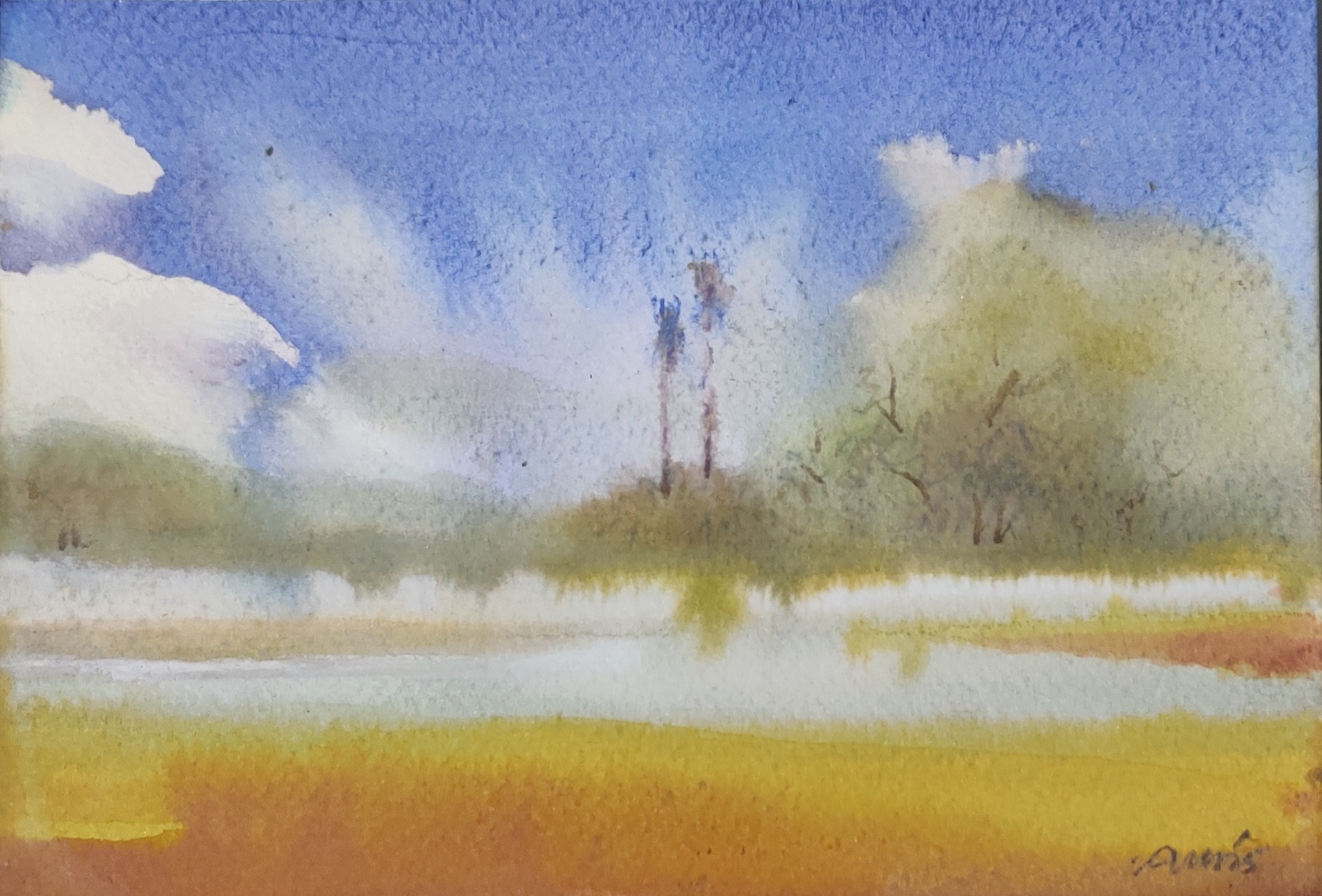
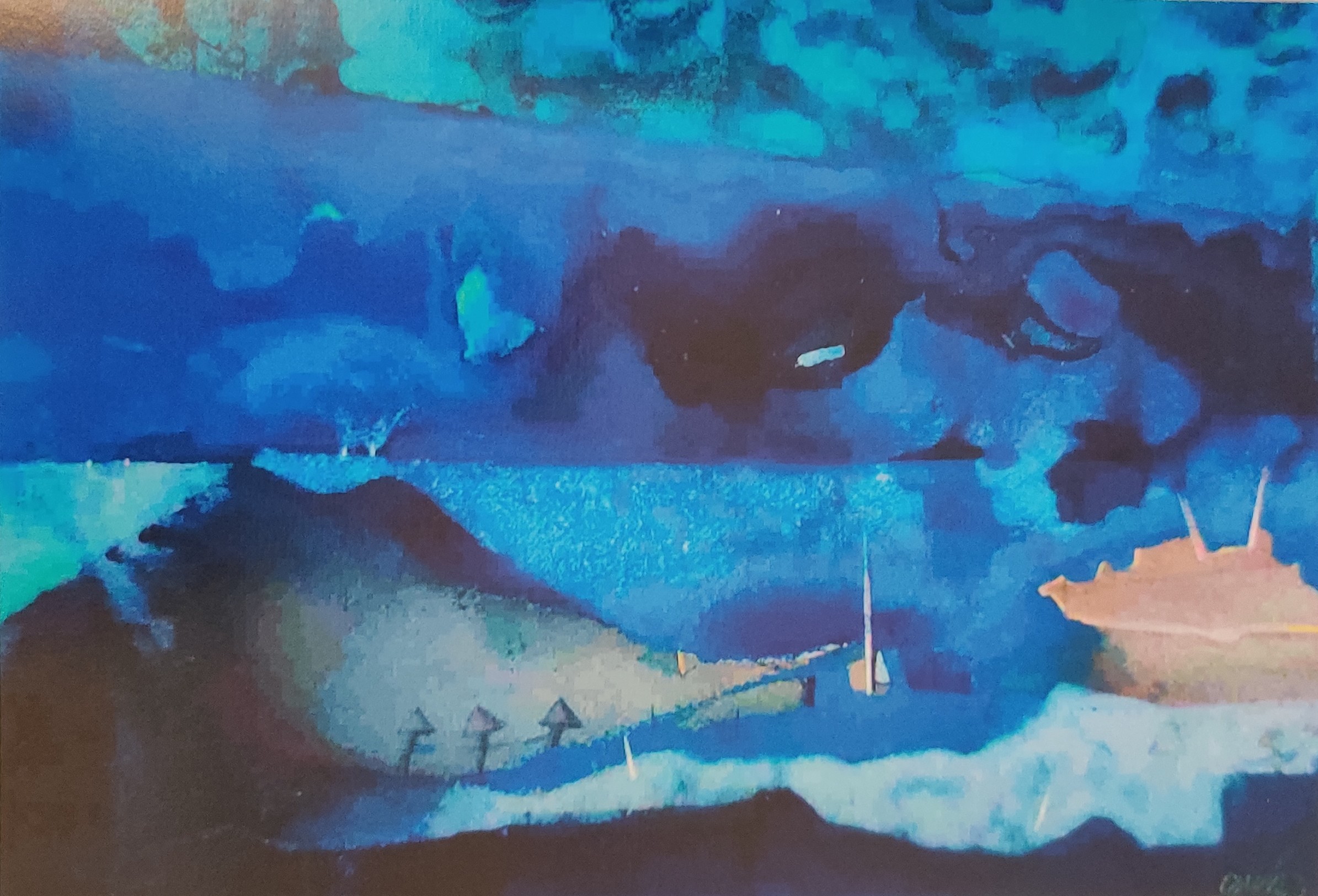
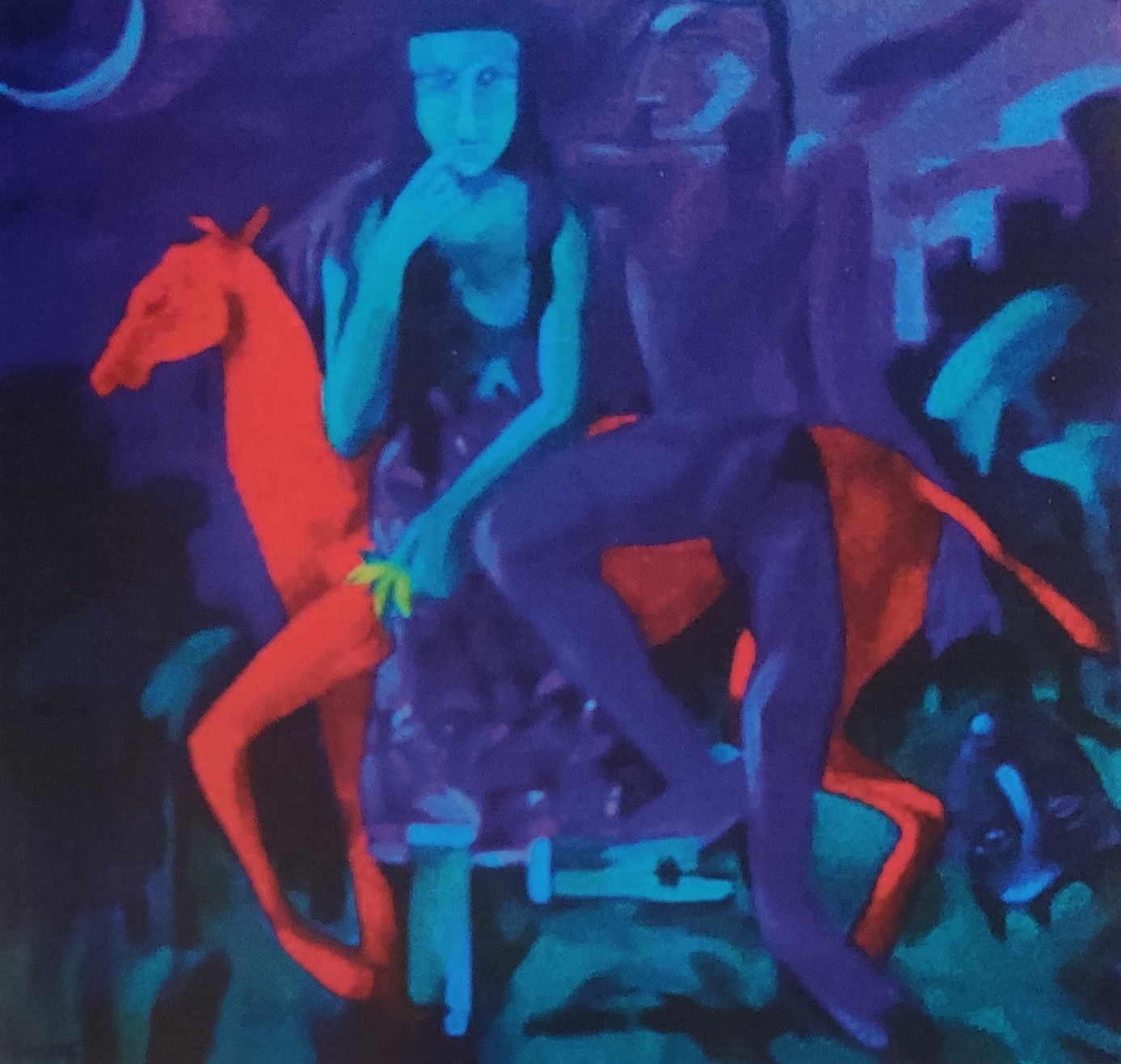
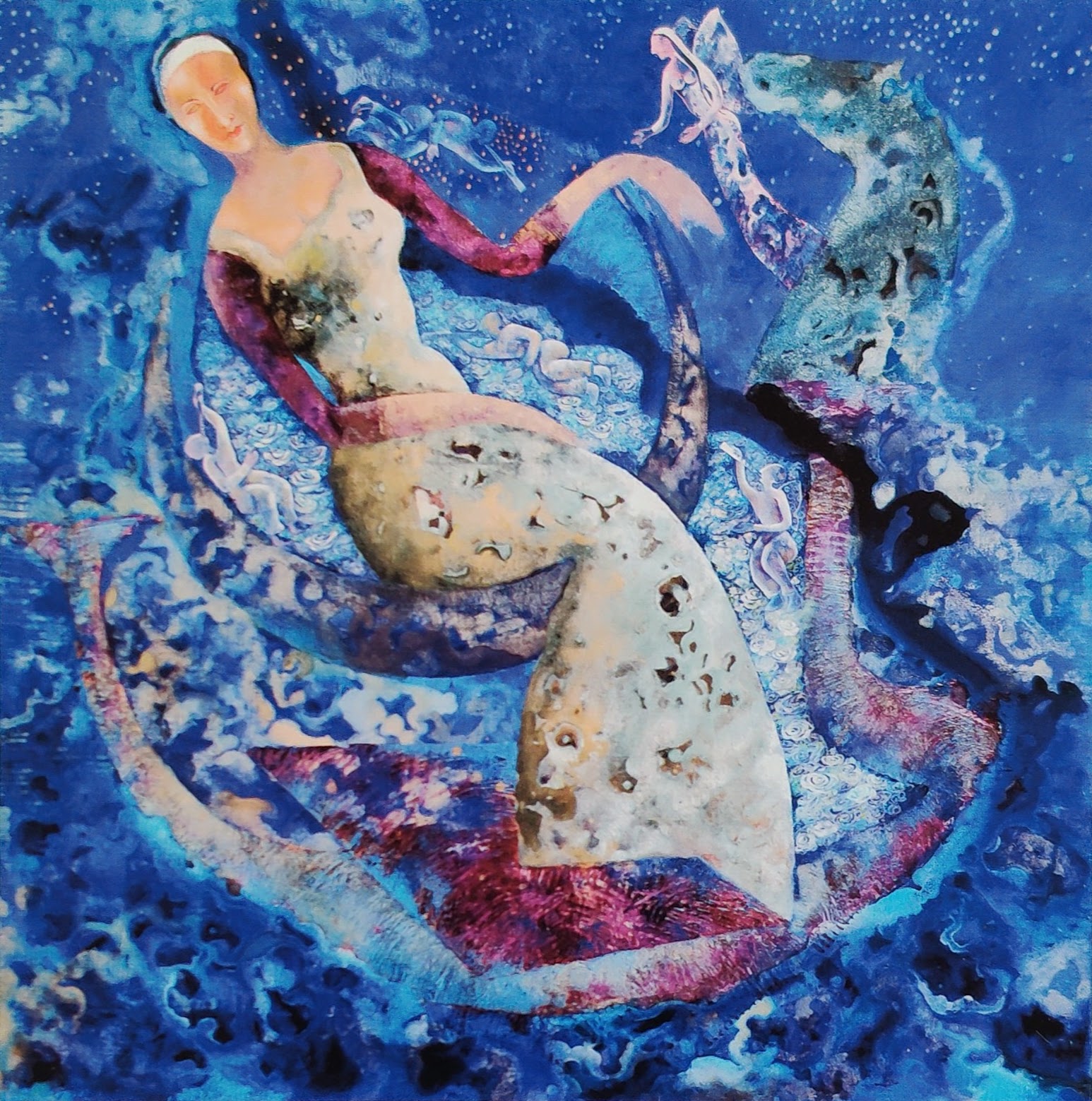
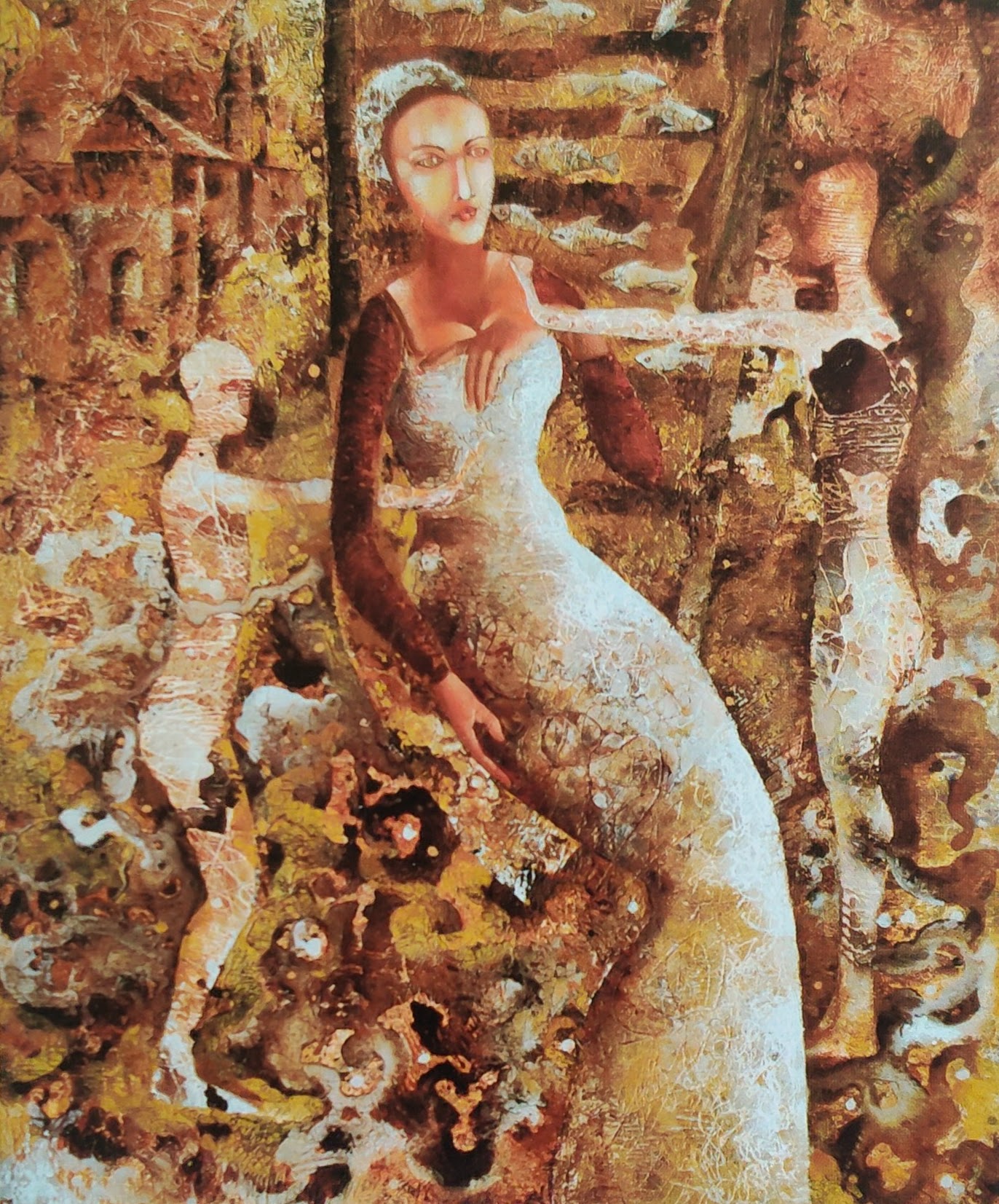
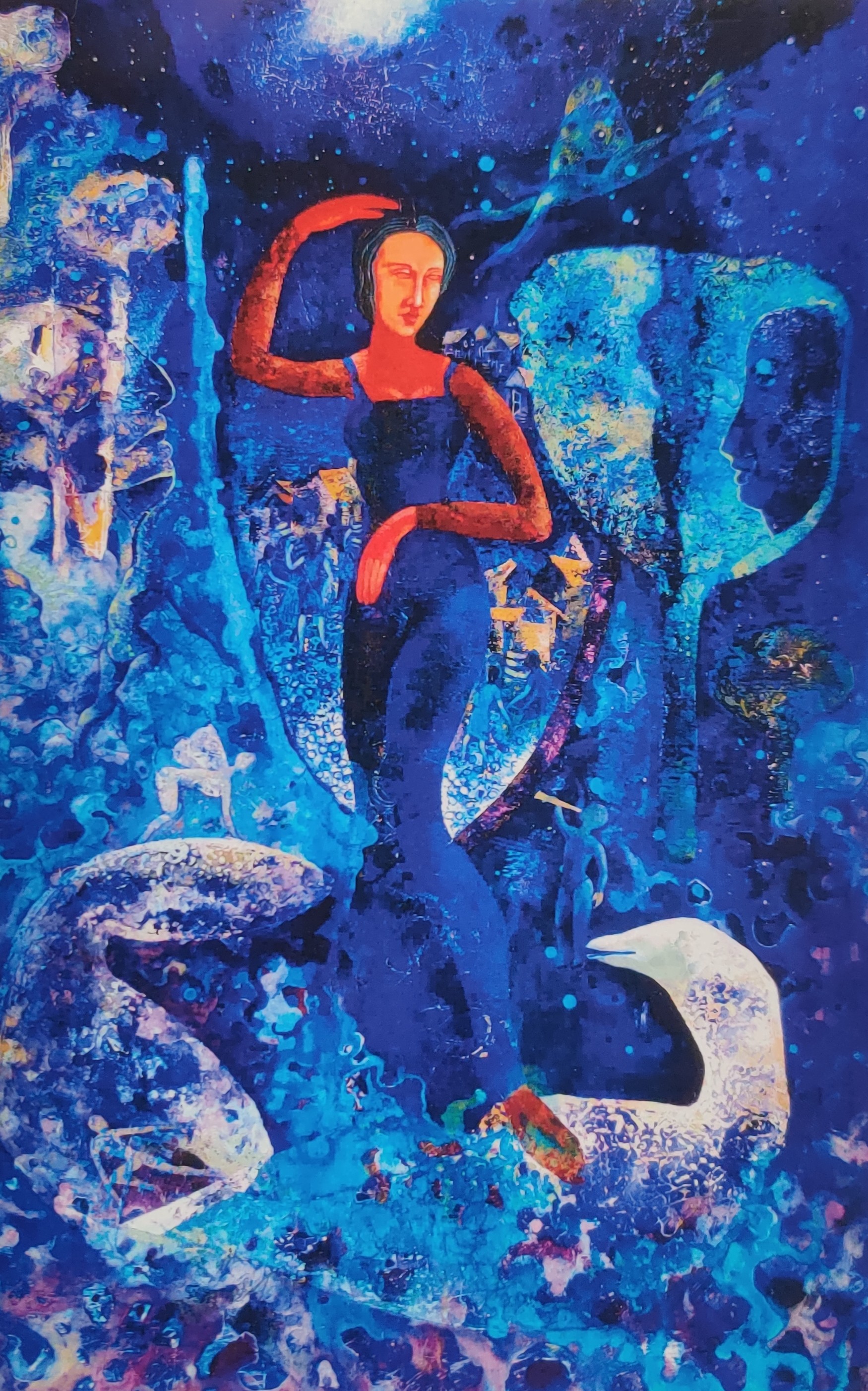
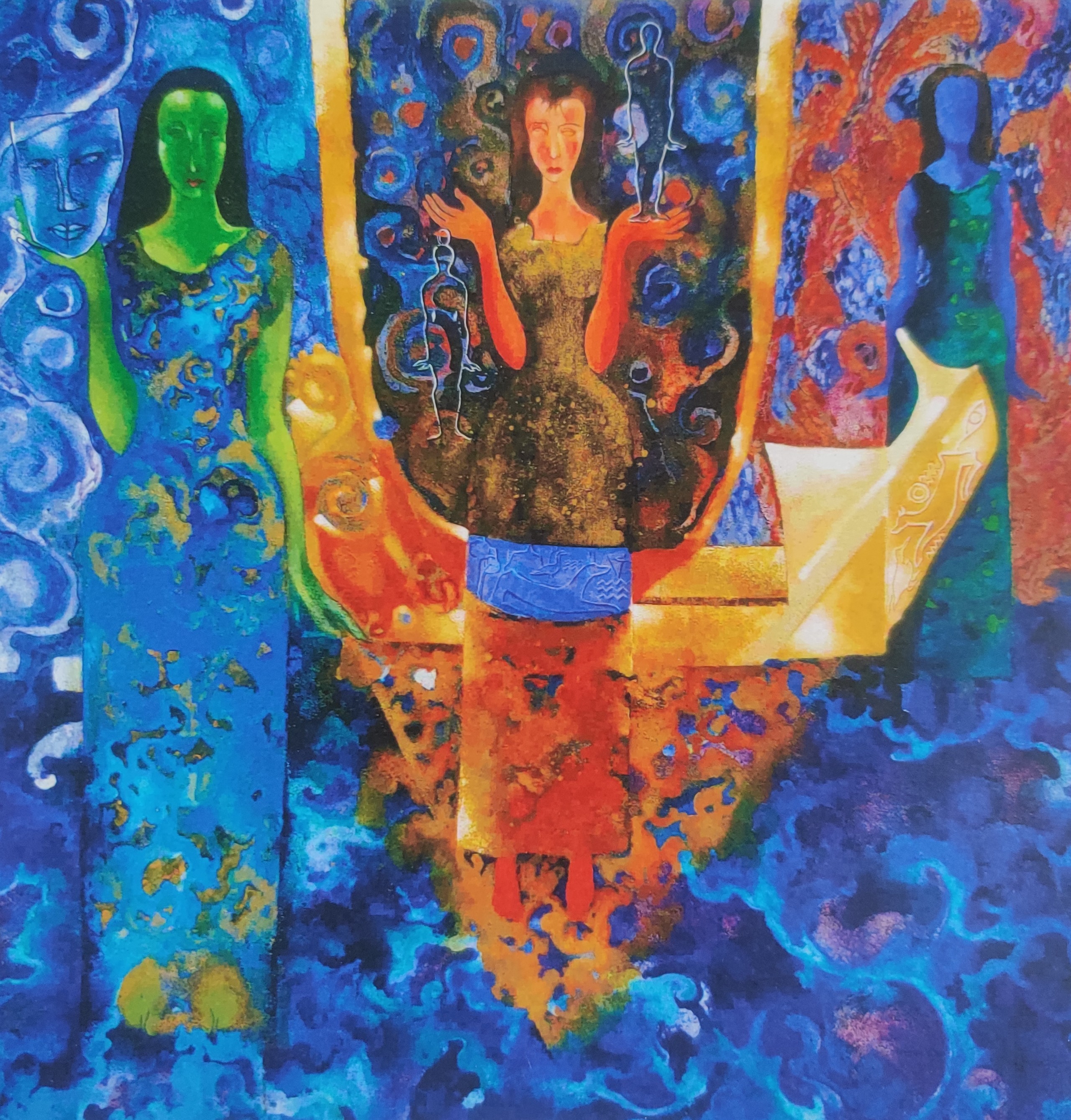
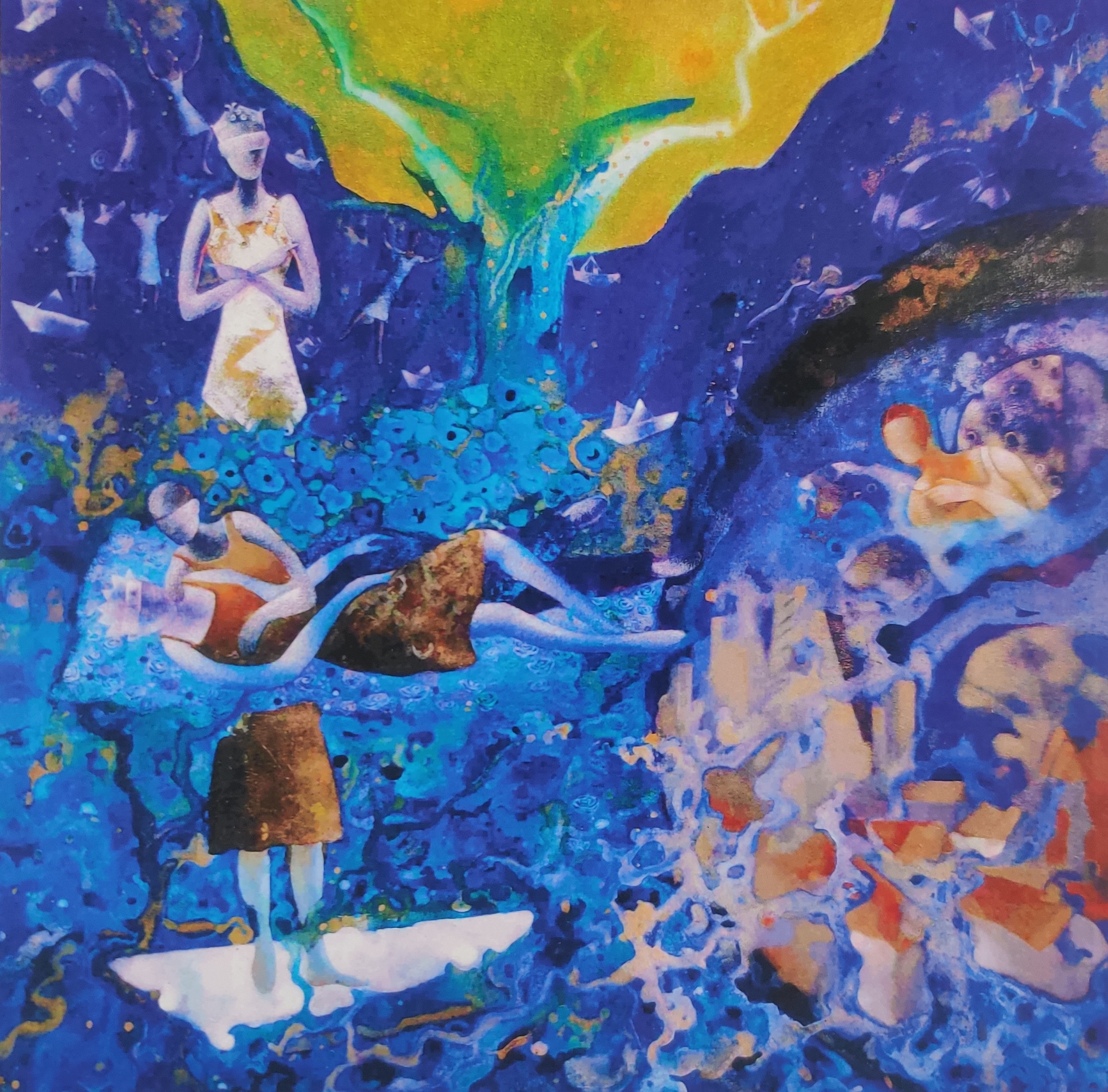
From Impressionism to the ‘Brutality of Fact’: Abhijit Mitra’s JourneyTill around the end of the first decade of this century, Abhijit’s art was full of dreams and romance. His style and way of looking at the world was deeply influenced by impressionism and surrealism. In his last exhibition in Birla Academy in 2009 his paintings were largely draped in an ethereal blue, peopled by floating images of young women, fairies and the moon. The women, with hourglass figures, were represented mostly as objects of desire, with a sublimated sexuality in the atmosphere. He obviously was trying to escape the harsh reality of Calcutta and the world. Some of his early landscapes also carried the imprint of impressionism.
In the second half of the first decade of this century West Bengal was once again in the eye of a political storm centred on the events of Singur and Nandigram. The Communist government of the state chose these two places for setting up automobile and chemical complexes, which were fertile agricultural zones. The peasants resisted the forcible acquisition of their land and soon state violence and popular protests gripped the entire state. Bengal has a long history of radical politics, which reached its peak in the 1960s and early 1970s. But after that state repression, a long phase of the communists in power led to a de-radicalisation, especially of the youth. The mass protests of Singur and Nandigram re-radicalised considerable sections of the people, particularly the young. Abhijit Mitra again plunged into these popular uprisings and this, I believe, changed his way of looking at the world and hence his art also became radical.
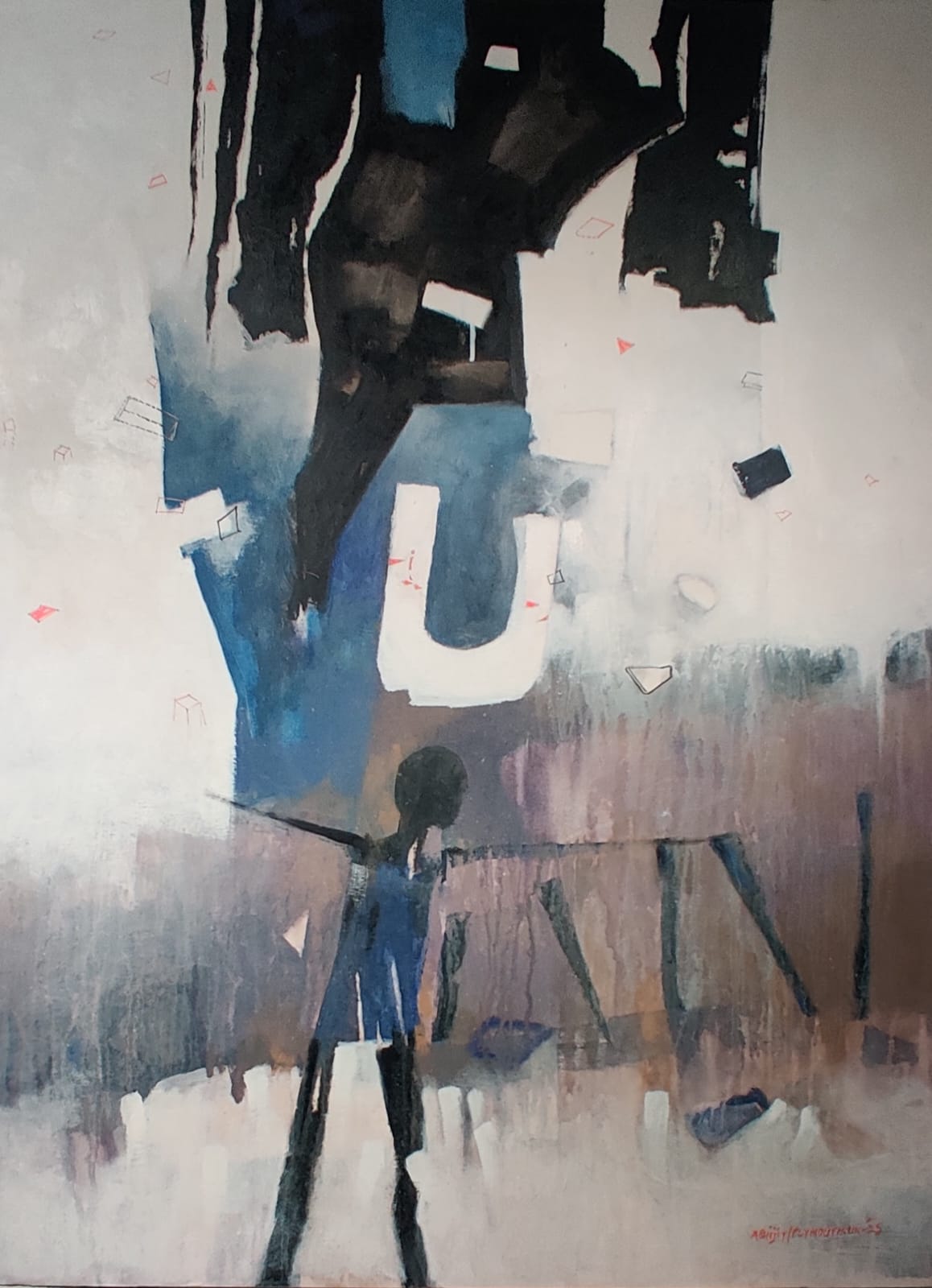
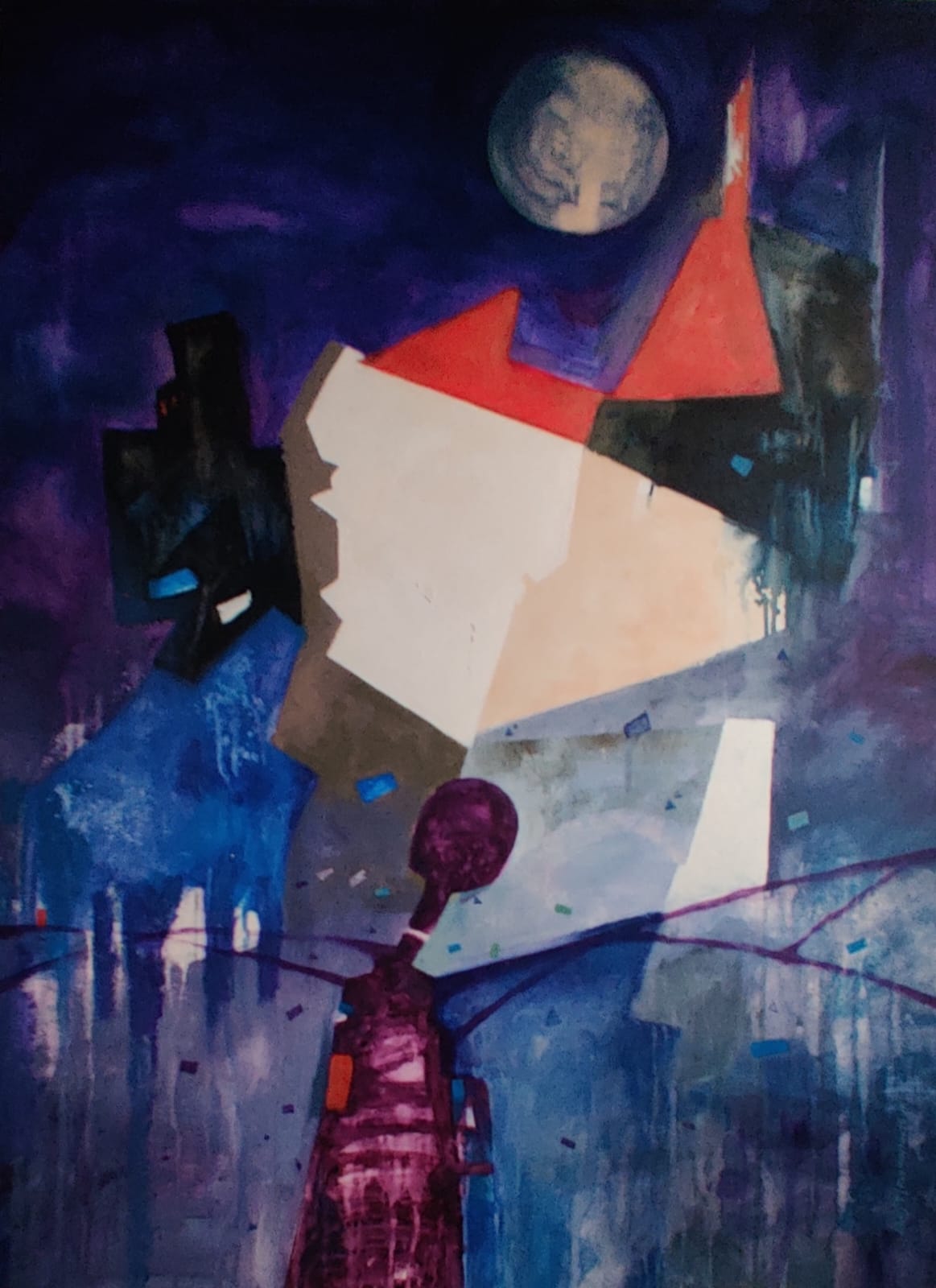
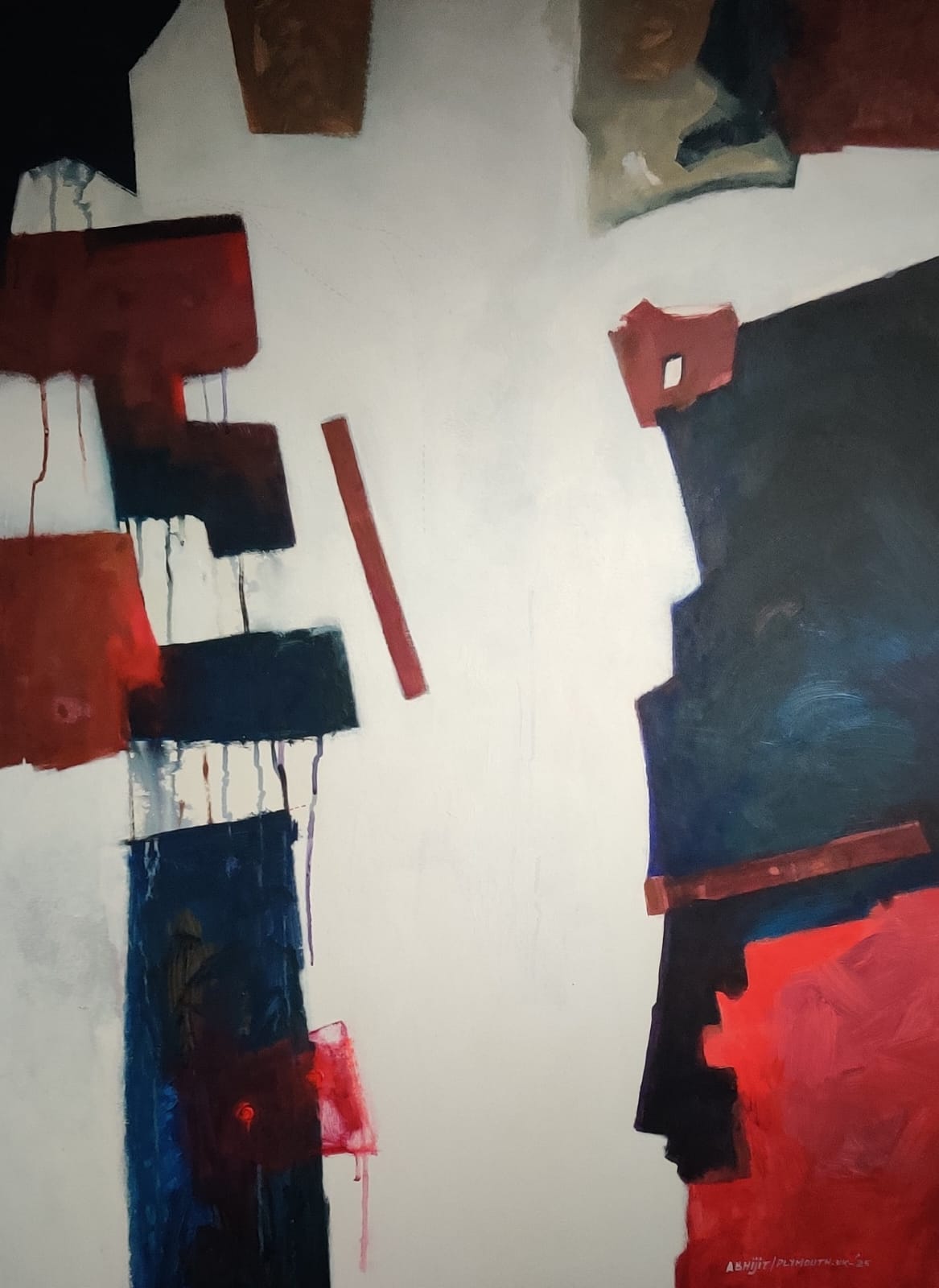
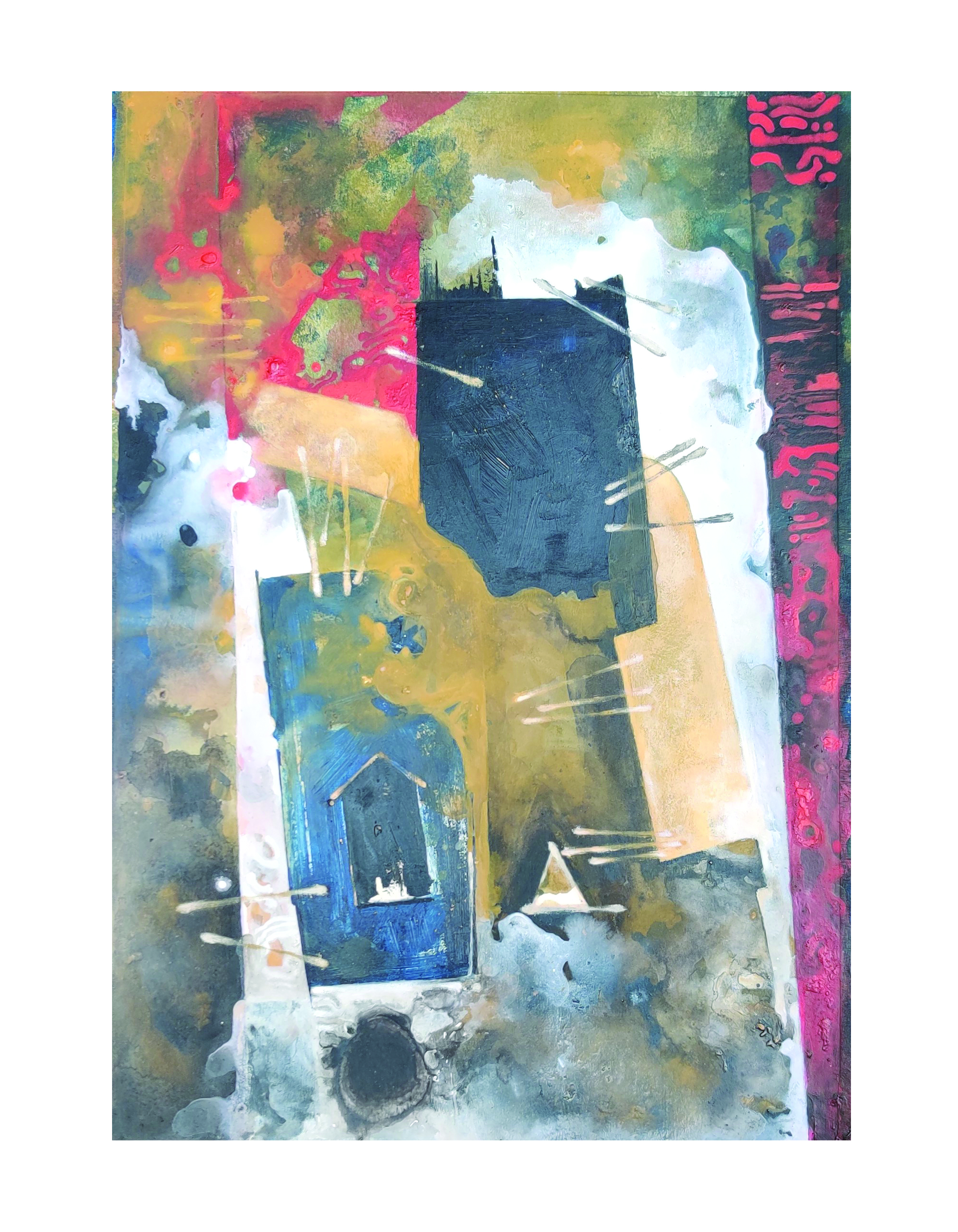
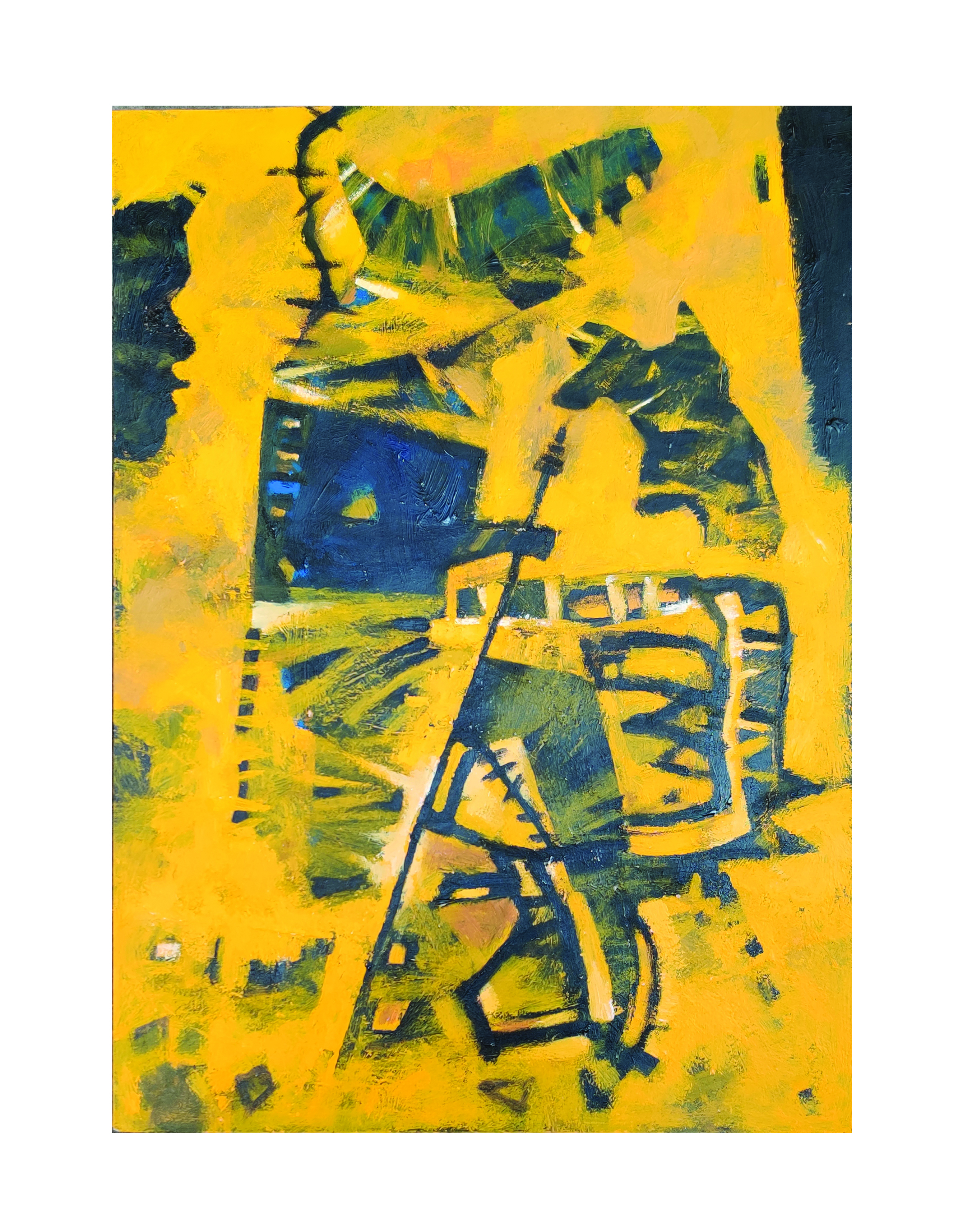
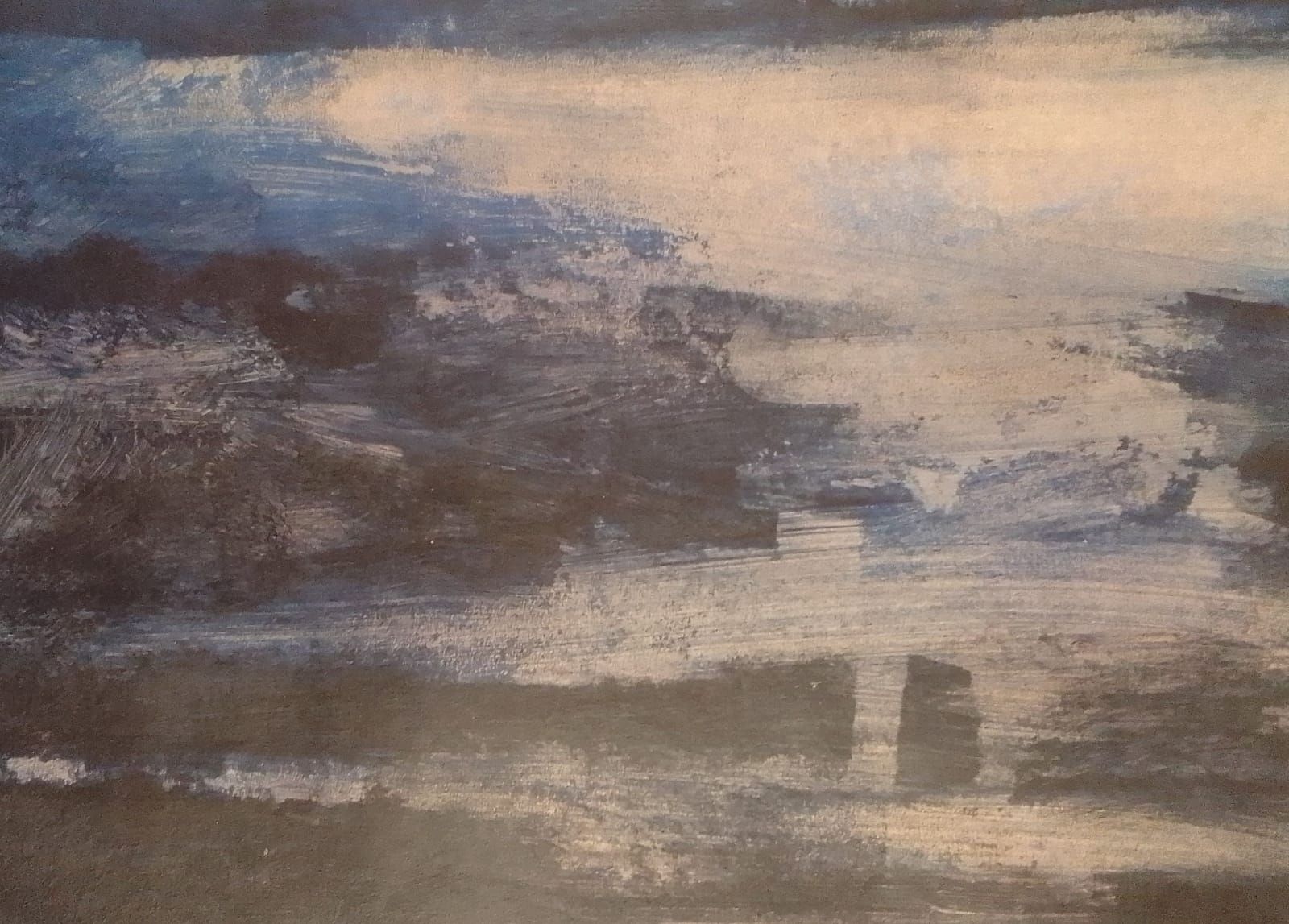
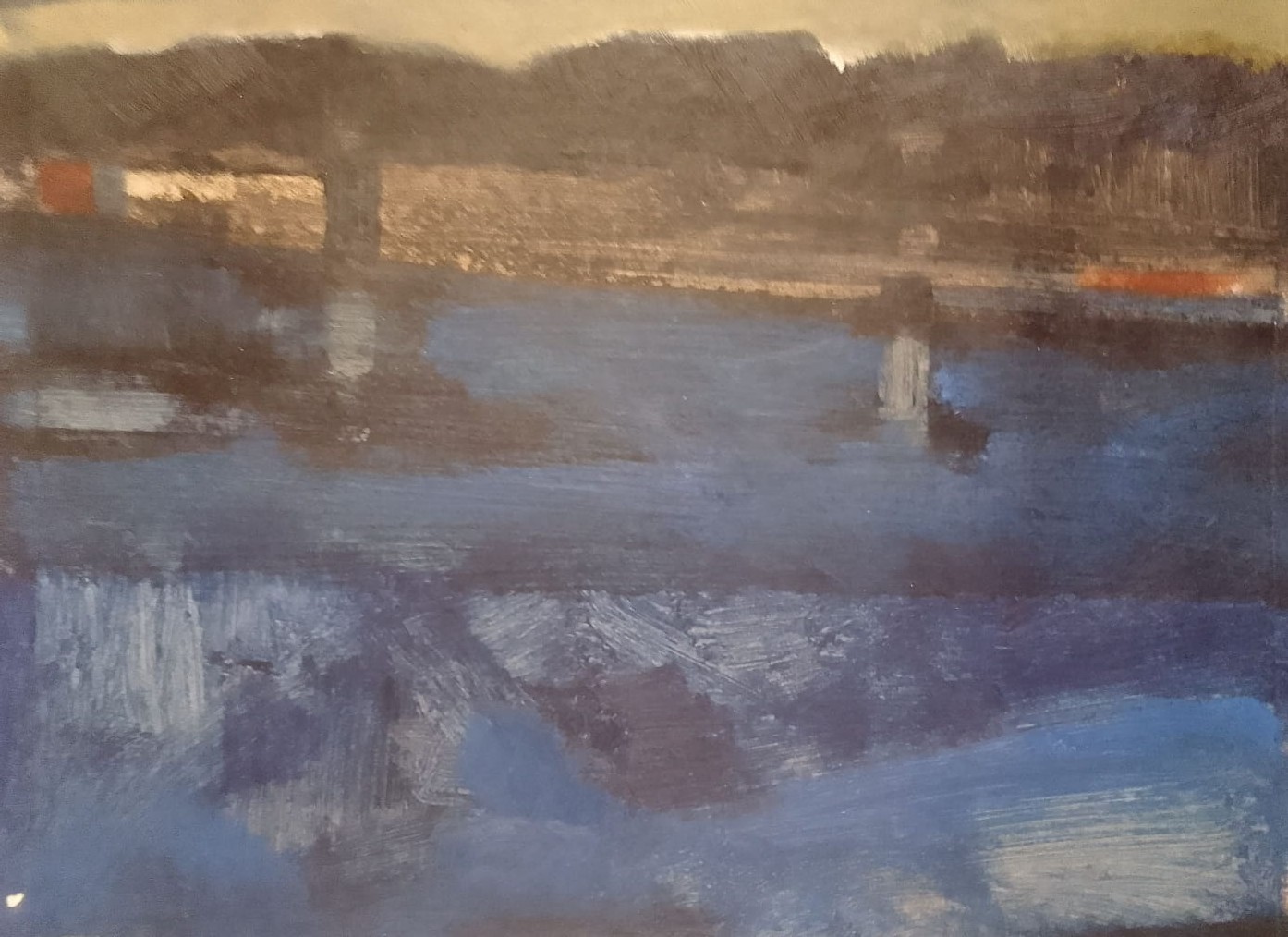
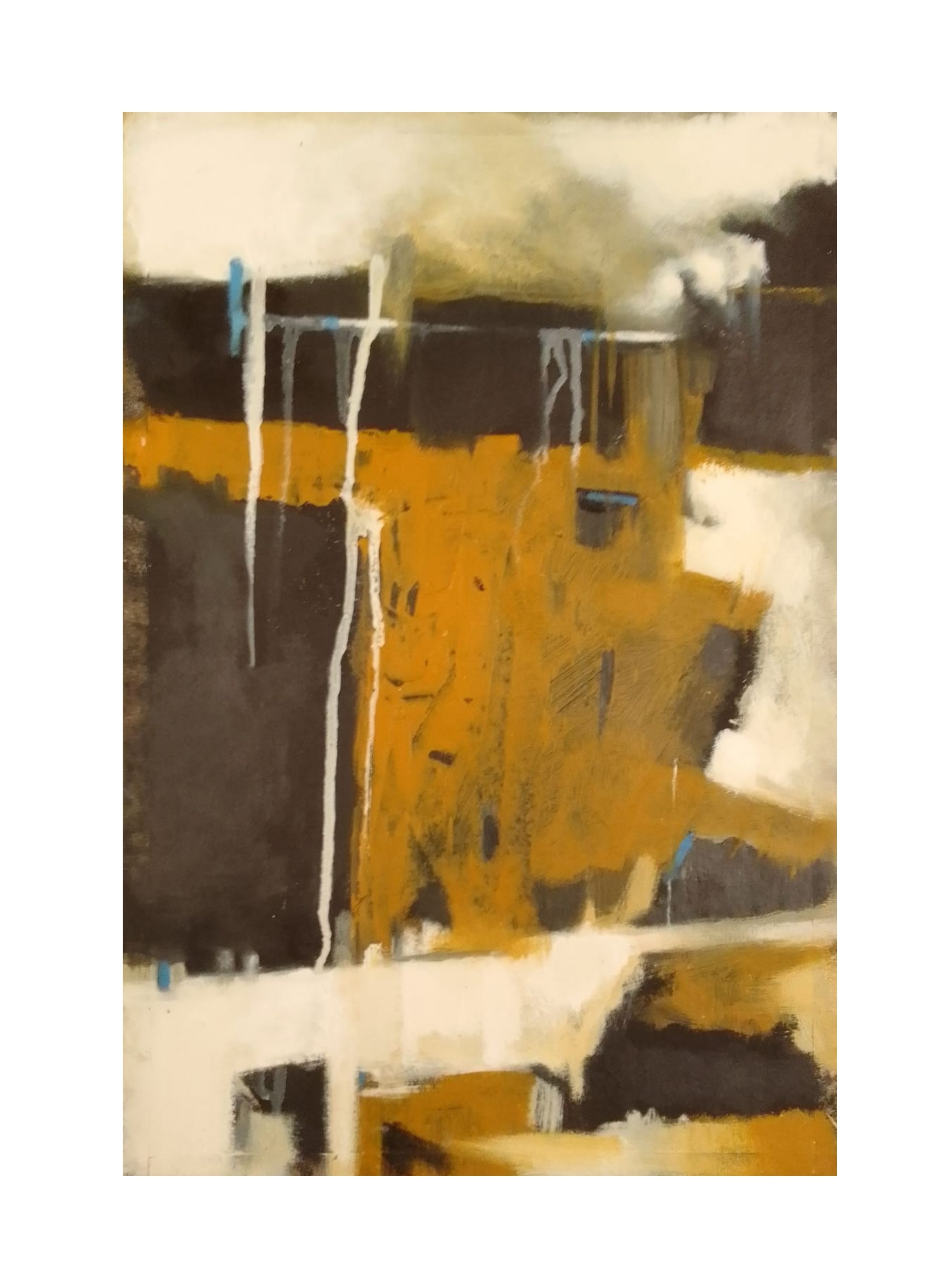
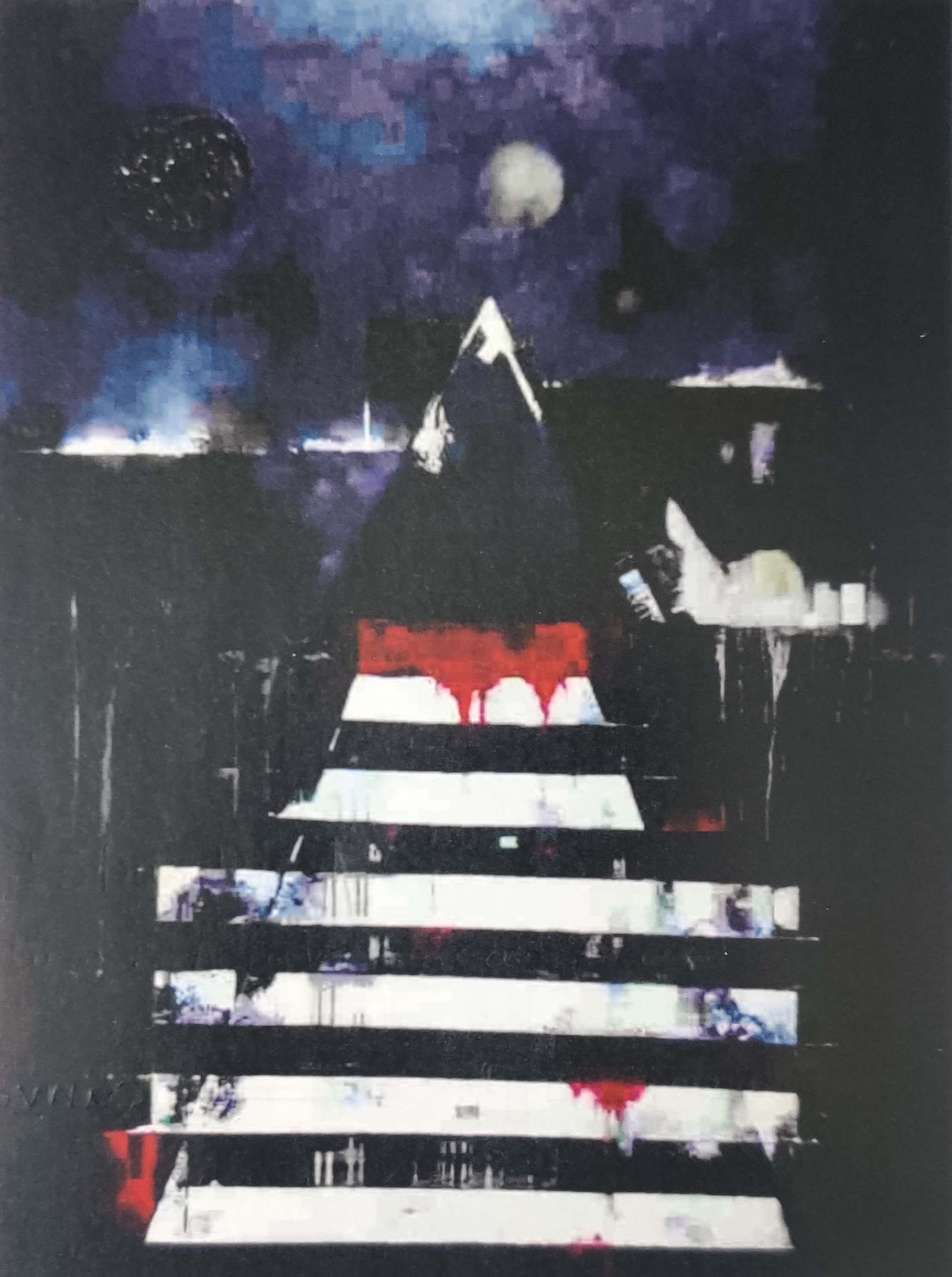
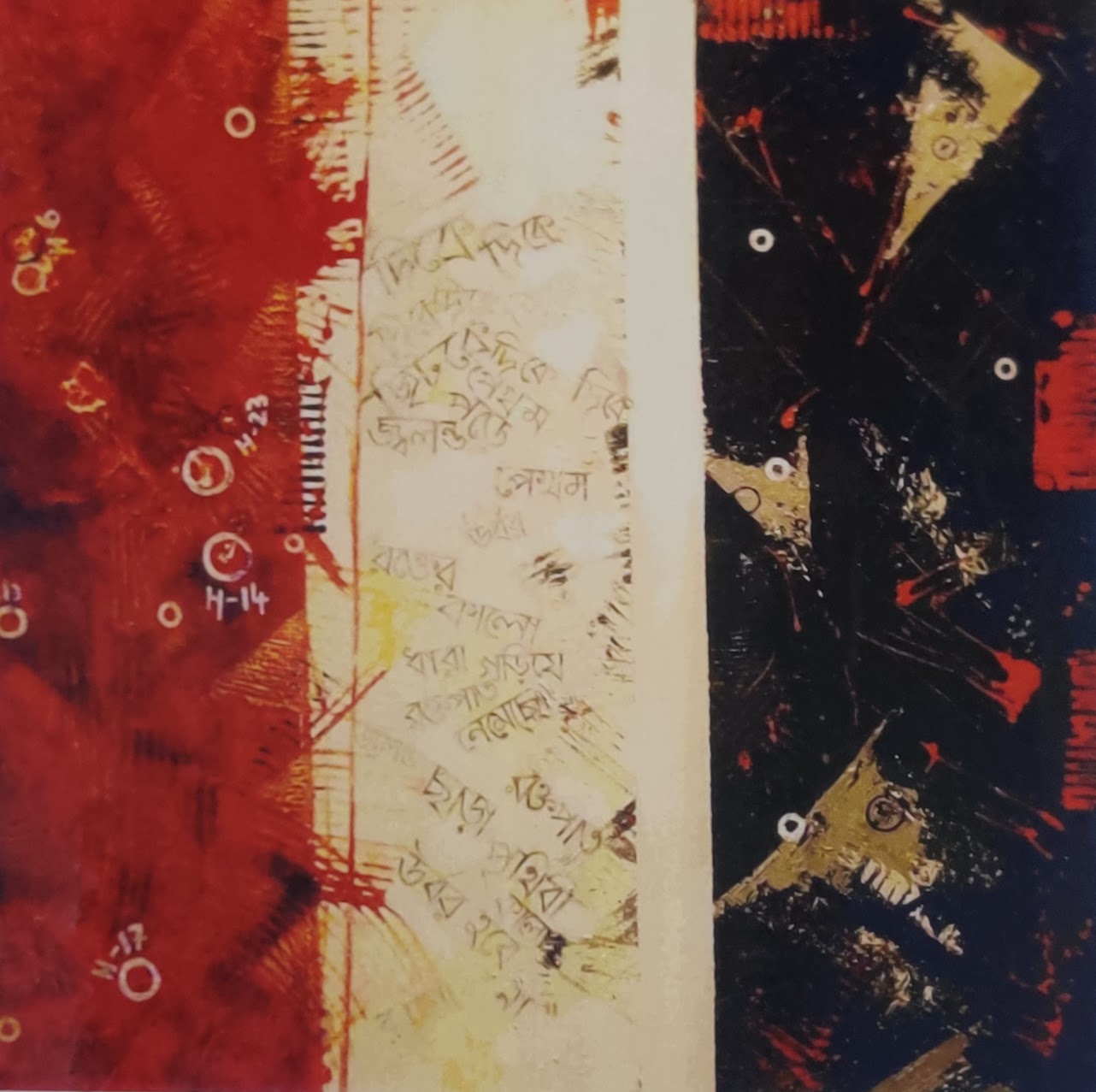
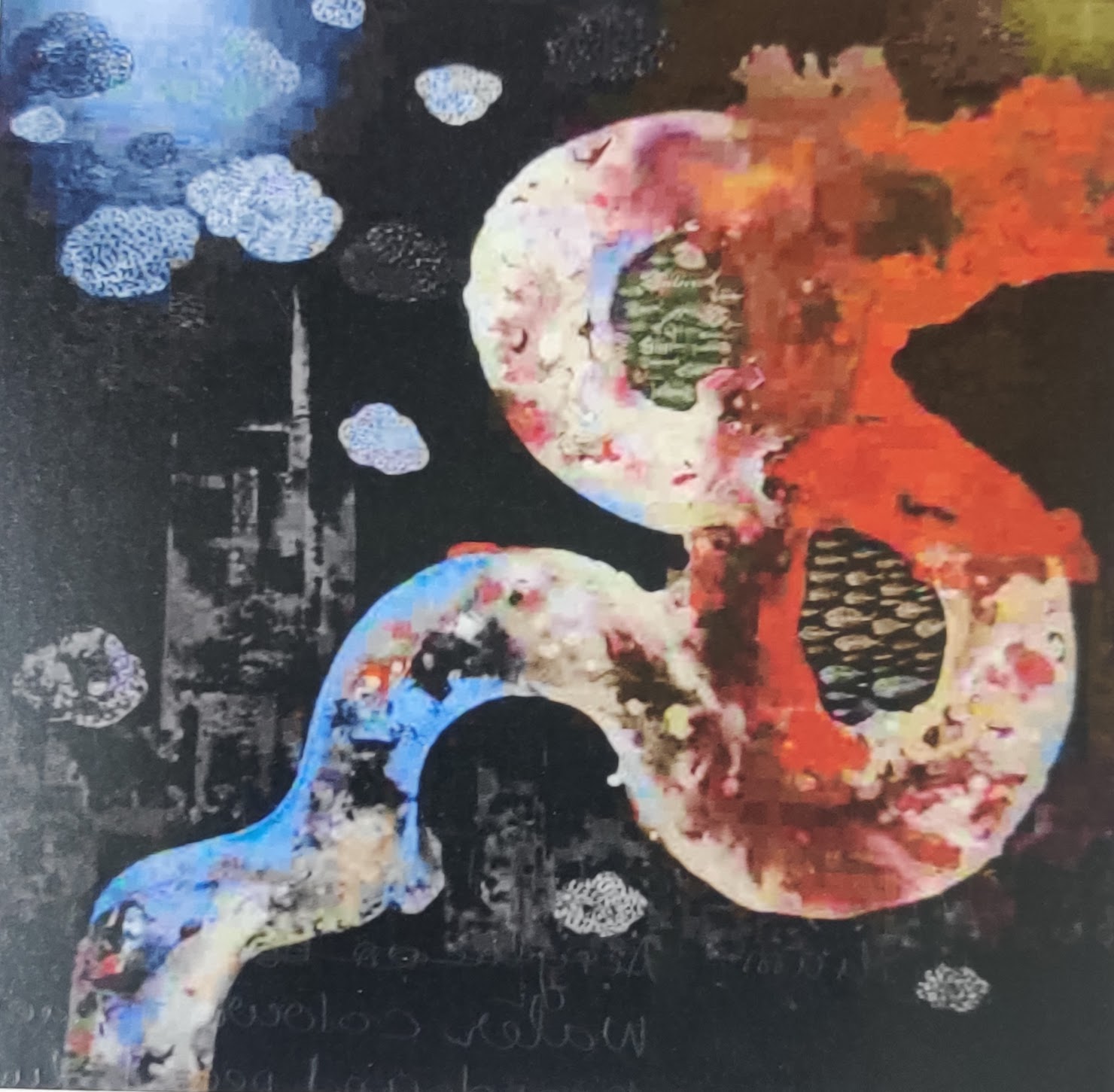
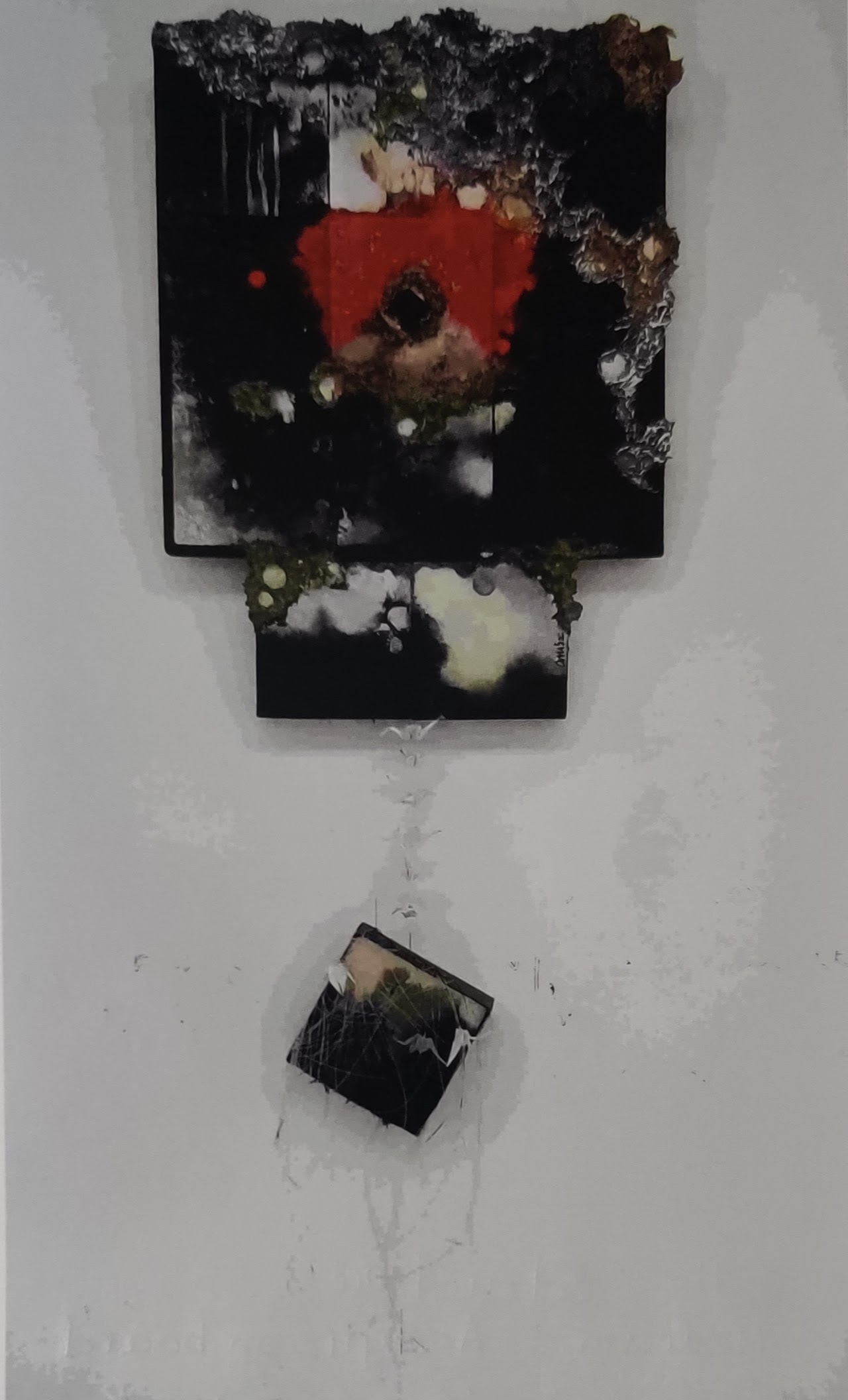
In the new series he christened Resistance and Resilience the imagery, colour, composition and style undergoes a fundamental transformation. His works display a passionate intensity through the use of dark and dense colours, which helps creates a sombre mood. His art now becomes completely political, with organised violence, death and destruction all around. Political slogans appear as part of his pictorial imagery. But Abhijit’s political art is far from our known styles, for example, the once fashionable school of socialist realism. That kind of political art was primarily ideologically motivated, with strong norms governing it. Like all ideologically driven art, it could not stand the test of time or aesthetic appreciation. Like the Soviet Union it remains a relic of that age and regime.
In this series, we can discern two major subjects, first, the violence, death and suffering, largely in India, caused by the global pandemic. Secondly, his art is deeply impacted by the ongoing Holocaust unleashed by Israel, with the support of the liberal democratic west, especially the United States, in Gaza. War against humanity and nature is the human condition in the present time. Global media has made available to us almost live images of this destruction. Representing this Holocaust gives his art an apocalyptic character, more so because it is being unleashed by a power which once was a victim of the Holocaust in the last century.
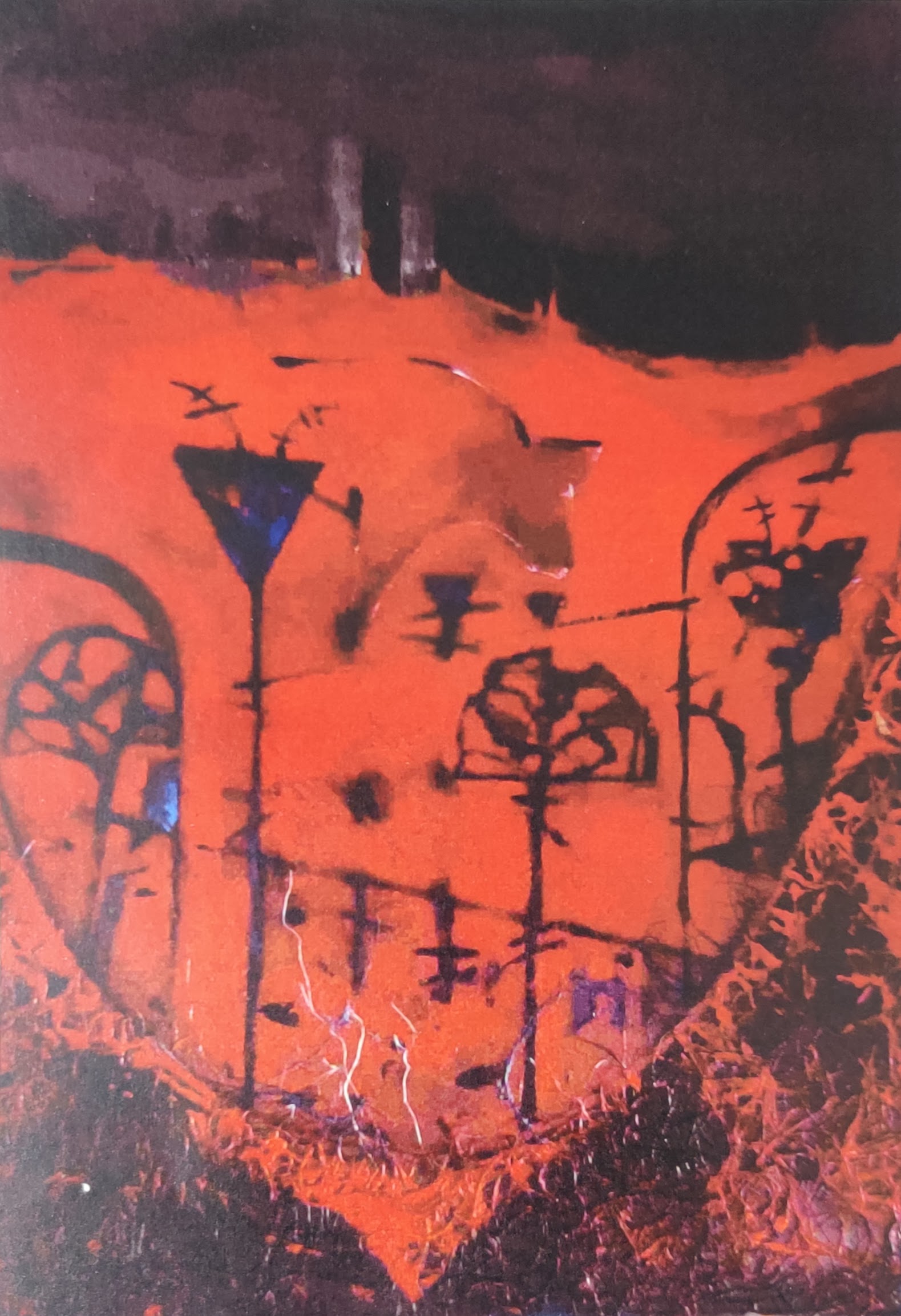
In some of the first group of paintings we find the prominent use of red and black, depicting blood and the dark times. Some even have snippets of political slogans. There is one work with parallel railway lines joining together almost defying the principles of perspective. Most important, there is blood strewn on the tracks, which perhaps leads to the meeting of the two lines.
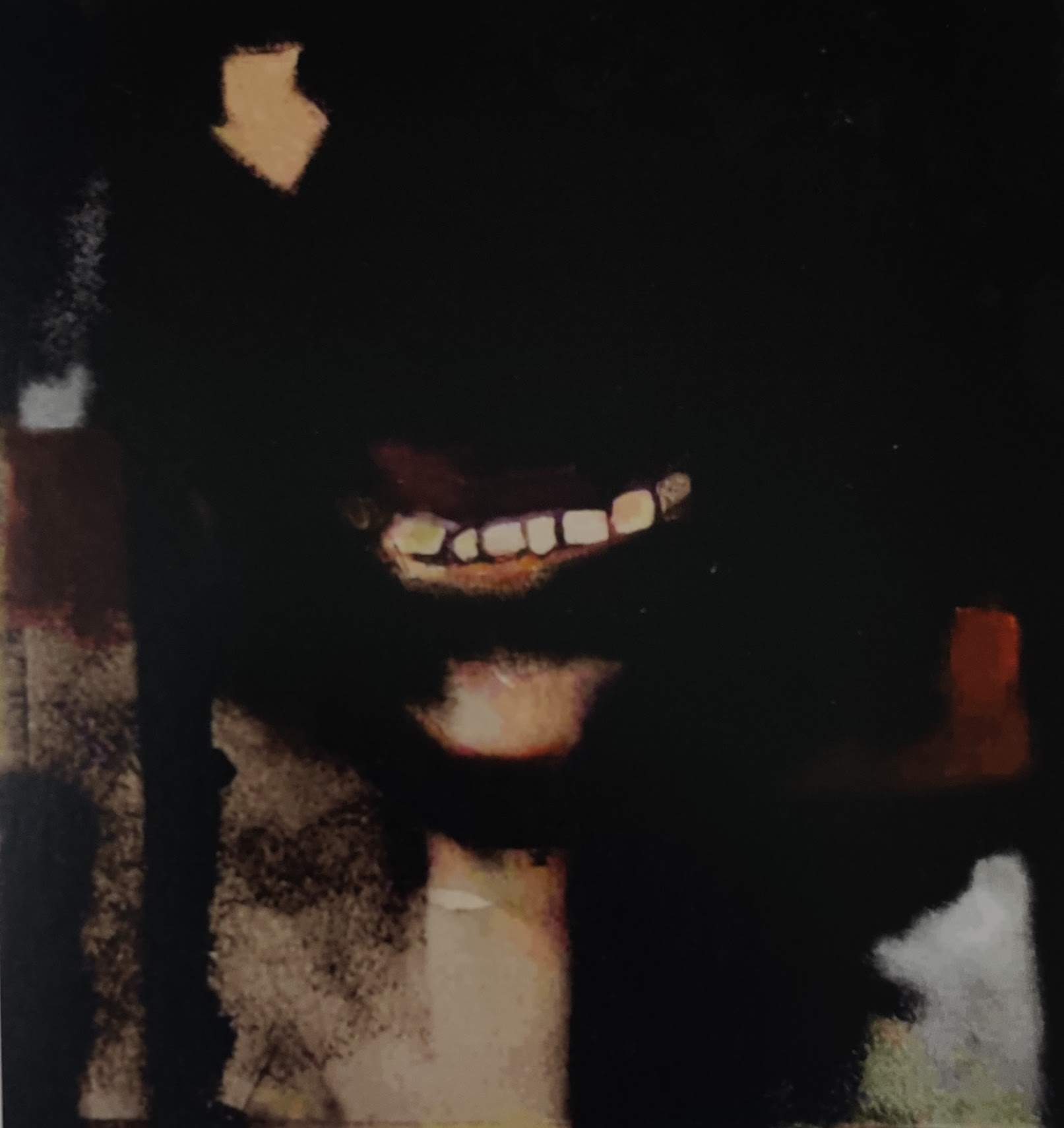
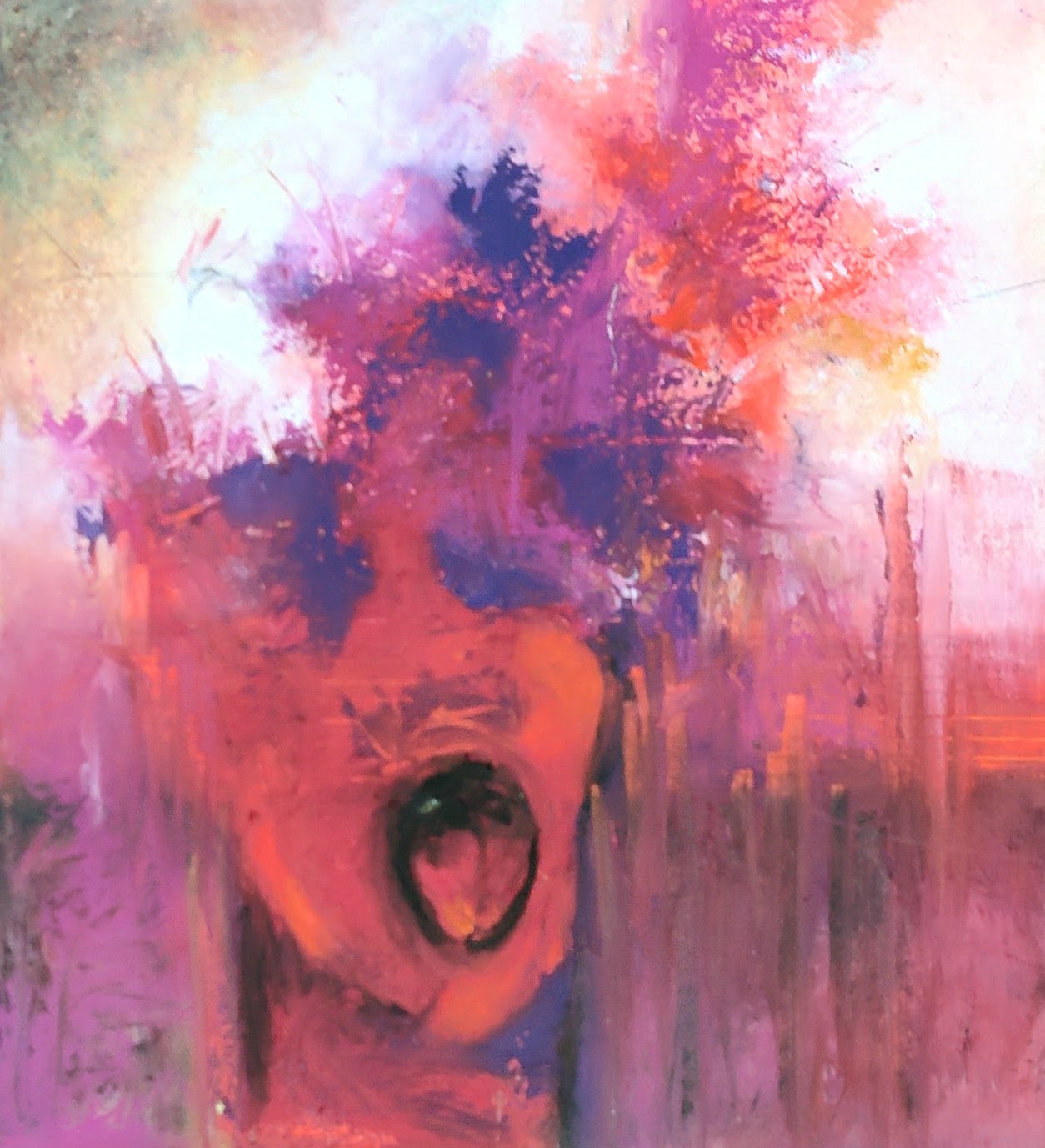
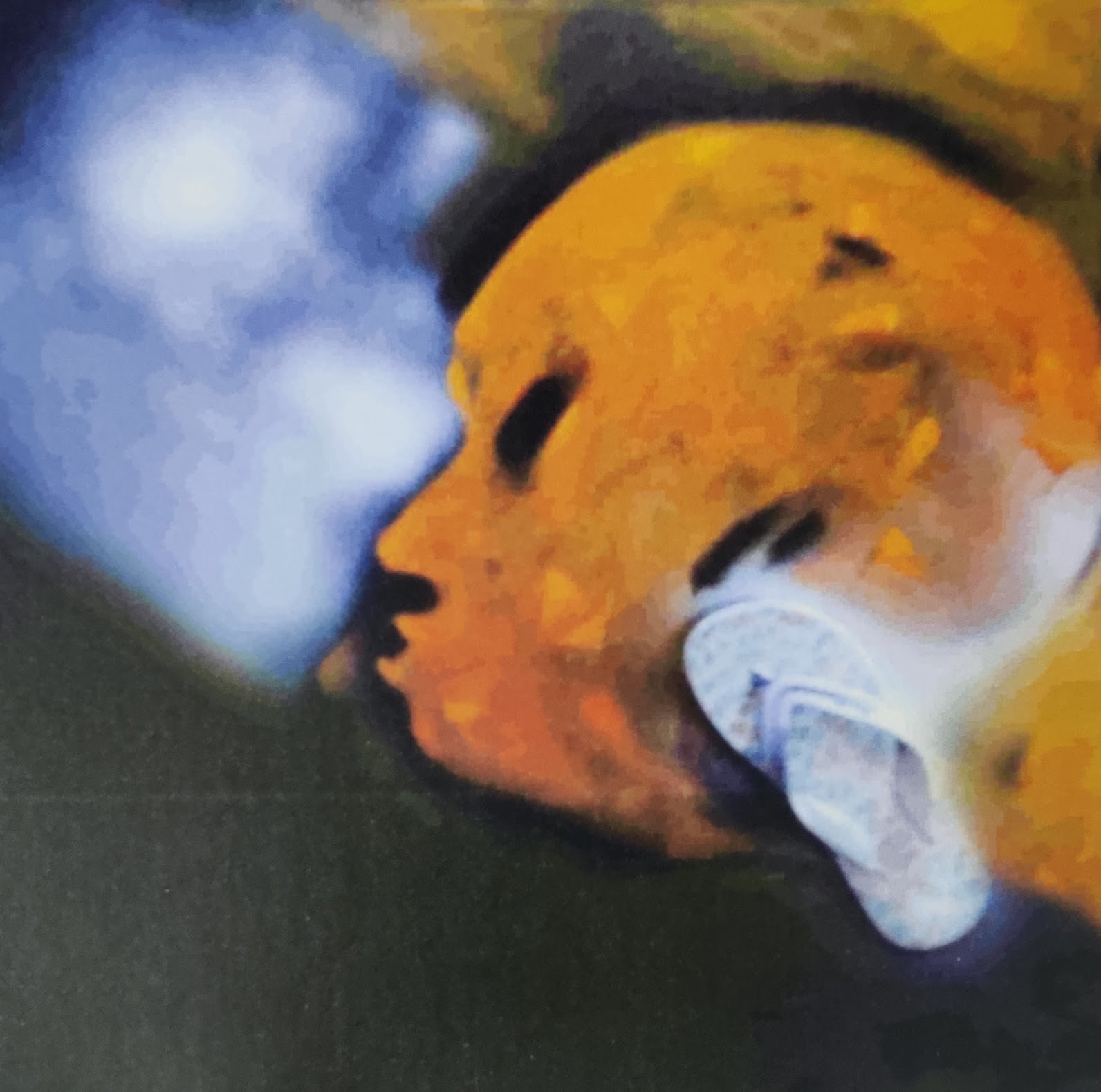
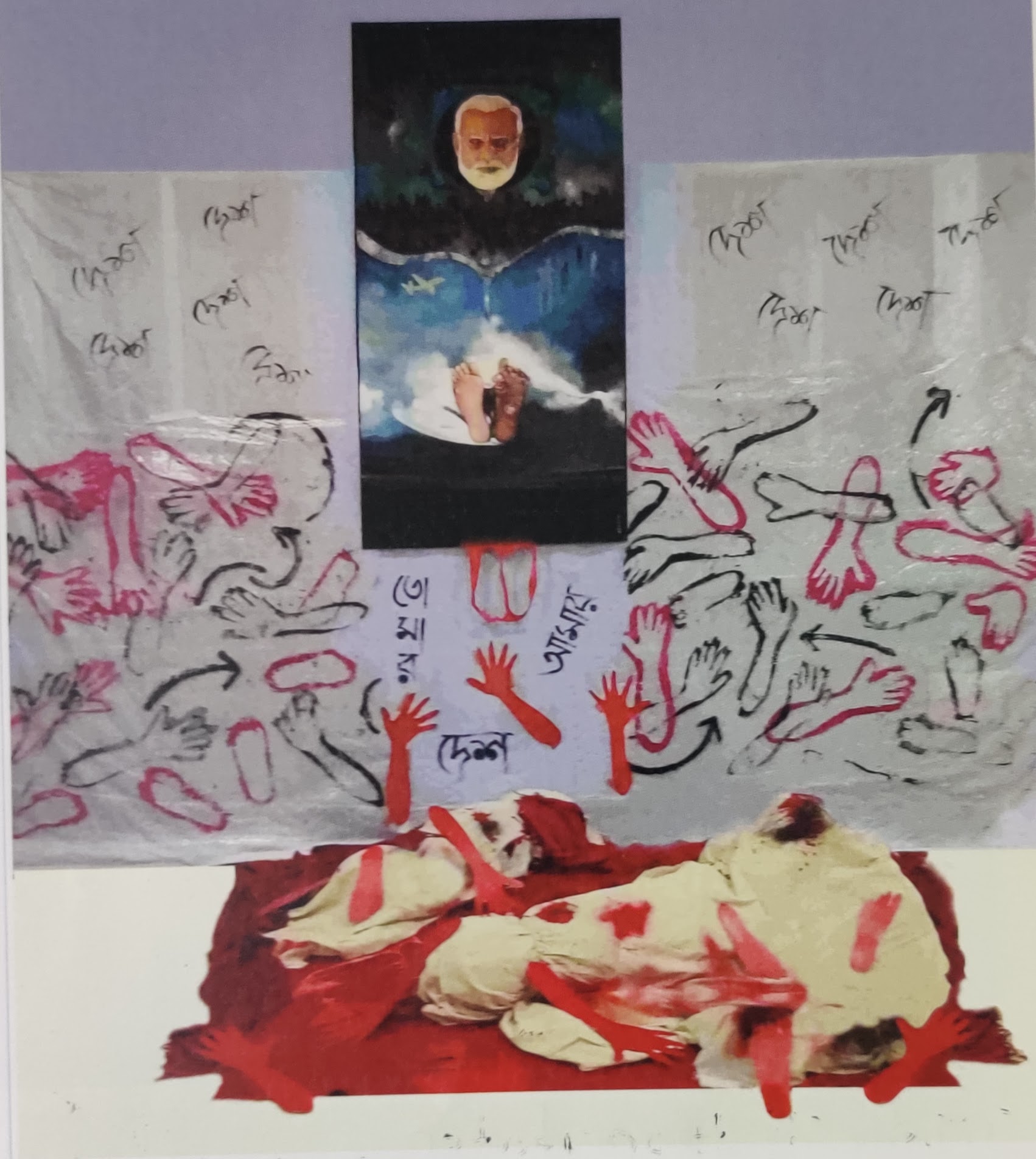
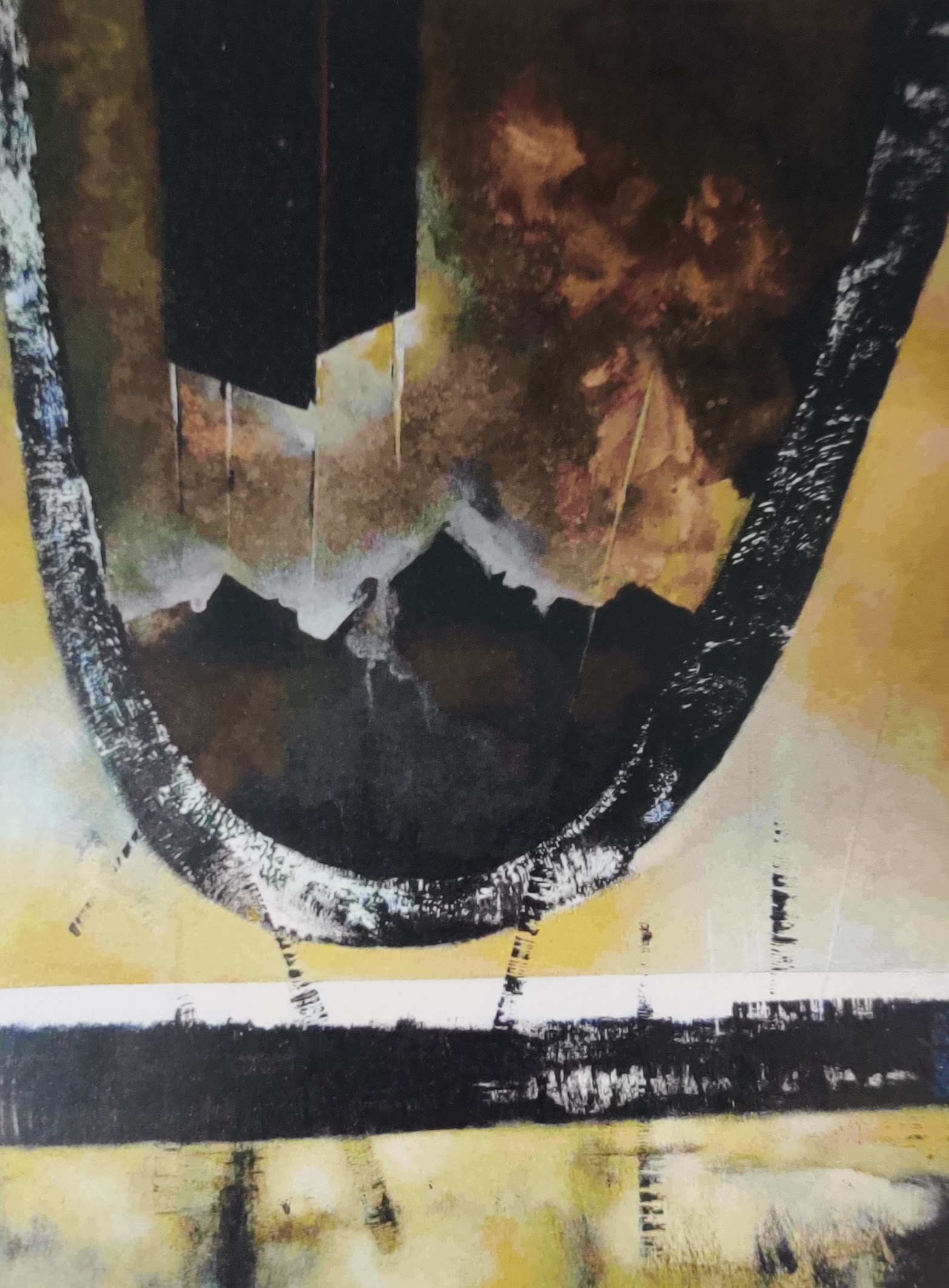
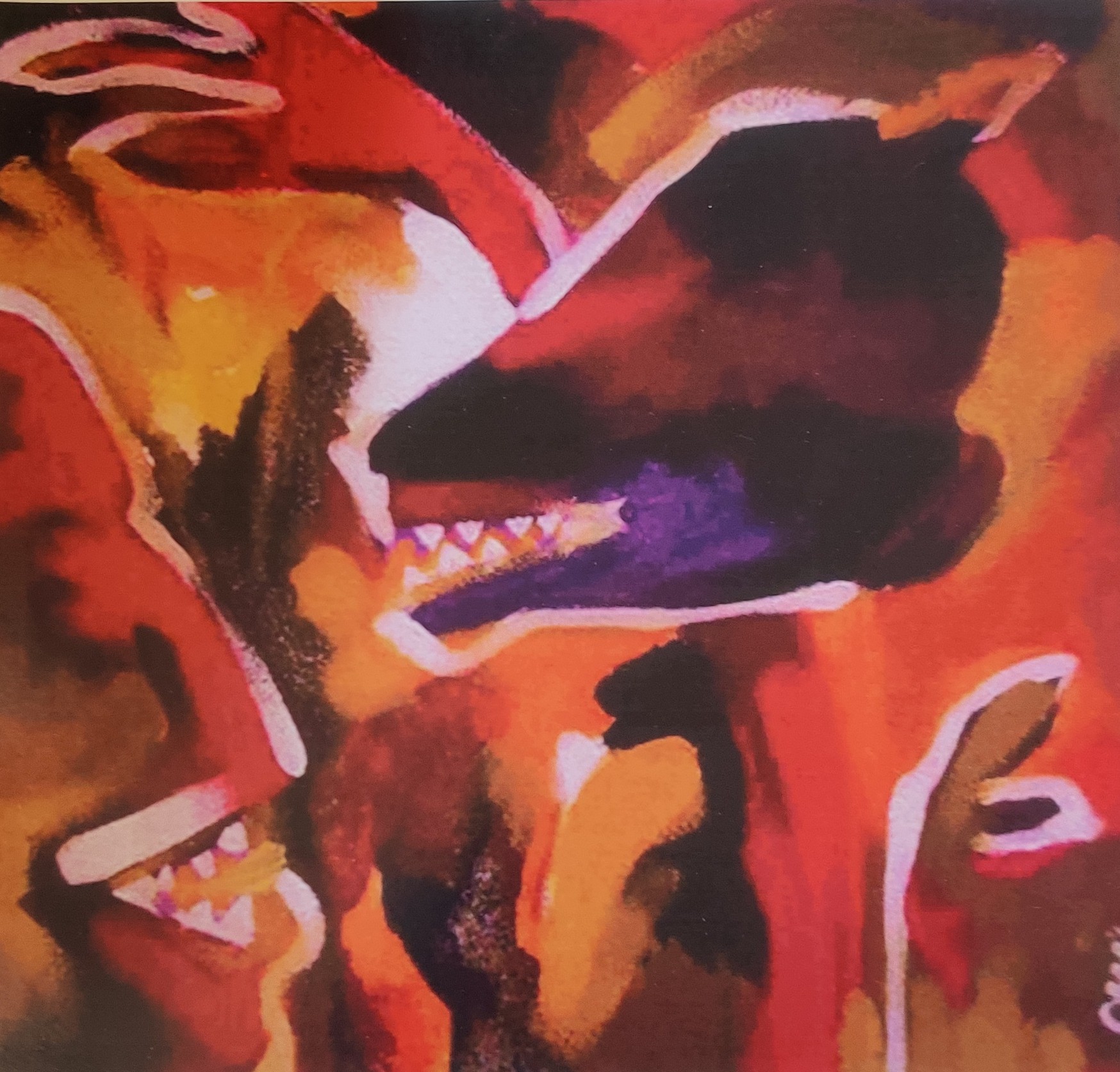
There are two startling paintings, the first with an image of a dead, wounded and battered face, still carrying the traces of pain and indignity and a single footwear loudly lashing it. In the second, in a daring move, in a painting within the painting there is a bust of Narendra Modi in a pseudo meditative posture superimposed on a dead body, whose feet is only showing. The main painting shows a wall with slogans proclaiming our country and limbs strewn all over. Under that wall is a heap of wrapped dead bodies and blood. In this remarkable composition we find three layers of representation. In the first is the real dead bodies; in the second is a wall with slogans and limbs and in the third layer is a painting of a pretentious Modi lording over this tragedy of which he is the architect. This multiple representational device has much for viewers and critics to ponder over. Finally, there are two works with gaping jaws and one a menacing set of teeth. They all add to the atmosphere of violence and fear which is a hallmark of our time.
From Guernica to GazaThe genocide in Gaza is being enacted in full global view; images and reports are continuously being electronically transmitted. However, after the initial protests we have largely been numbed or see it as part of the new normal. Calcutta, once known as the city of processions and protests, responded furiously to the bombing of Vietnam by America. One popular slogan reverberating in the streets and walls of Calcutta was, ‘tomar naam, amar naam, Vietnam’. In an act of black humour, even the road locating the Consular office of America, in Calcutta, was renamed Ho Chi Minh Sarani, with a bust of Ho Chi Minh, to remind the Americans of both their war crimes and their defeat in the hands of a tiny country and its fearless people. But in the long de-radicalised interlude of this city solidarity struggles or expressions in the arts became scarce. This makes Abhijit’s series deeply moved by the Gaza genocide, not only artistically significant but also morally important, reminding intellectuals and artists of their moral responsibilities. I know of no other sustained engagement with any tragedy of our times in this city, once known for its committed intellectuals. It is the lost voice of the conscience of this city. I would thus place this series as part of the reactions to mass bombings, from Guernica to Gaza.
Unlike Guernica, Gaza represents a war on an ancient civilisation and its people by the west and, of course, the scale of destruction and devastation is incomparable. Abhijit’s response to this genocide is purely aesthetic and ethical; it carries no traces of agitprop art, which often happens when raw emotions and ideology takes the driver’s seat in political art.
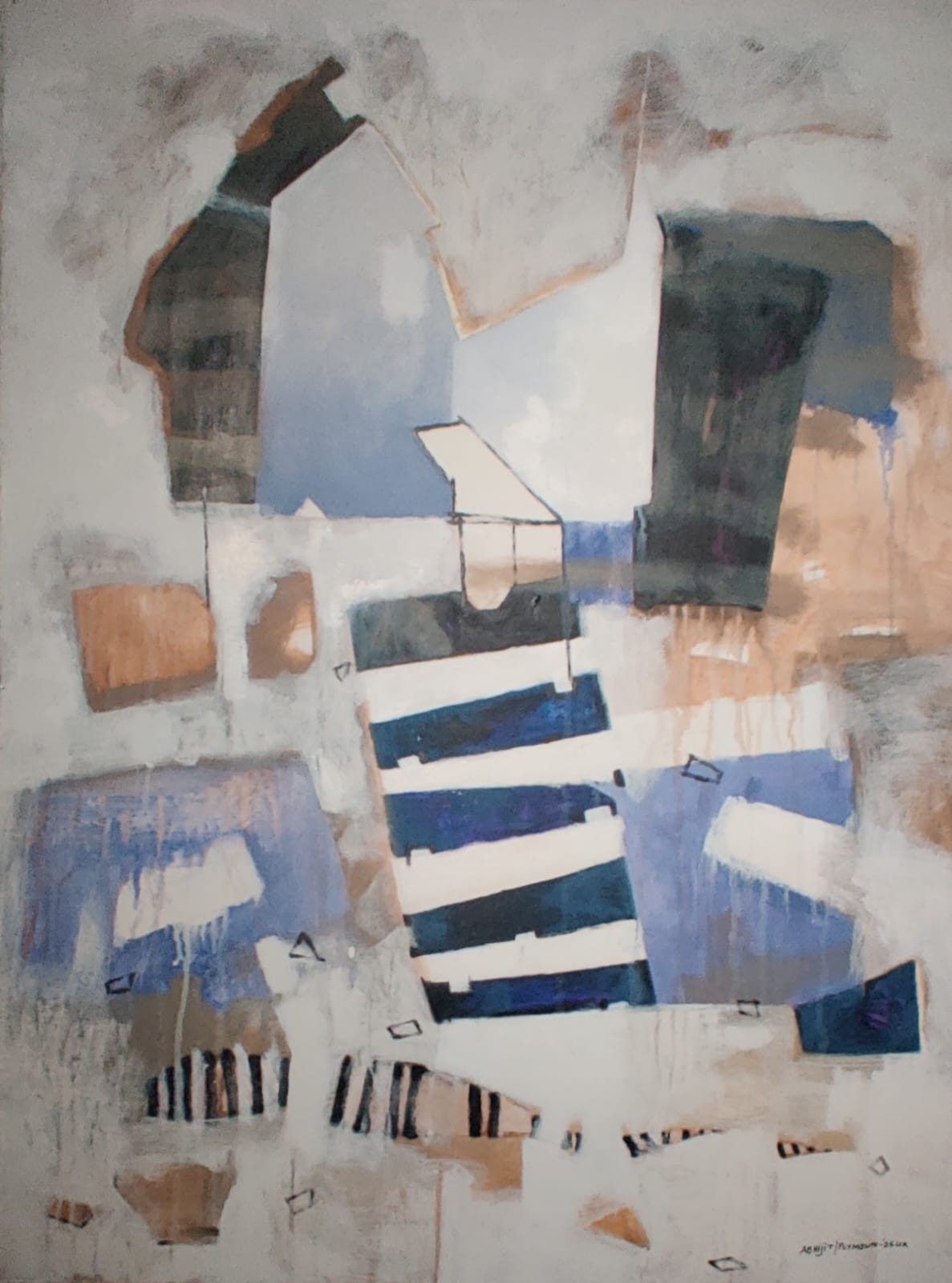
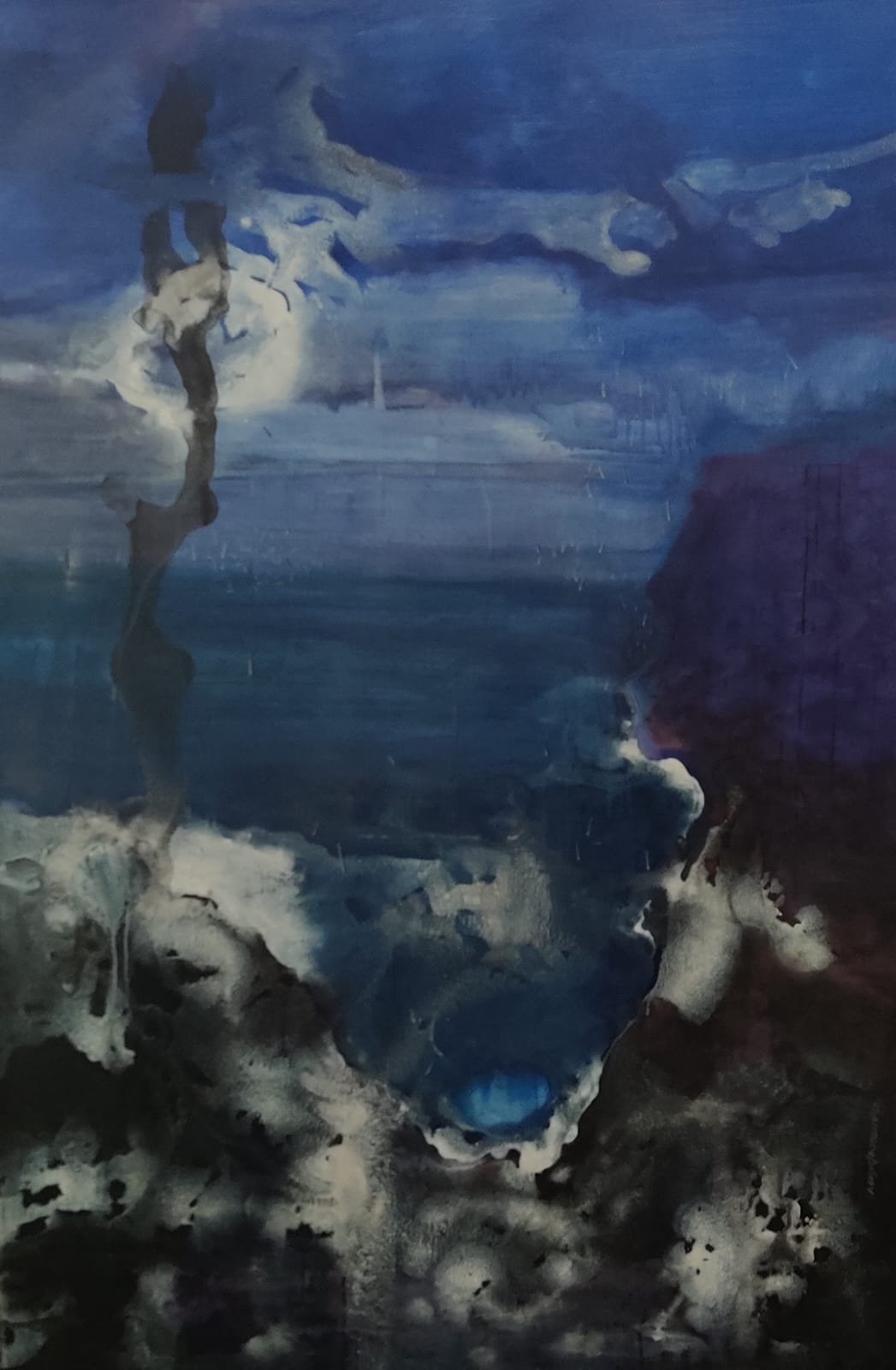
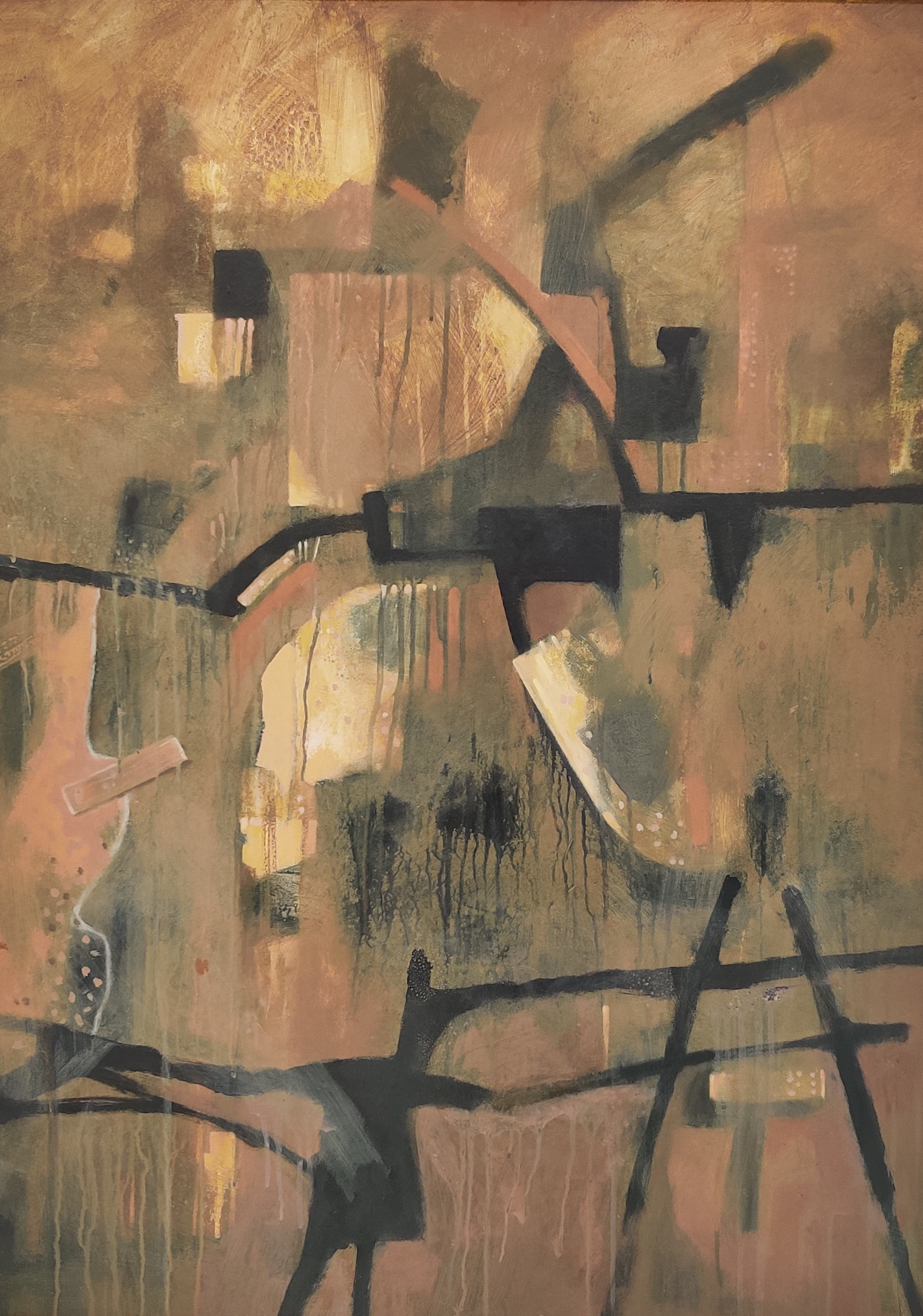
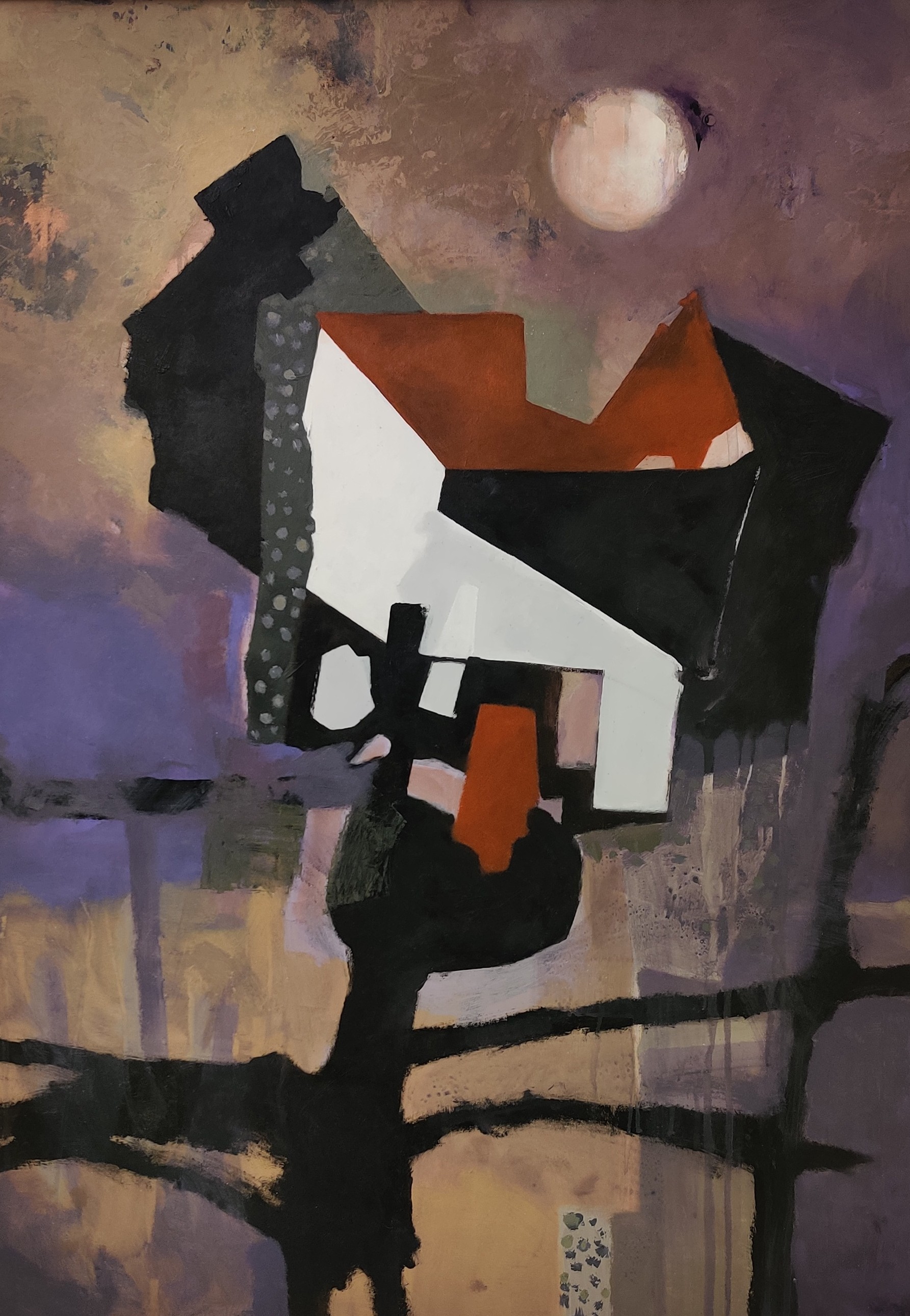
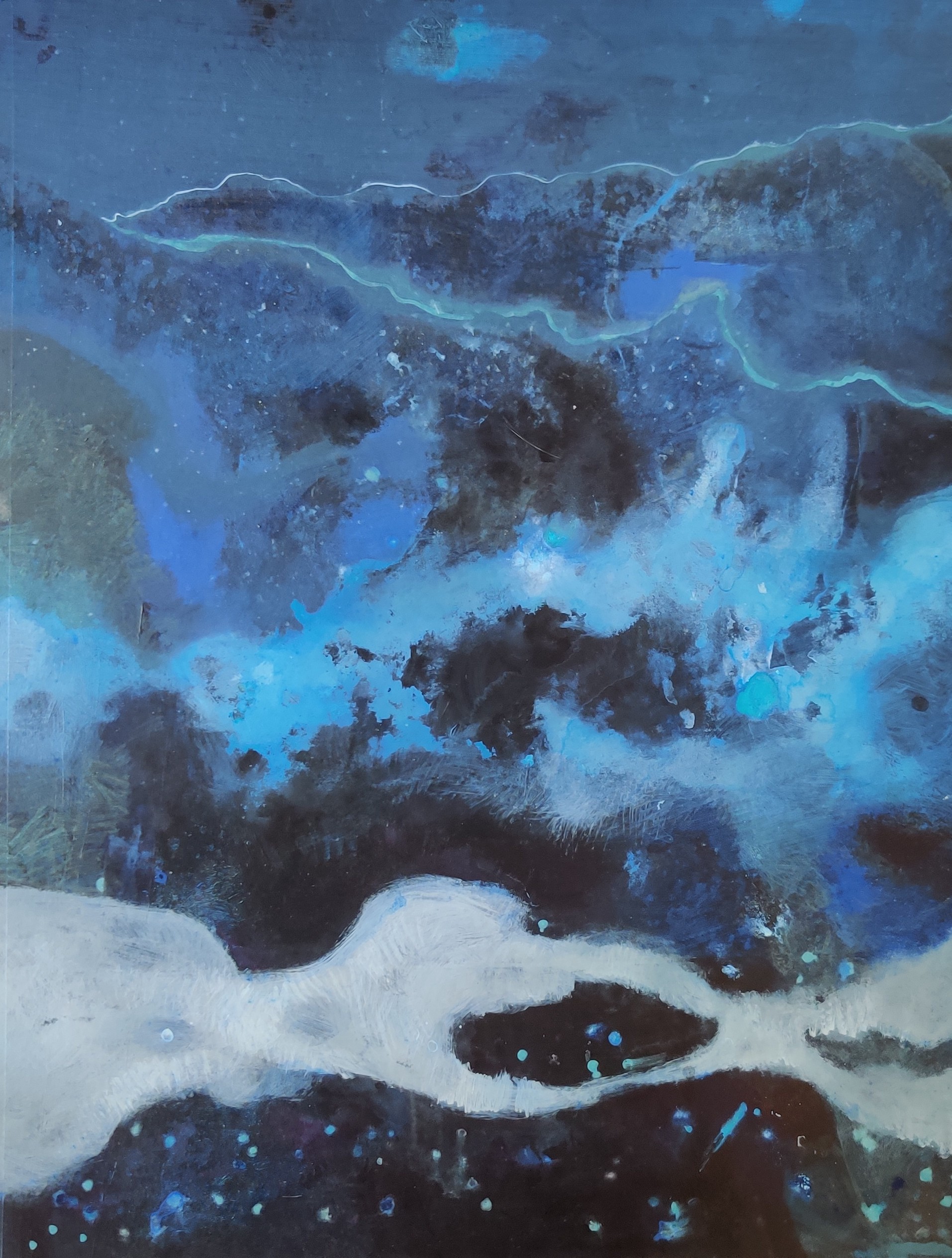
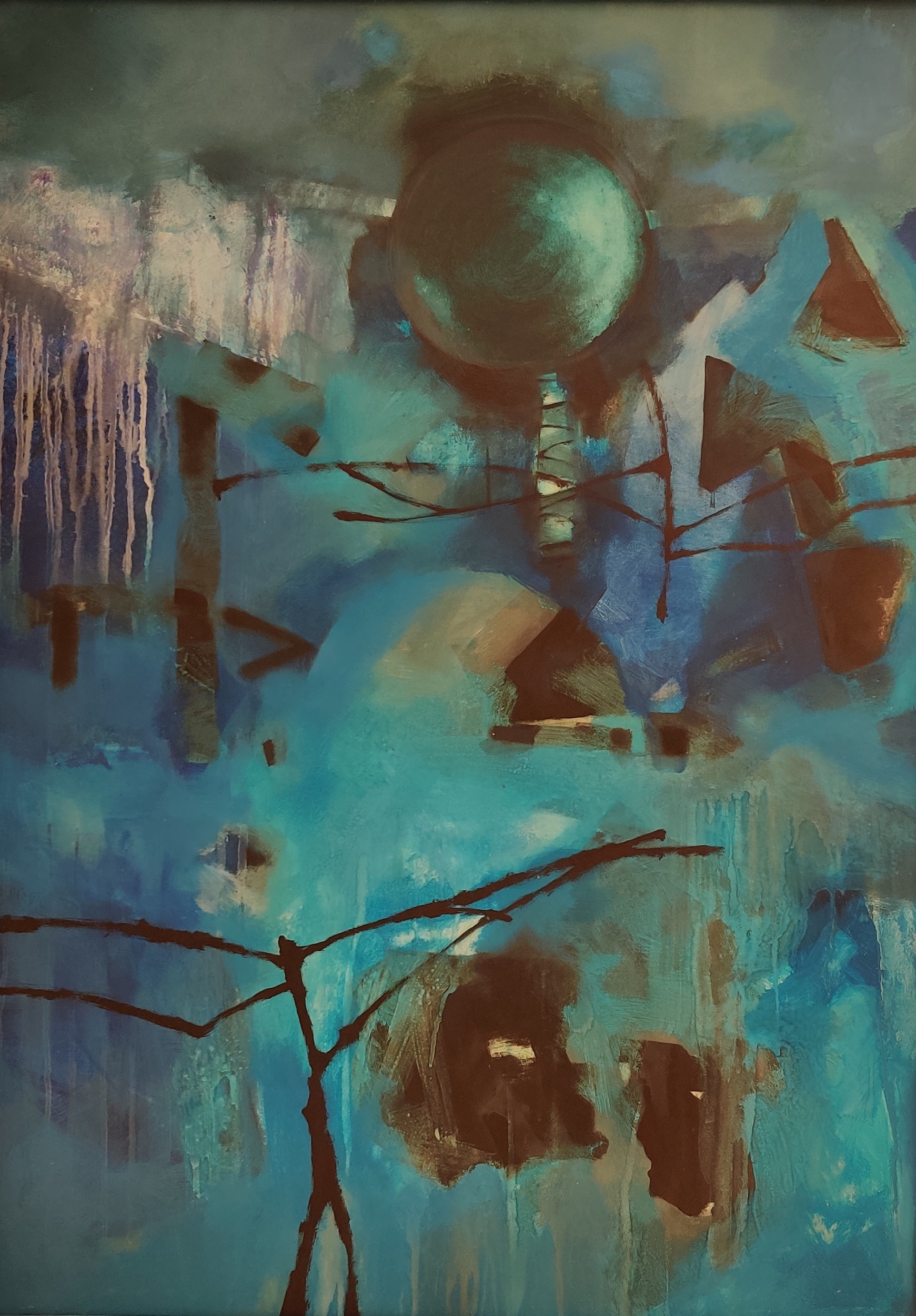
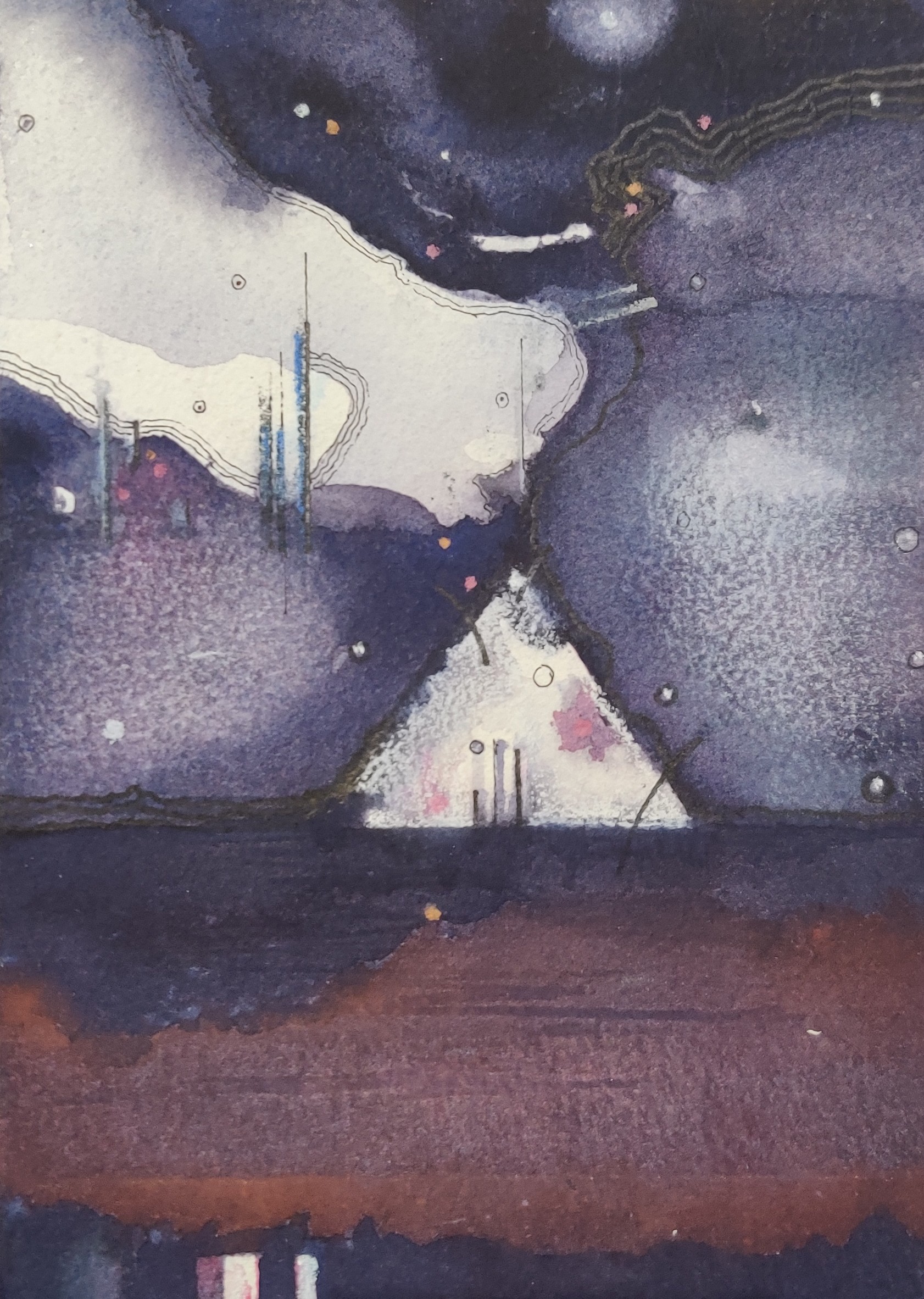
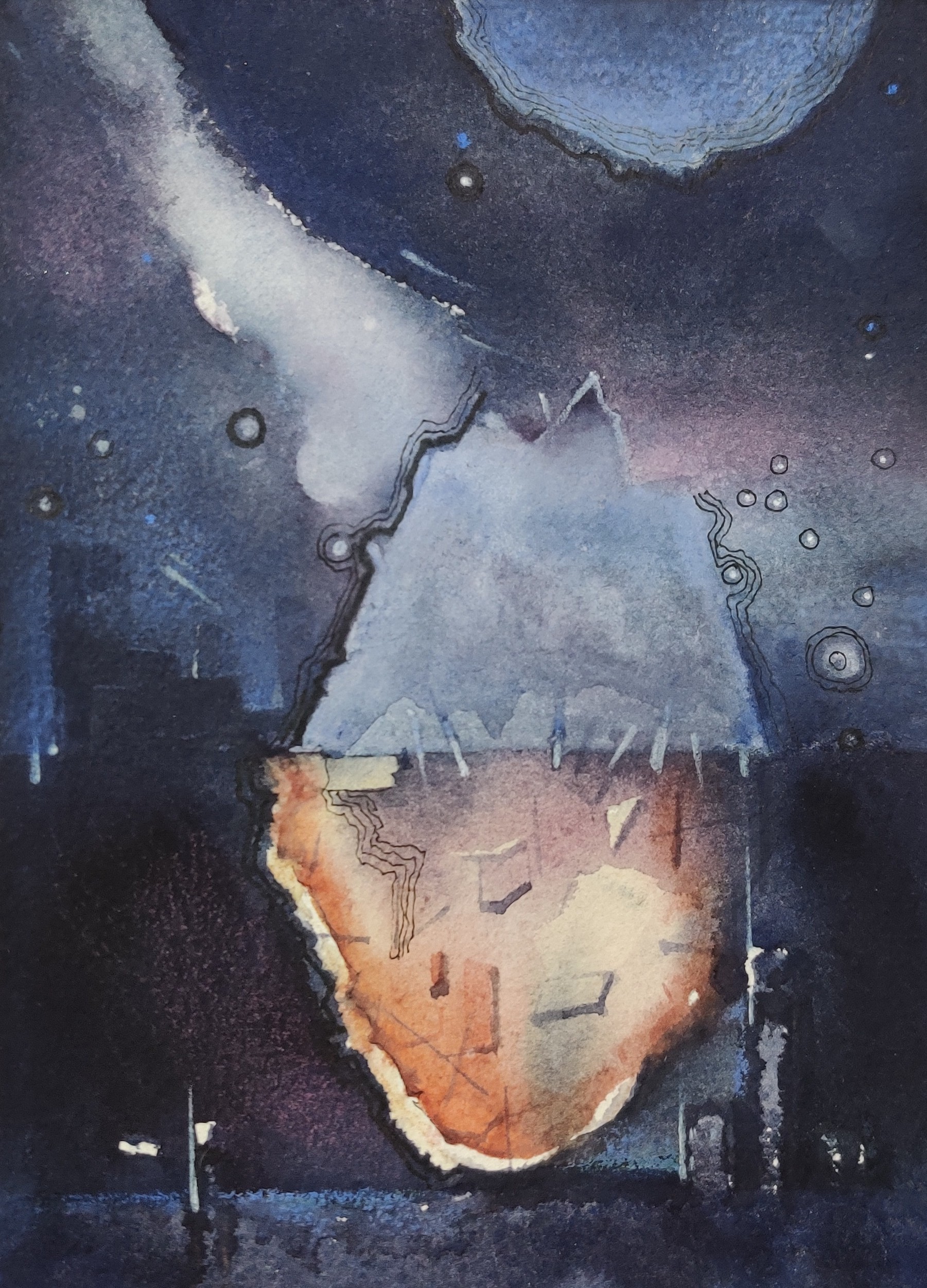
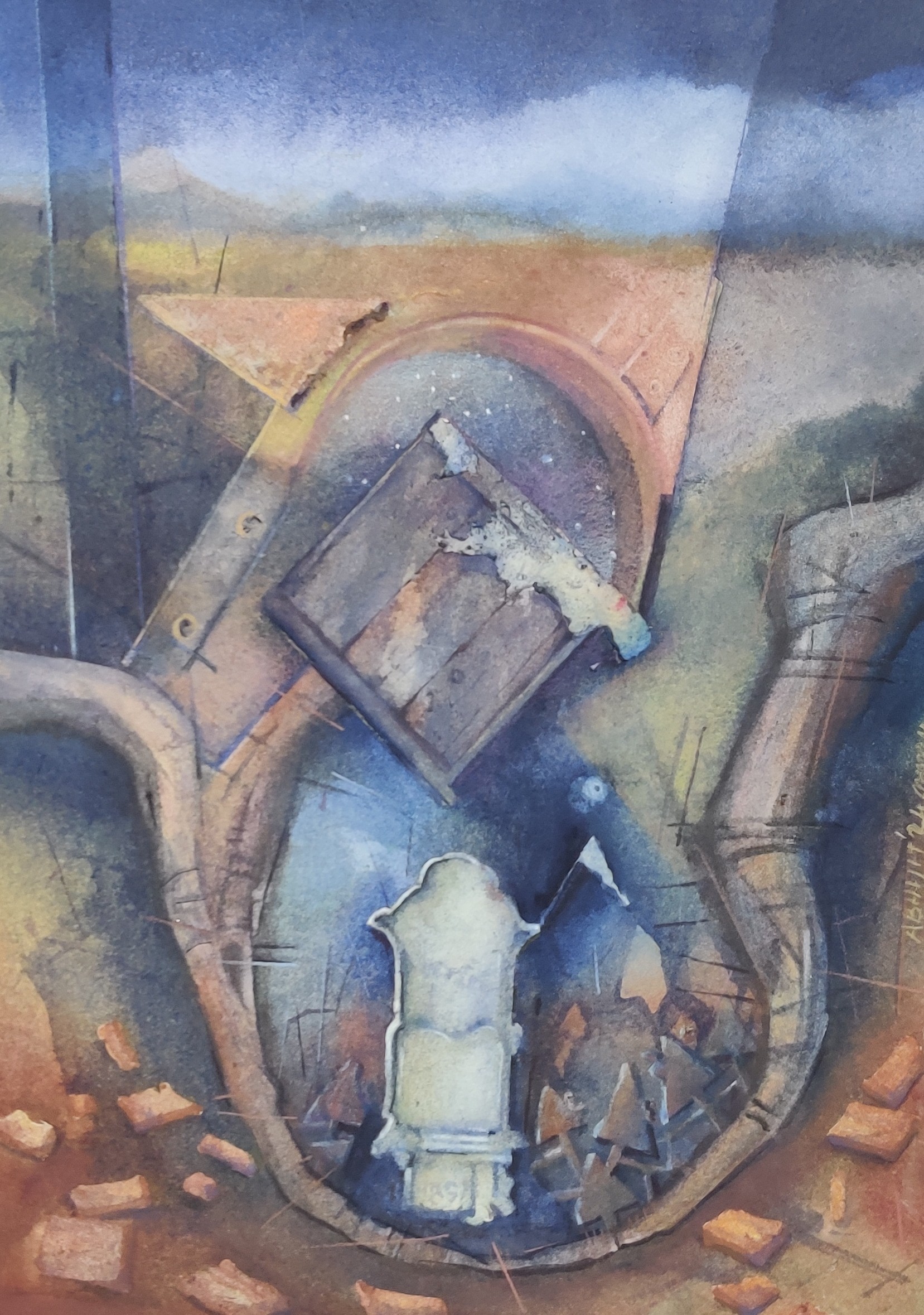
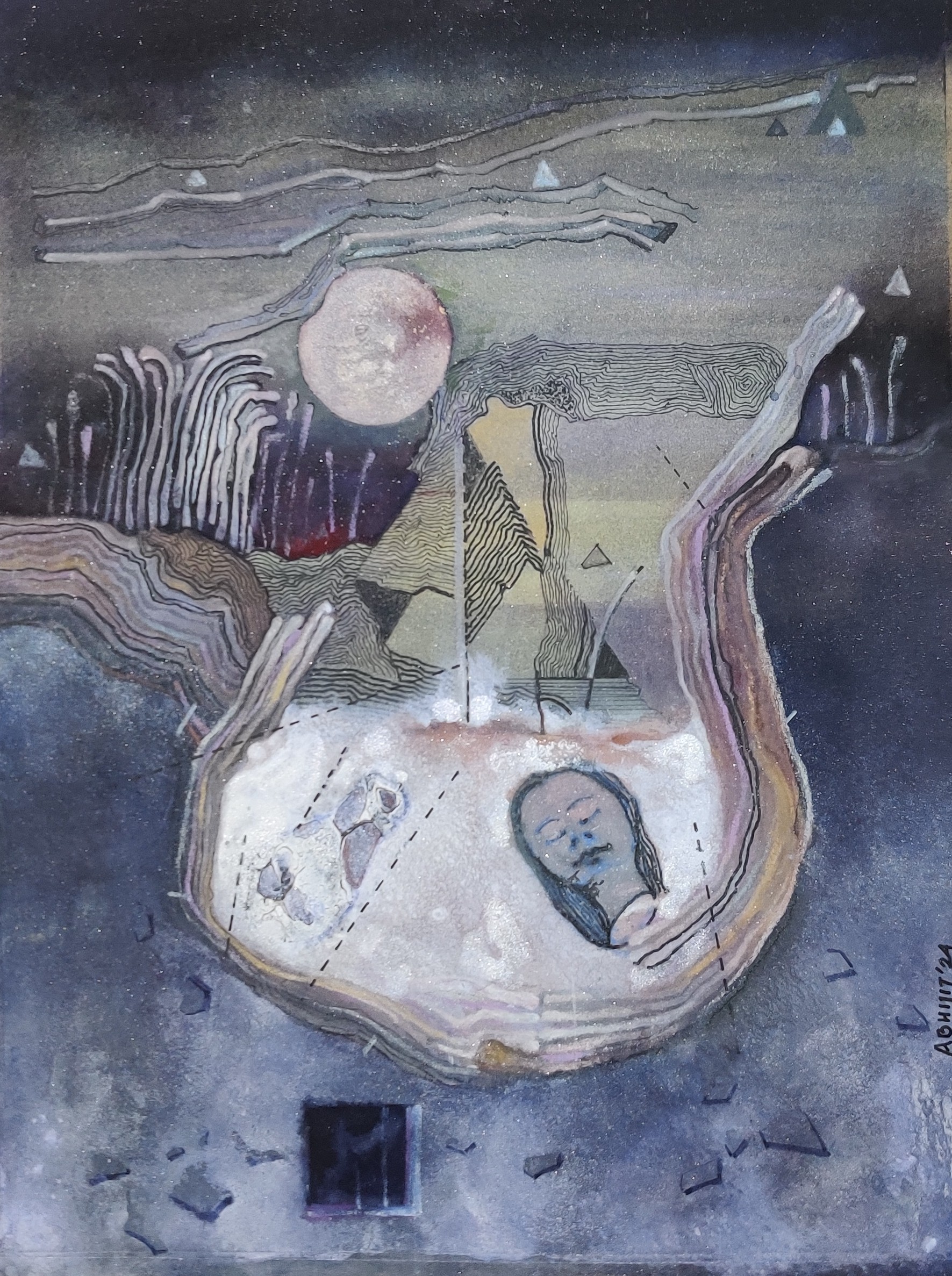
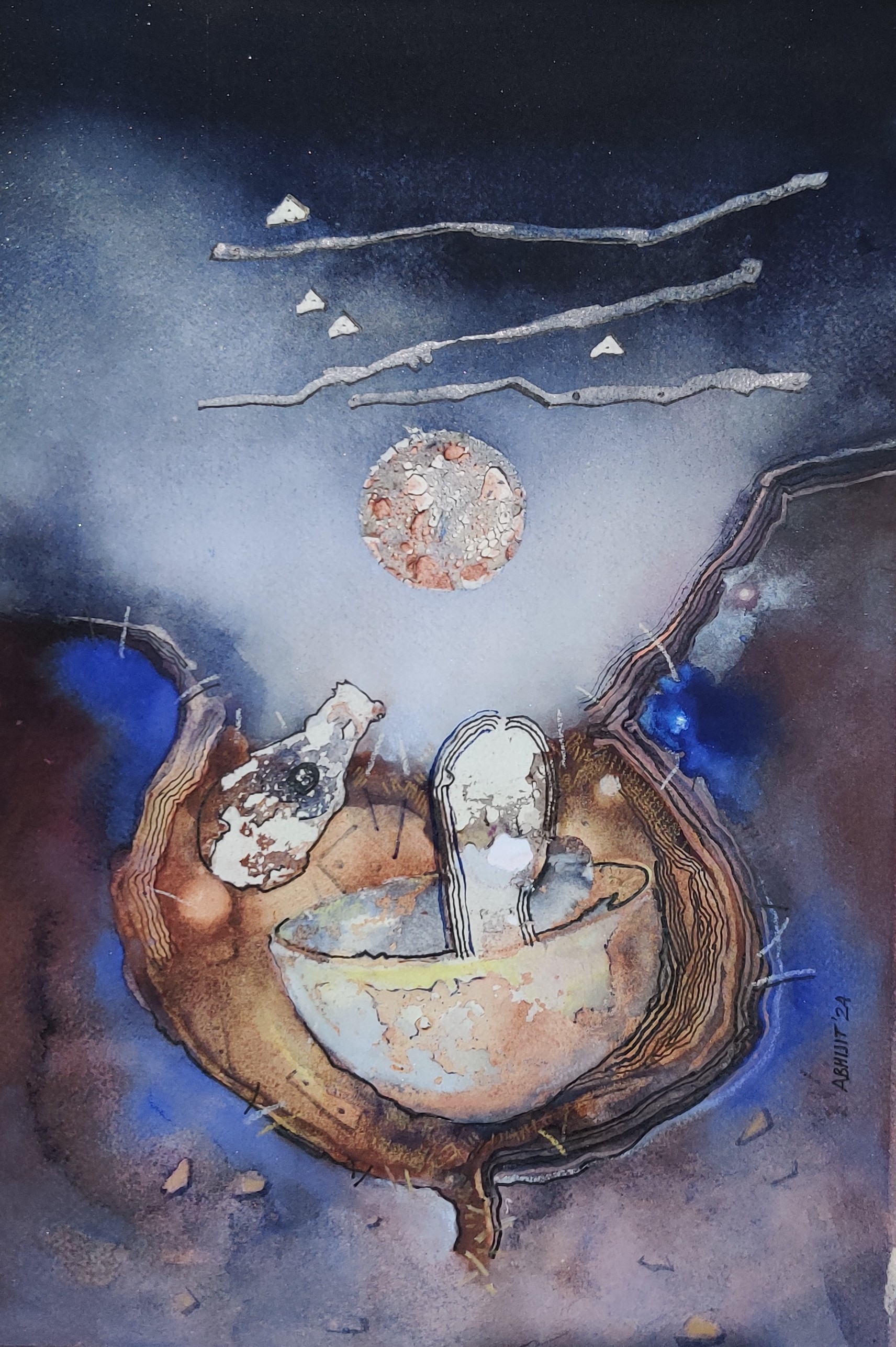
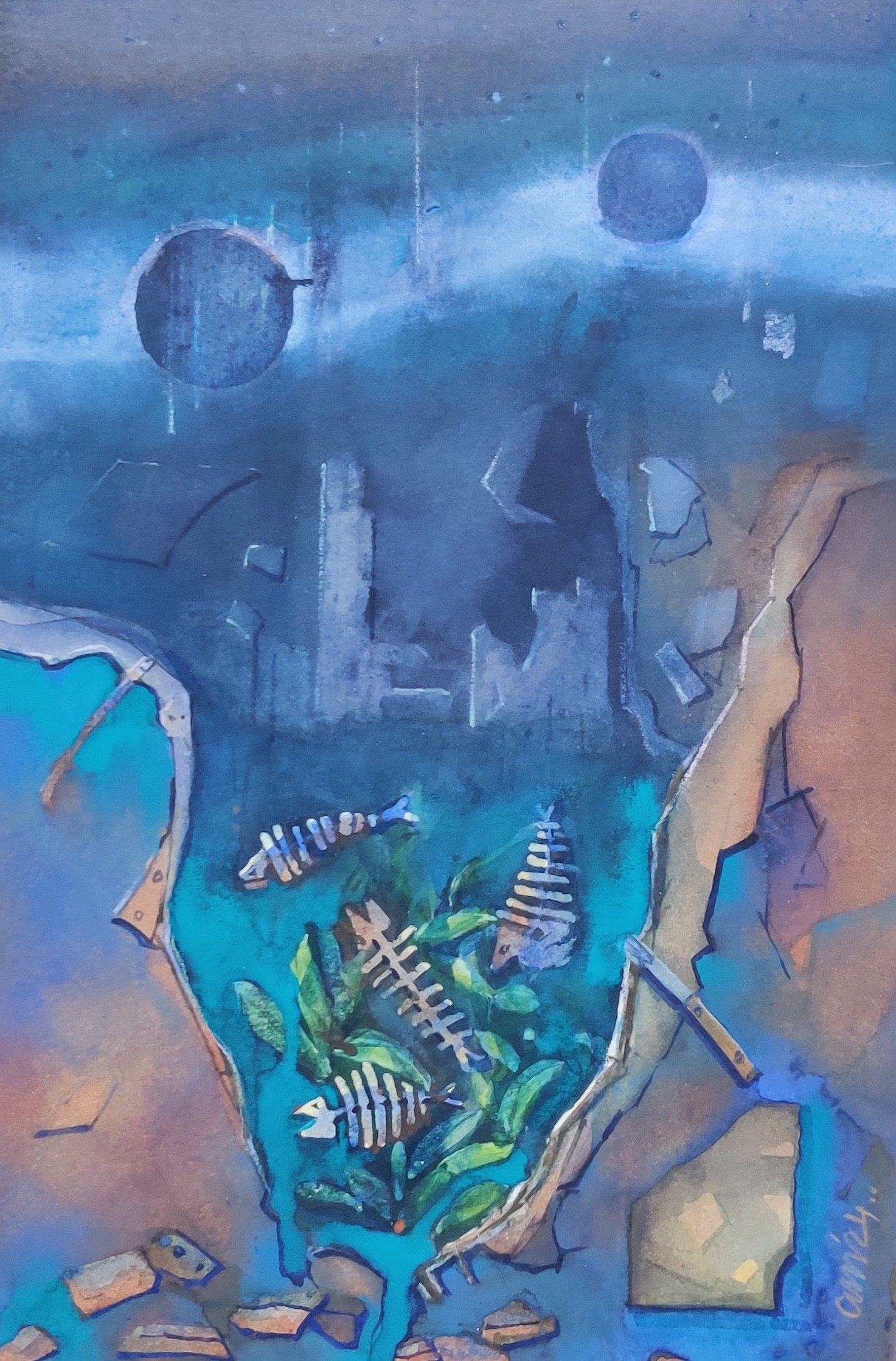
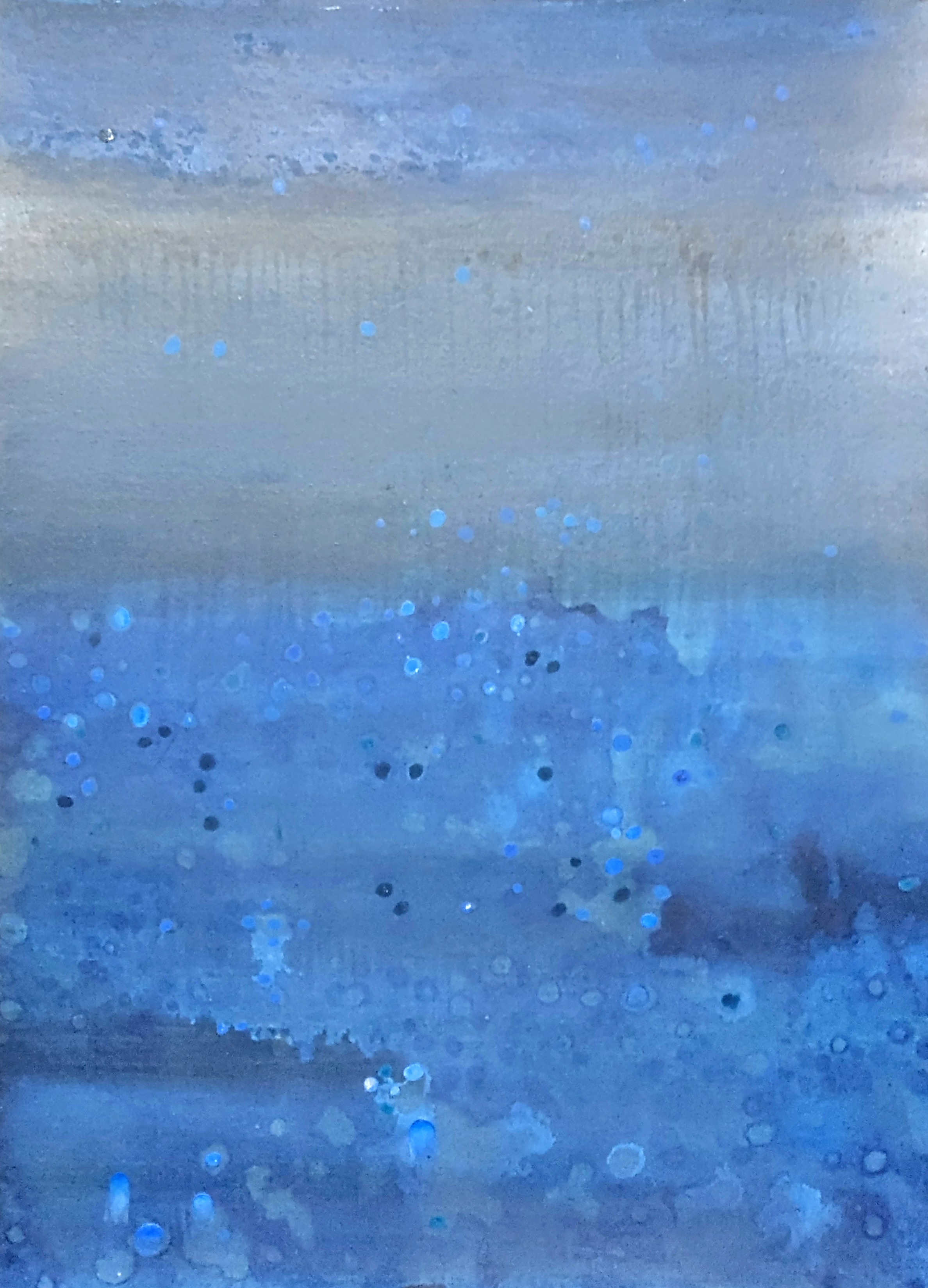
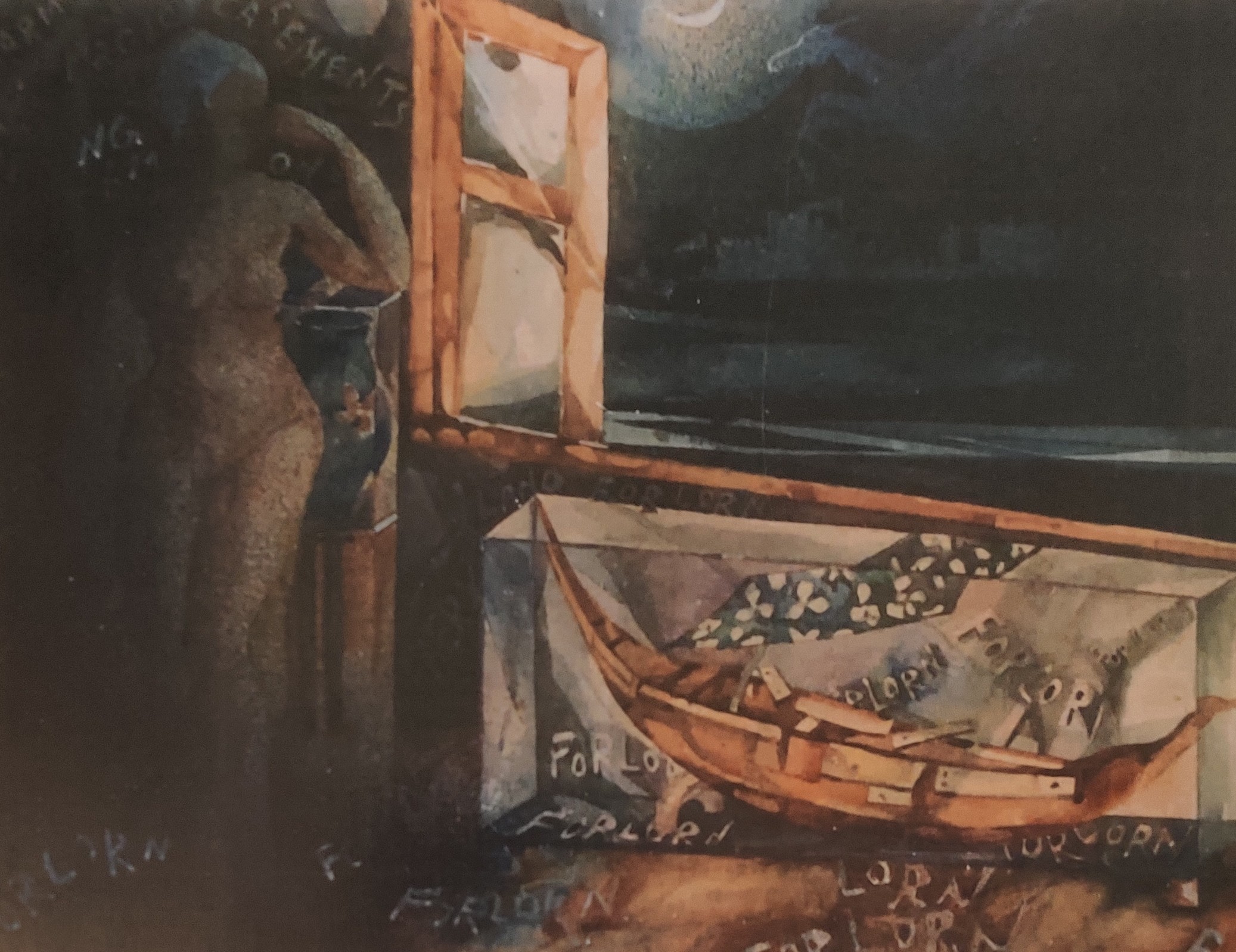
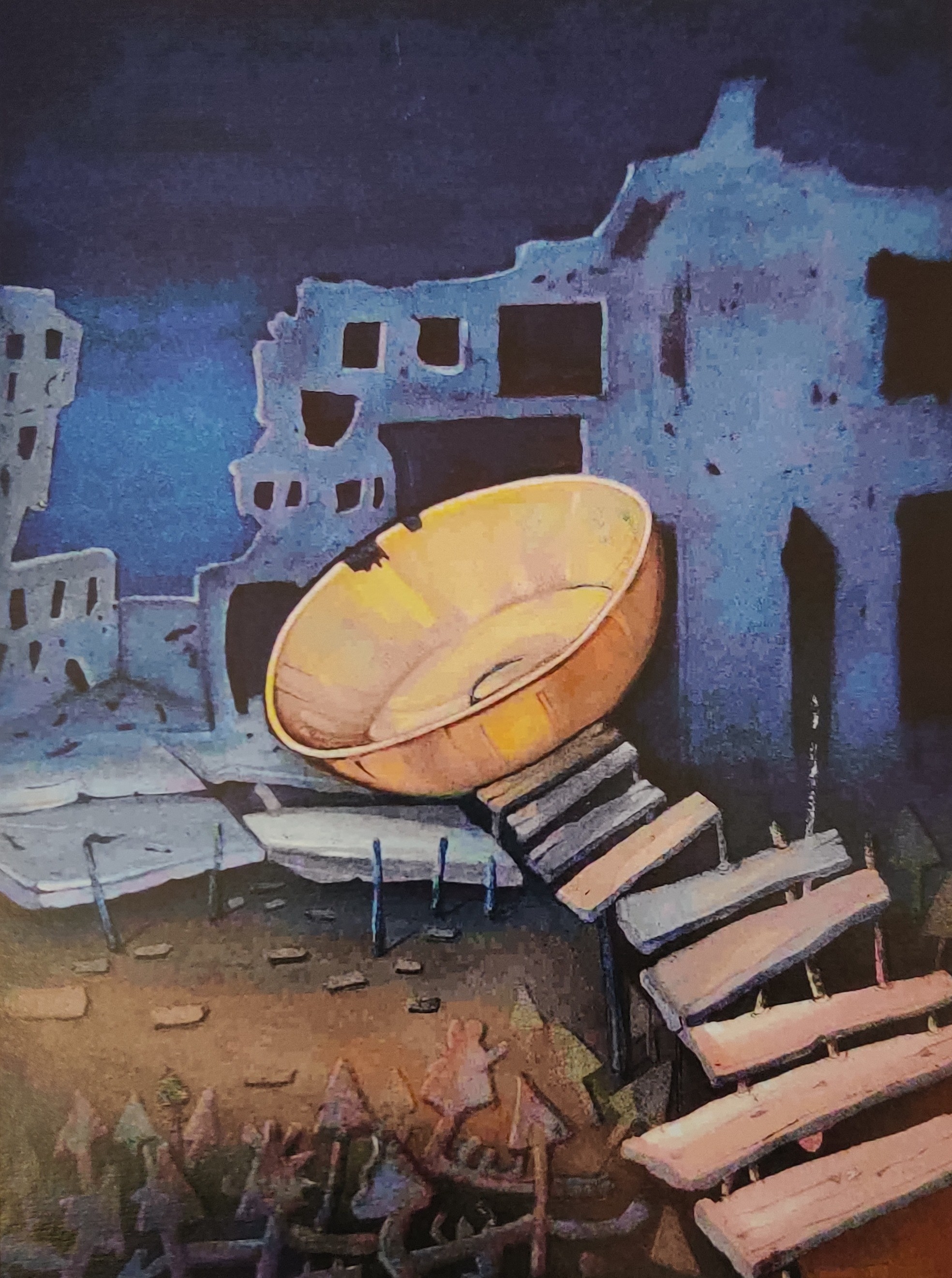
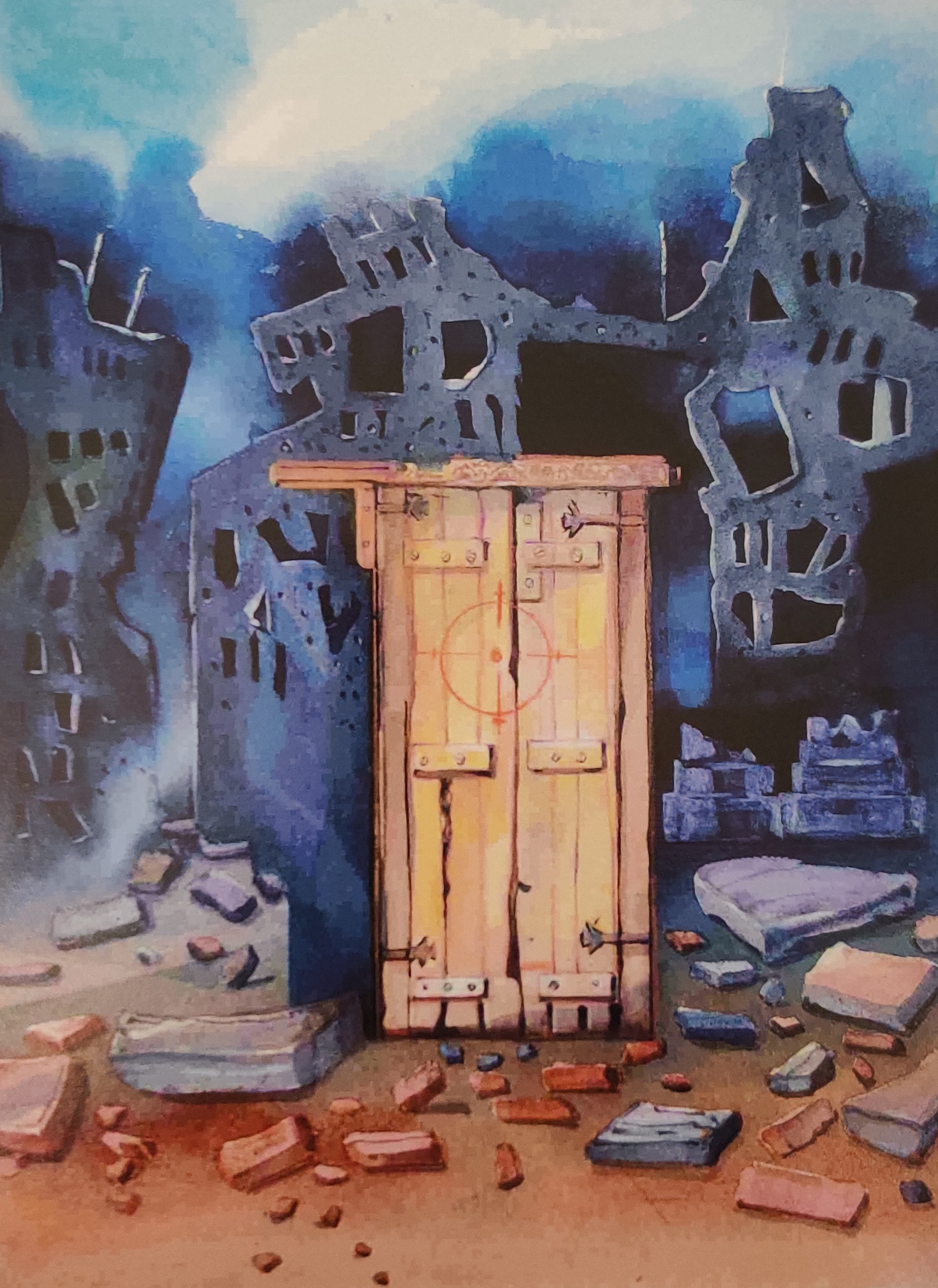
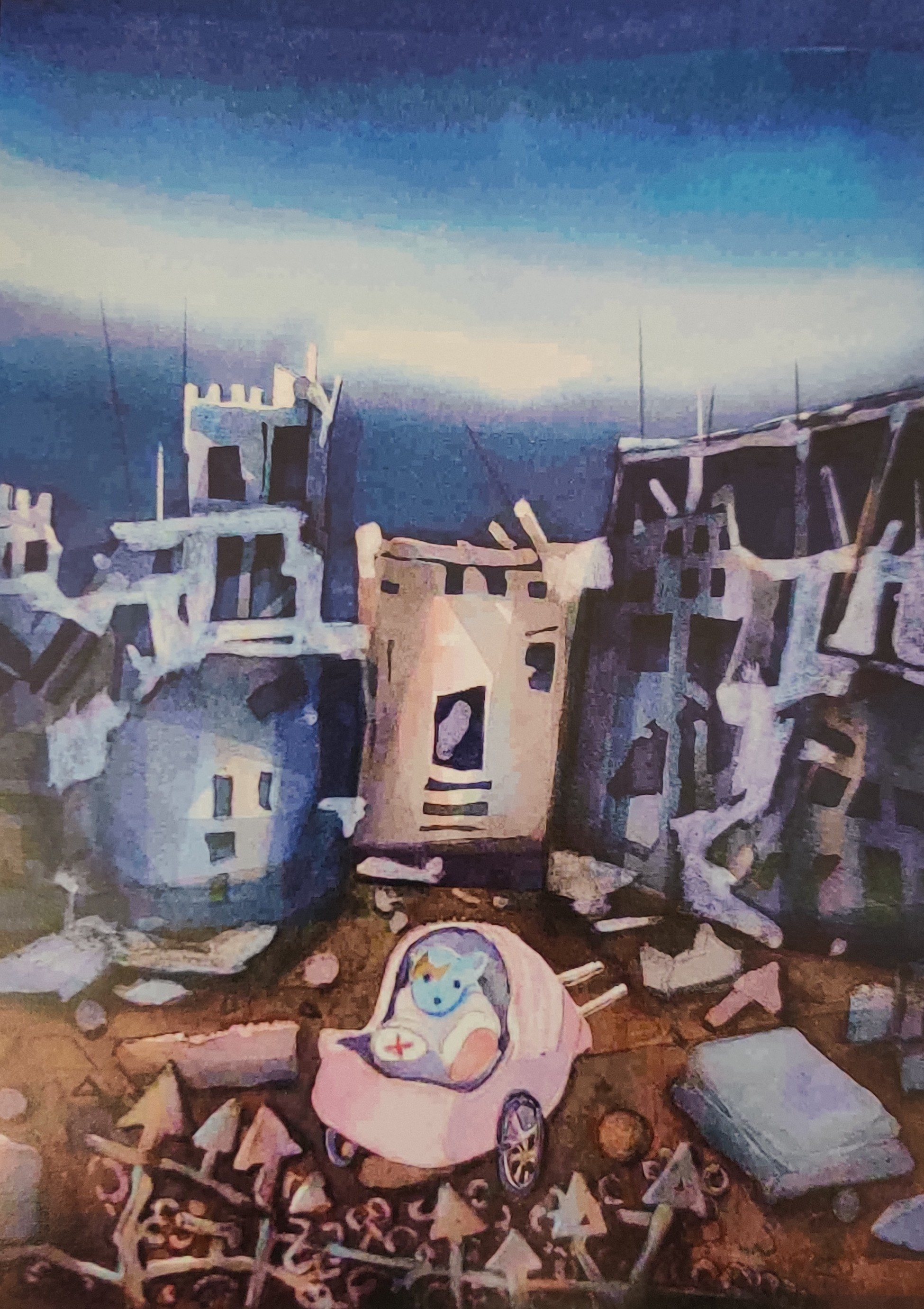
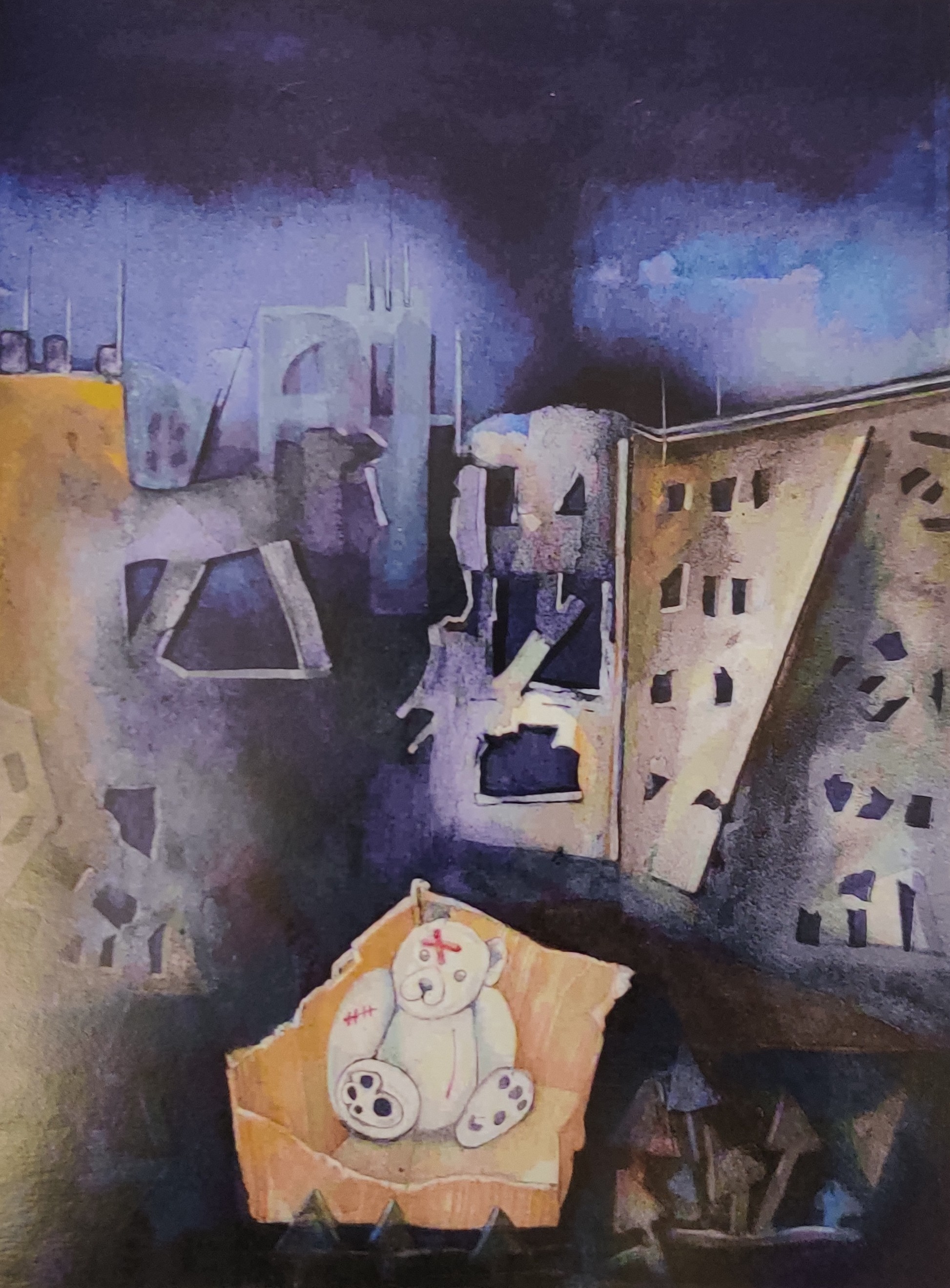
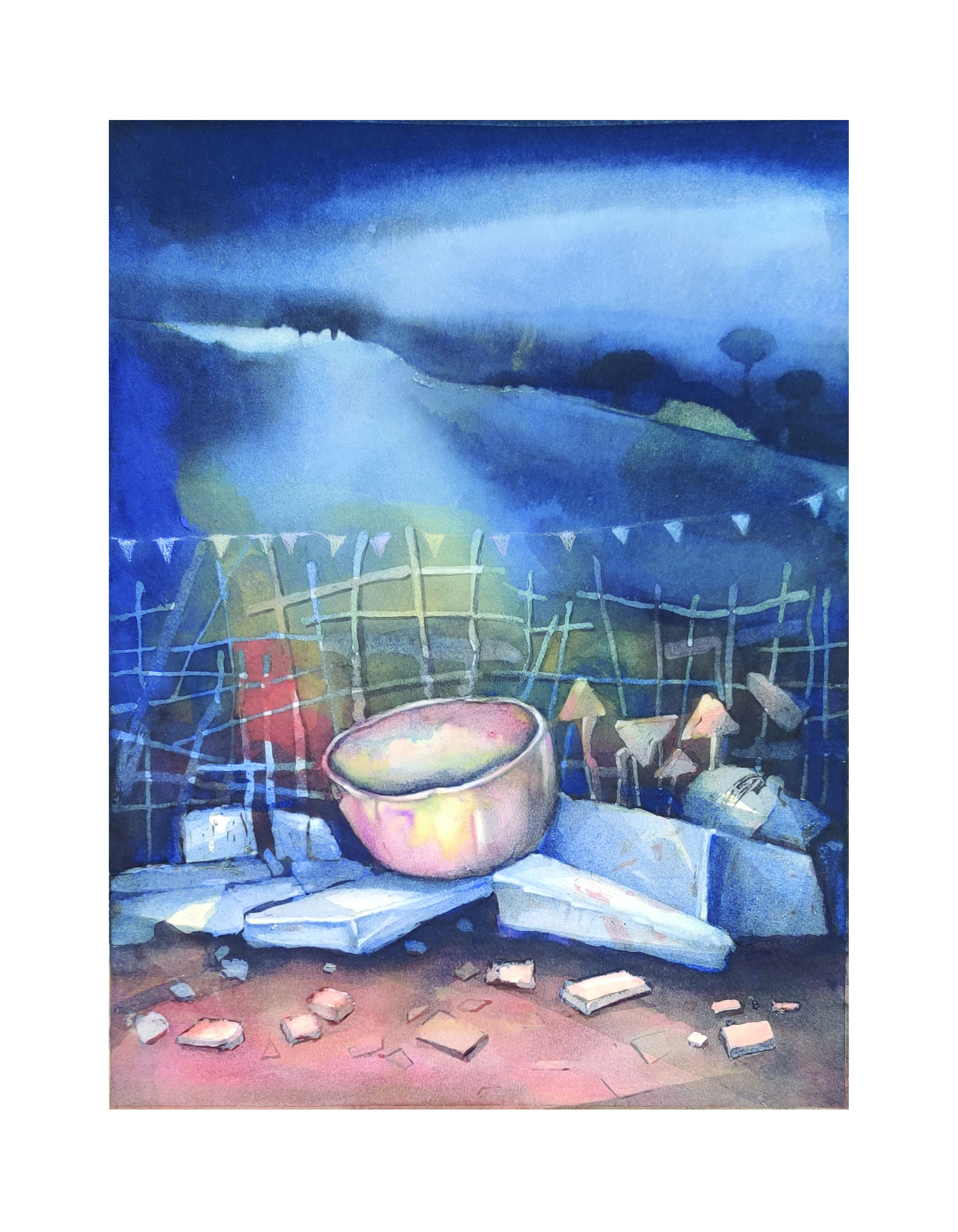
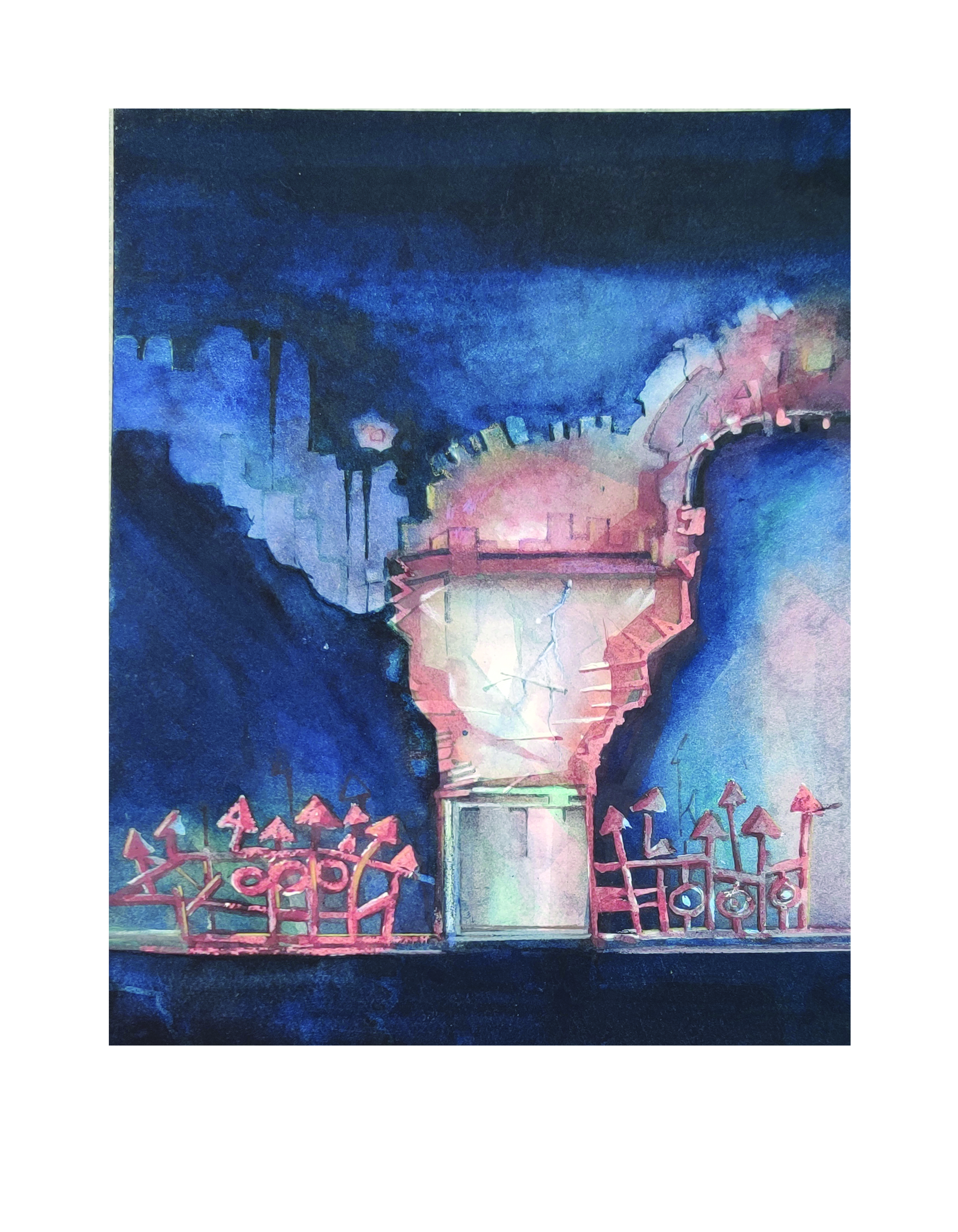
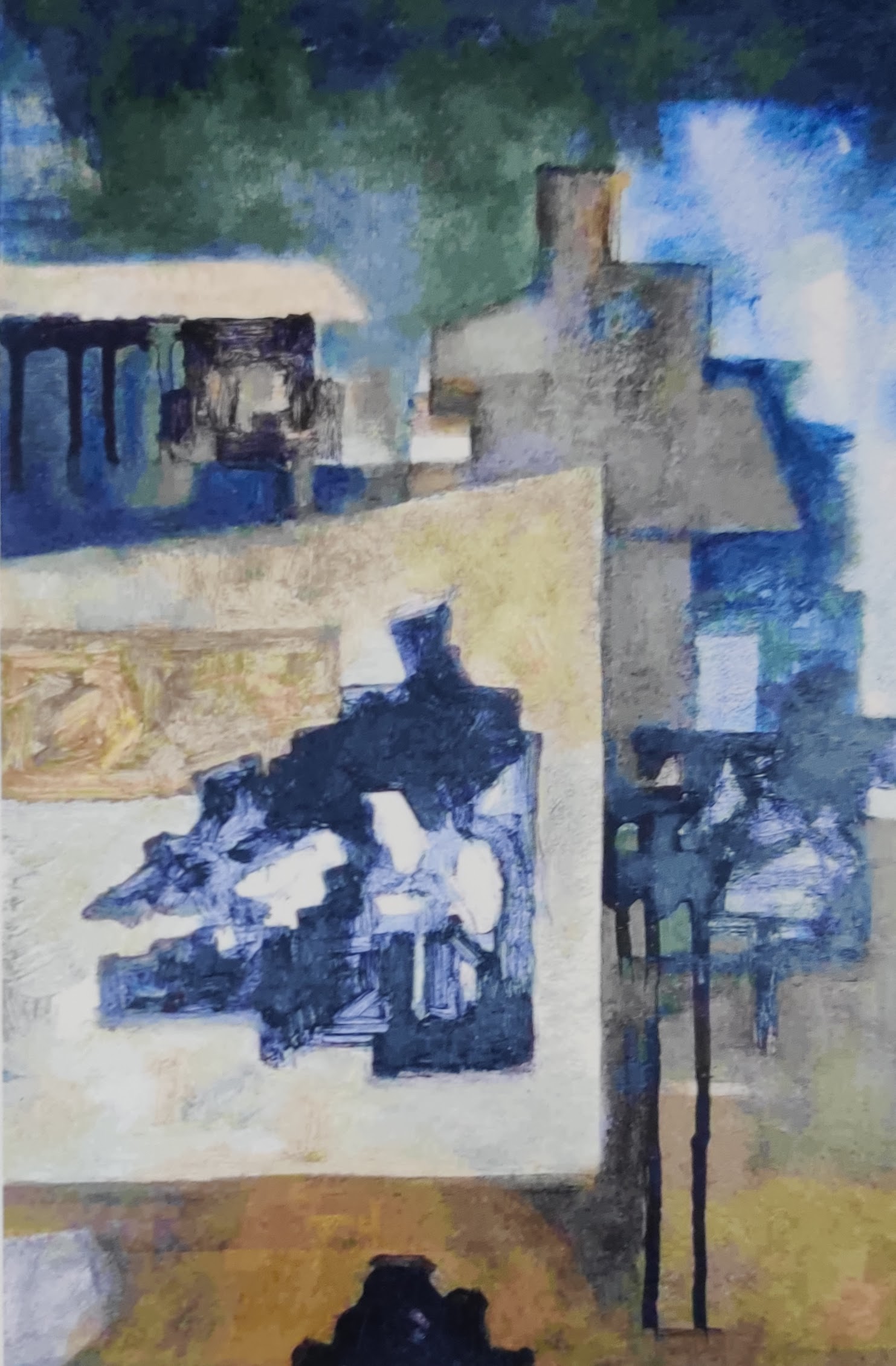
Apocalyptic and haunting scenes of all out devastation and unfathomable cruelty and hatred which went into its making are writ large over this series of paintings. What draws the viewers’ attention is the scale of destruction and the suffering and death unleashed by this all-out war by the occupiers of Gaza on the Palestinians. A dark subdued blue envelops several works creating a tense and anguish ridden mood. The interesting feature of these works is the absence of any human being, dead or alive. These allegorical works instead refers to objects and houses once used by a people and now broken and in ruins crying out to its erstwhile users. Human suffering and the scale of killing is so monstrous that sometimes artists and writers have no words or images to describe or represent them. There is also no outward signs of resistance, yet one might ask then why has the series been called ‘Resistance and Resilience’? The power of great art often lies in unstated or muted ways of representation. Obvious and explicit images of resistance tends to diminish the aesthetic appeal and power of art; they slide into the didactic or agitprop genre. Depictions of human suffering tend towards sentimentalism. Serious thought provoking art makes demands on the viewer to read and interpret the images. Destruction and armed attacks on this scale is not for nothing; they have emerged out of a great fear of the power of resistance of the Palestinian people and its unending will to fight back. This fear of resistance has led to such ghastly barbarity on the part of the Israeli state and its western allies. Israeli brutality is a direct response to the ferocious resistance of Palestine.
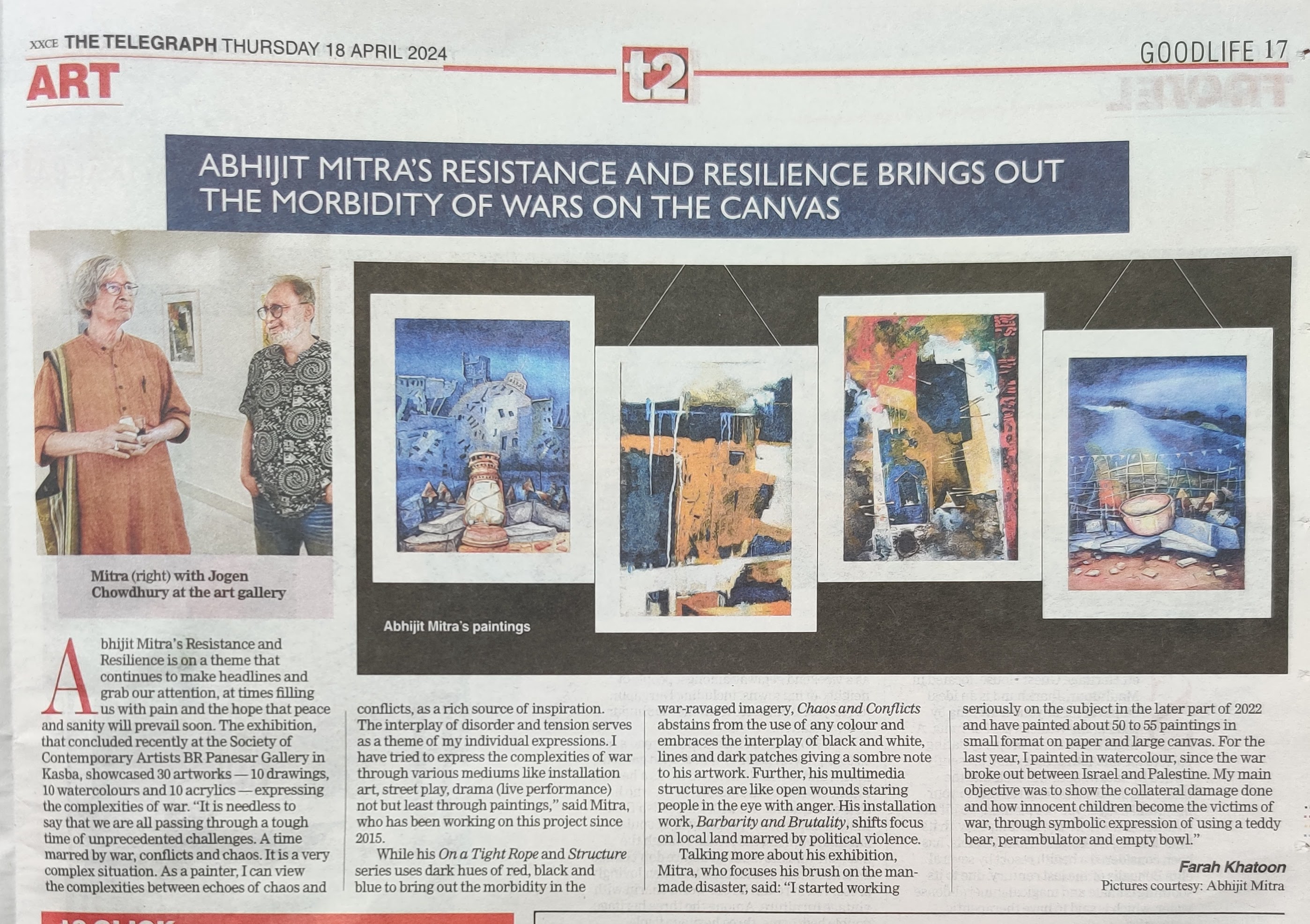
Every painting in this series has everyday objects used by people and they continue to exist, however broken or damaged they might have become. It is a cruel reminder of human mortality. Only human beings die, suffer and can cry. These objects are allegories of the dead and the wounded men, women and children who, otherwise are absent. Two of the most poignant images are of crumbling buildings in ruins in the background with an unattended pram carrying, not a child, but her favourite teddy bear, now wounded and looking bewildered and deserted. Both the works, like the rest, are dark and intense, which is further heightened by the skilful use of patches of light falling on the ruins and the teddy bear.
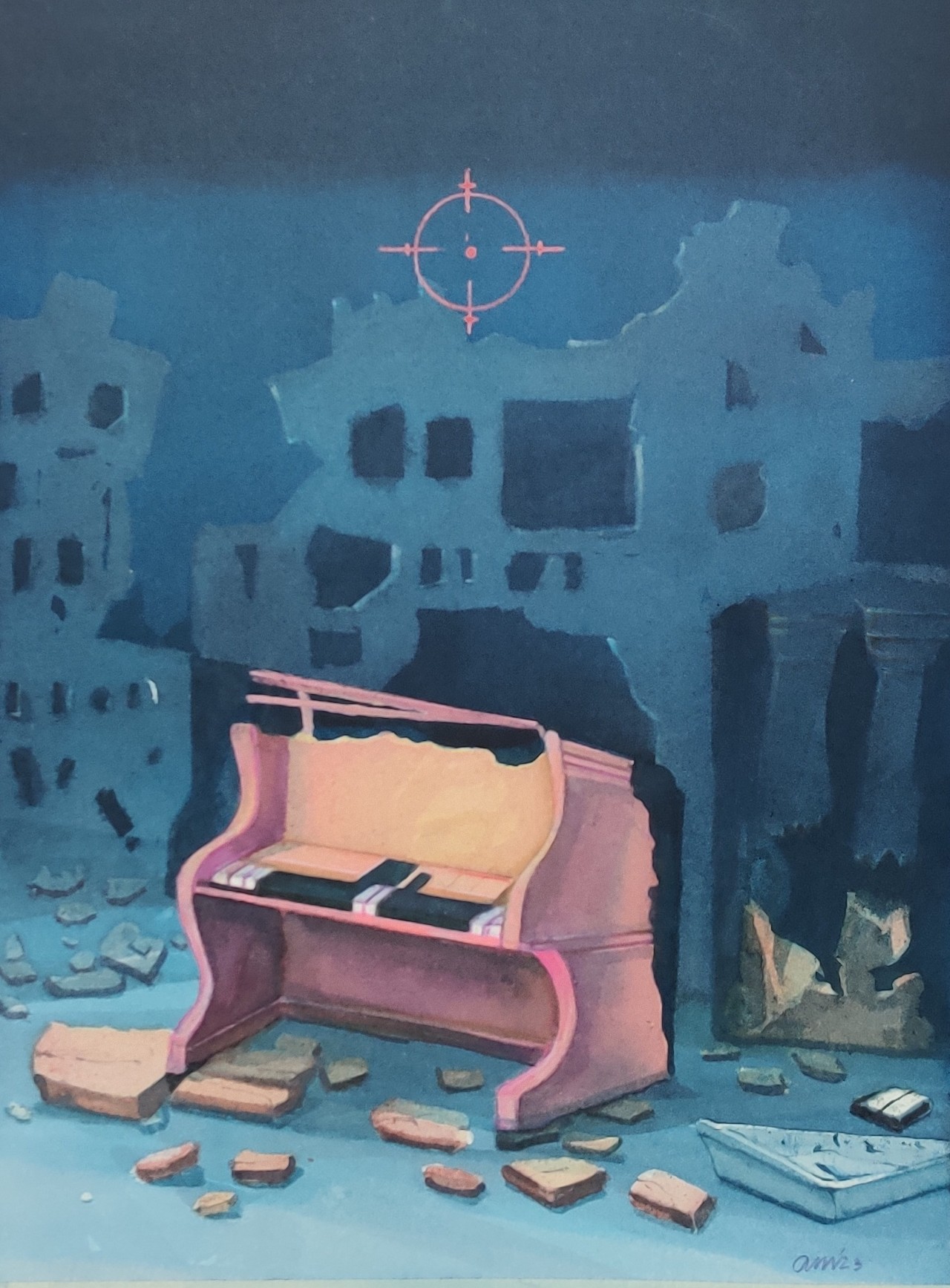
In another equally moving work, Abhijit paints a damaged piano in a dark background showing the walls of bombed out buildings. The piano is lit up with a mix of pink and other colours. Pieces of rubble are strewn all over. The piano is silent and there is no player, they are all dead. In times of great grief music is the only way to soothe such mental and physical agony. And now no one is left to even offer some musical solace. Above the remains of the bombed out building there is the symbol of a telescopic sight of a bomber aircraft suggesting its search for the piano, which still stands there. Genocide is not only killing a whole people but also destroying its music, its art and culture. What a way to describe the nature, extent and reach of war crimes. Genocide and war crimes are here represented in their everyday forms.
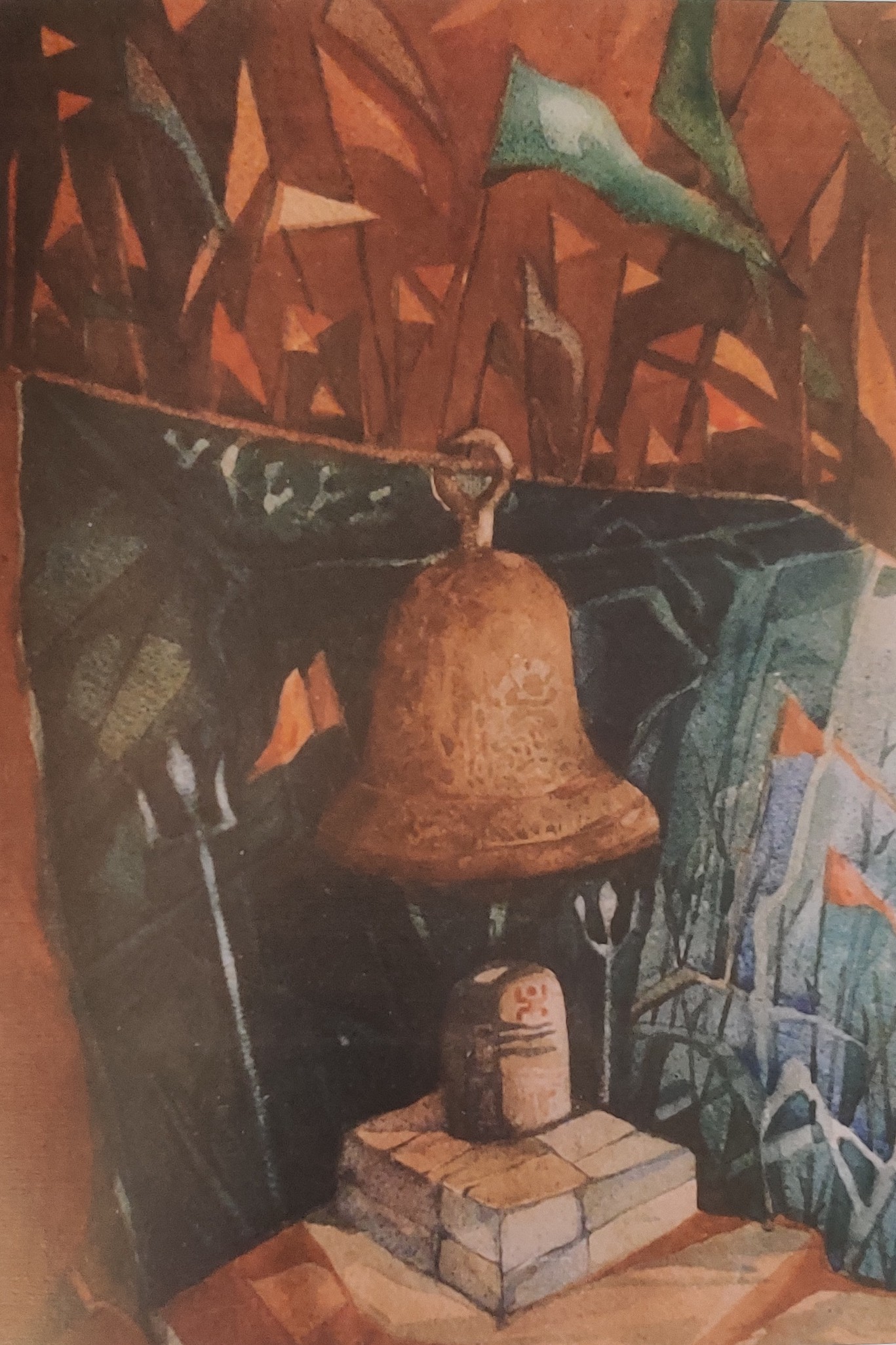
In two other works two empty and slightly dented utensils catch our eye. These are placed in the midst of rubble and broken buildings. The absence of food on the utensils and people point to the tragedy of Gaza. There is a string with paper flags still surviving, again a pointer to the distinction between matter and man. The fact that man is mortal makes murder such a heinous crime. It seems as if human artifacts remain as witnesses to this Holocaust, whether it is a piano or an old motor car.
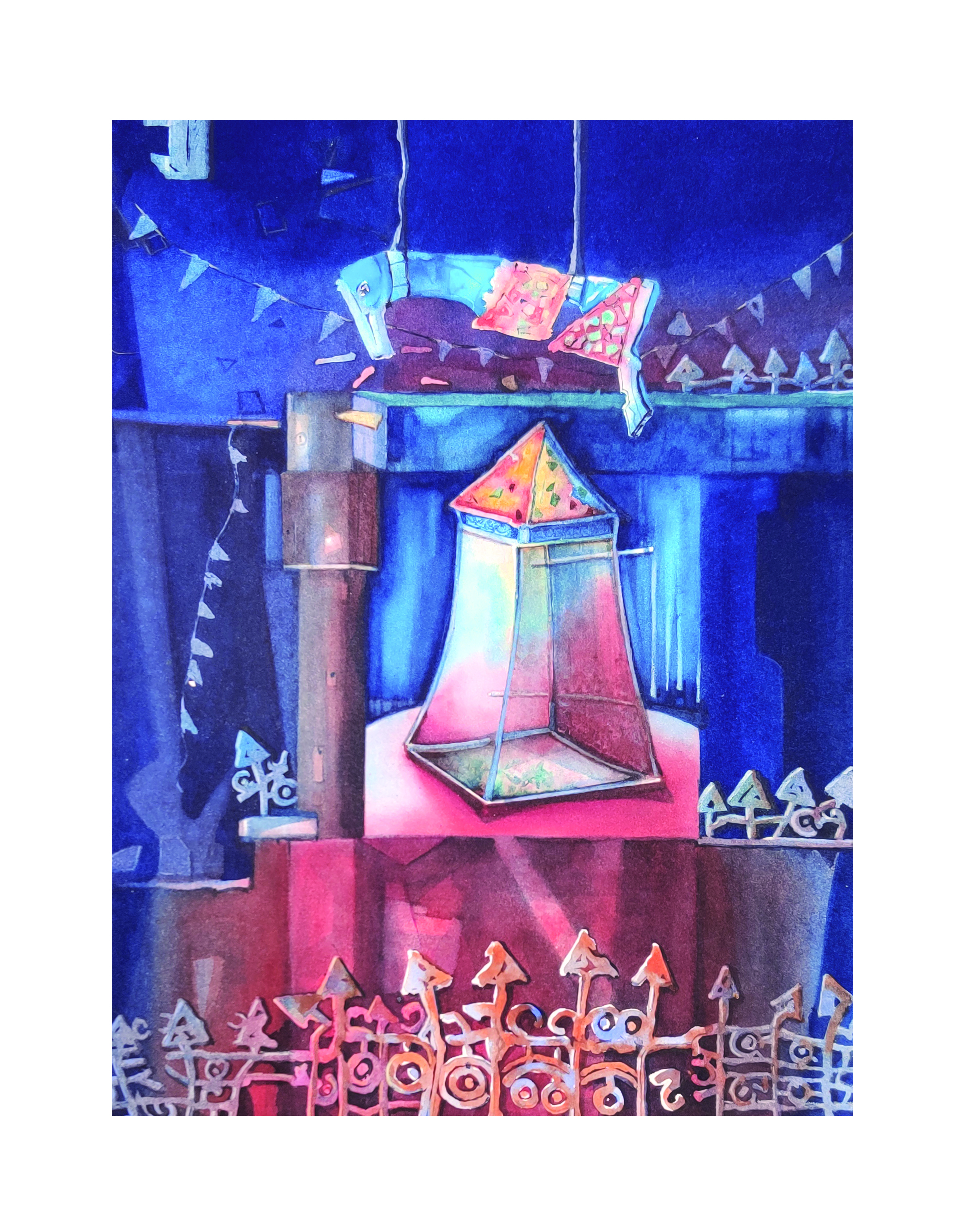
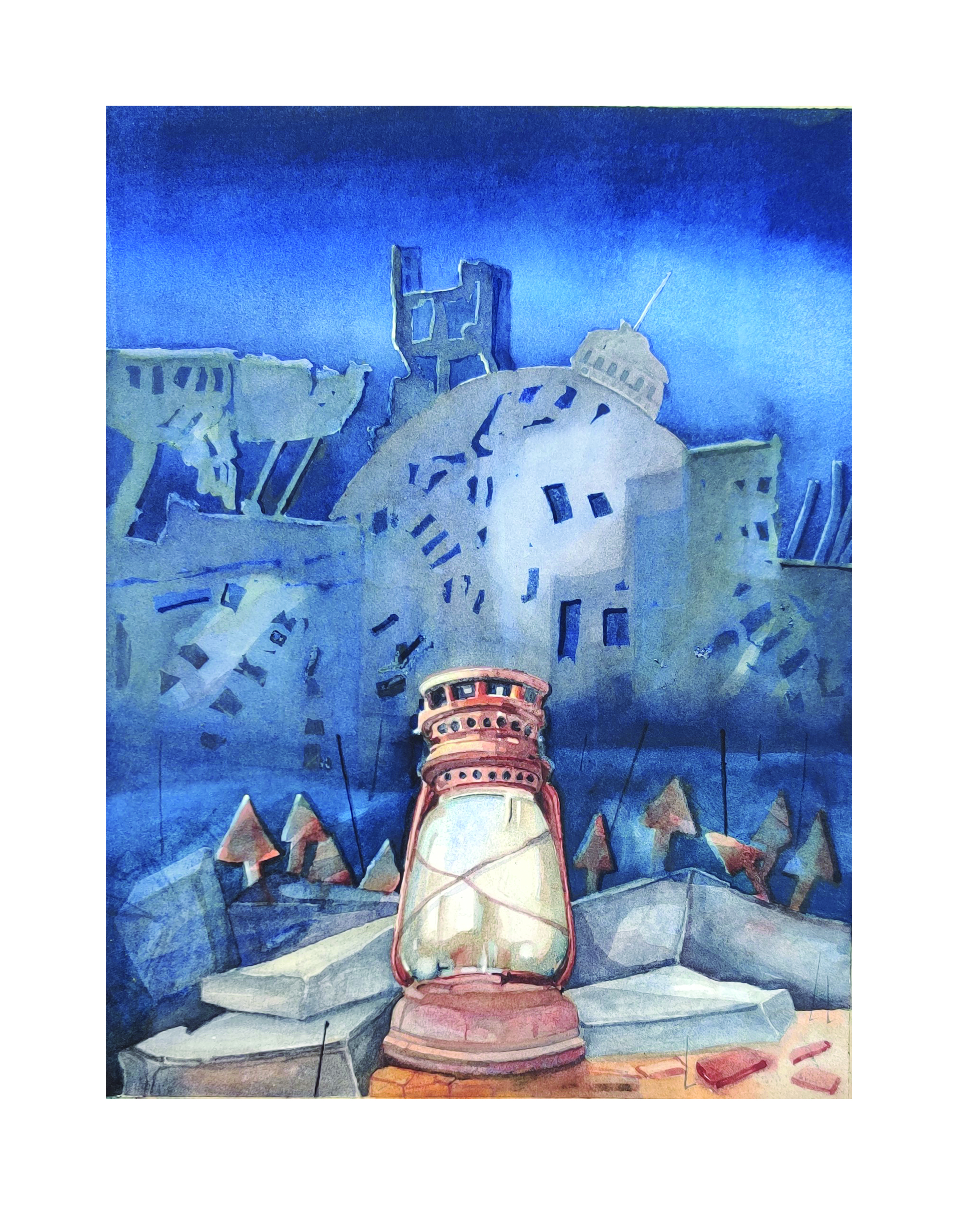
In two other paintings there is an empty lampshade and a lantern and both have lost their source of light in the midst of mangled iron railings and crumbling buildings. Behind the lantern we see a building almost in the moment of its crashing down to the earth. Yet the picture is steeped in ambiguity, for the lantern shines in the midst of the darkness of a destructive war, perhaps also referring to some hope still surviving.
The most powerful monumental work of Abhijit, representing both a total war against civilisation as well as a singular sign of resistance and hope. Again it is not some human figure fighting back, but a ochre like door, bolted and standing erect and intact in the midst of such devastation. It is a mark of creative genius to imagine and compose such an astounding piece of art. Except for a hazy ray of brightness in the horizon the main body of the composition is dark, dense and sombre. It is also a stark reminder of the power of modern science and technology and our scientists, who without any compunction use their creative powers and knowledge to devise such deadly machines of destruction. In the background, the buildings have all collapsed, only some portions of their walls stand precariously balanced, waiting to tumble down anytime. What stands in stark contrast is a door, shining brightly and immediately catching the eye of the viewer. But this monument of resistance and hope is marked with a telescopic sight of an invisible gun aiming to blow it up.
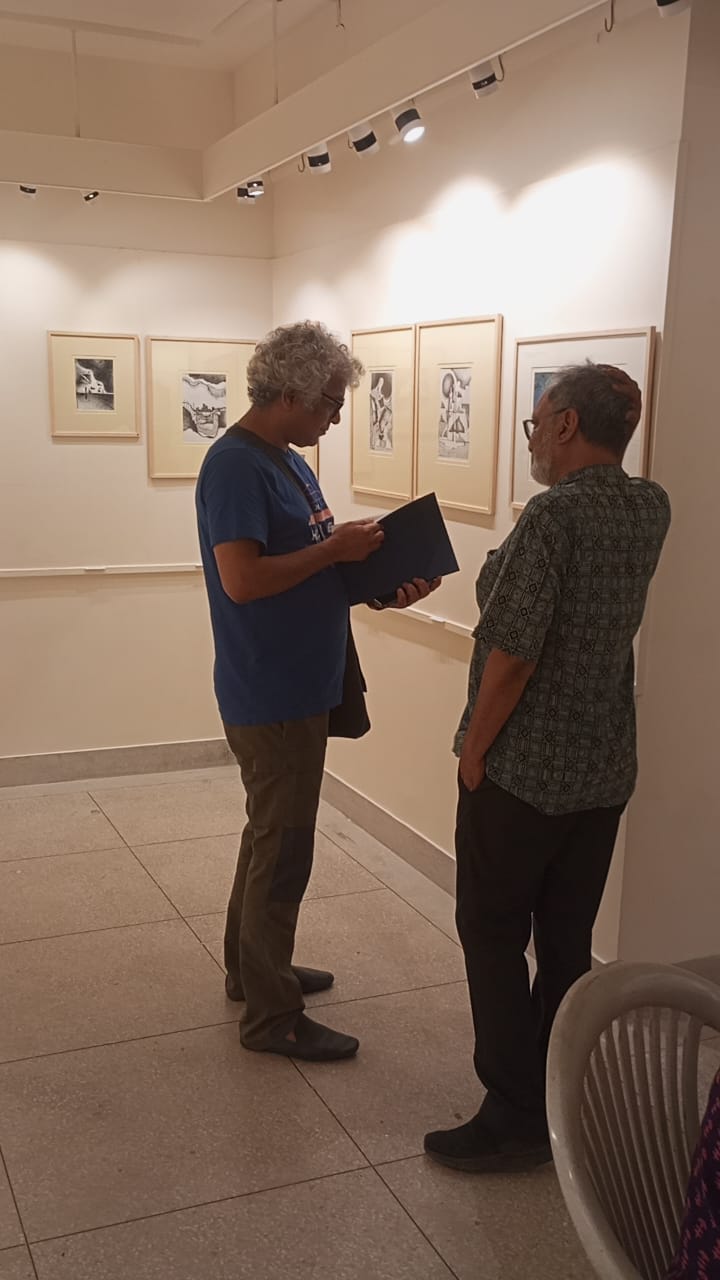
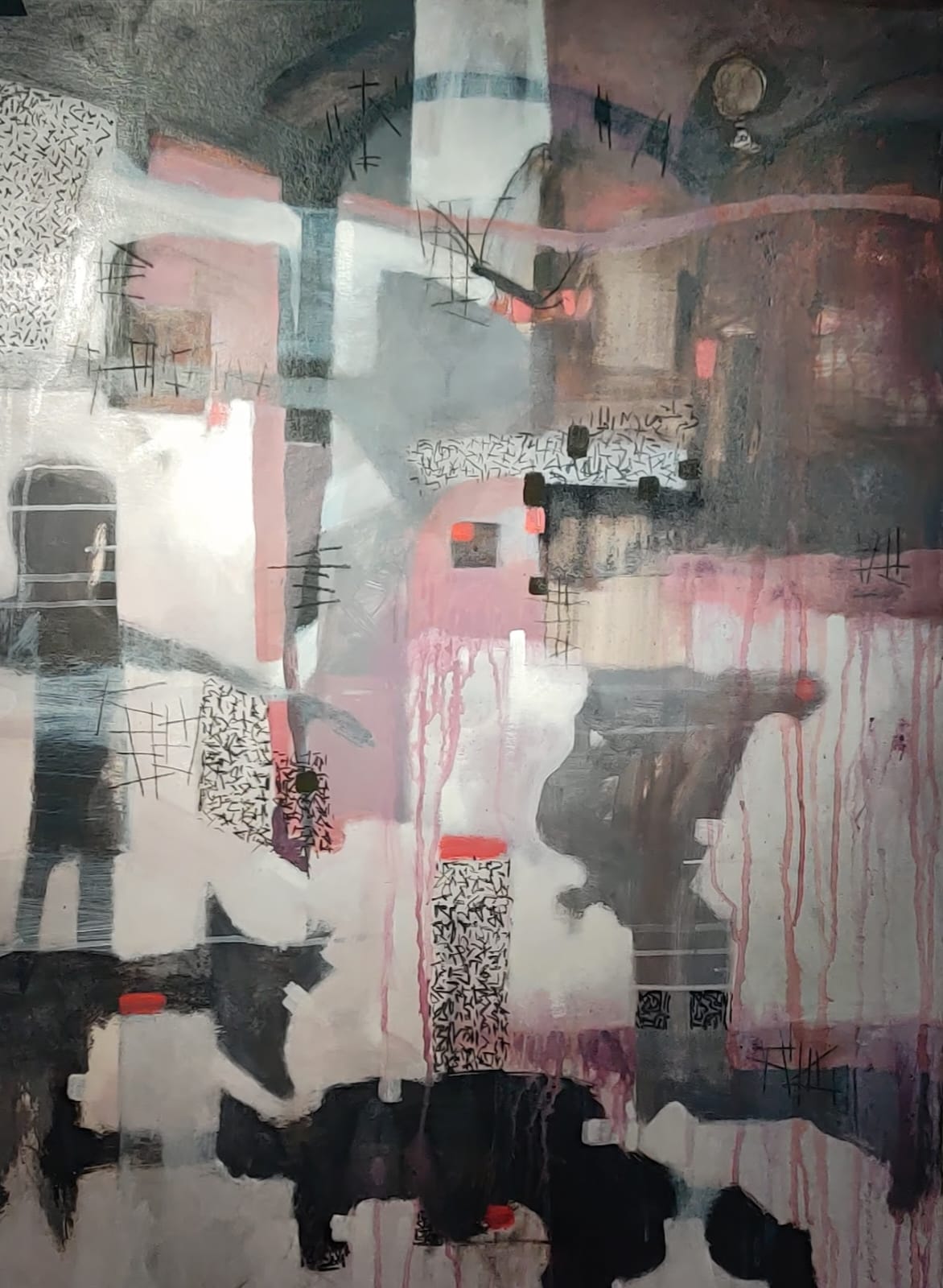
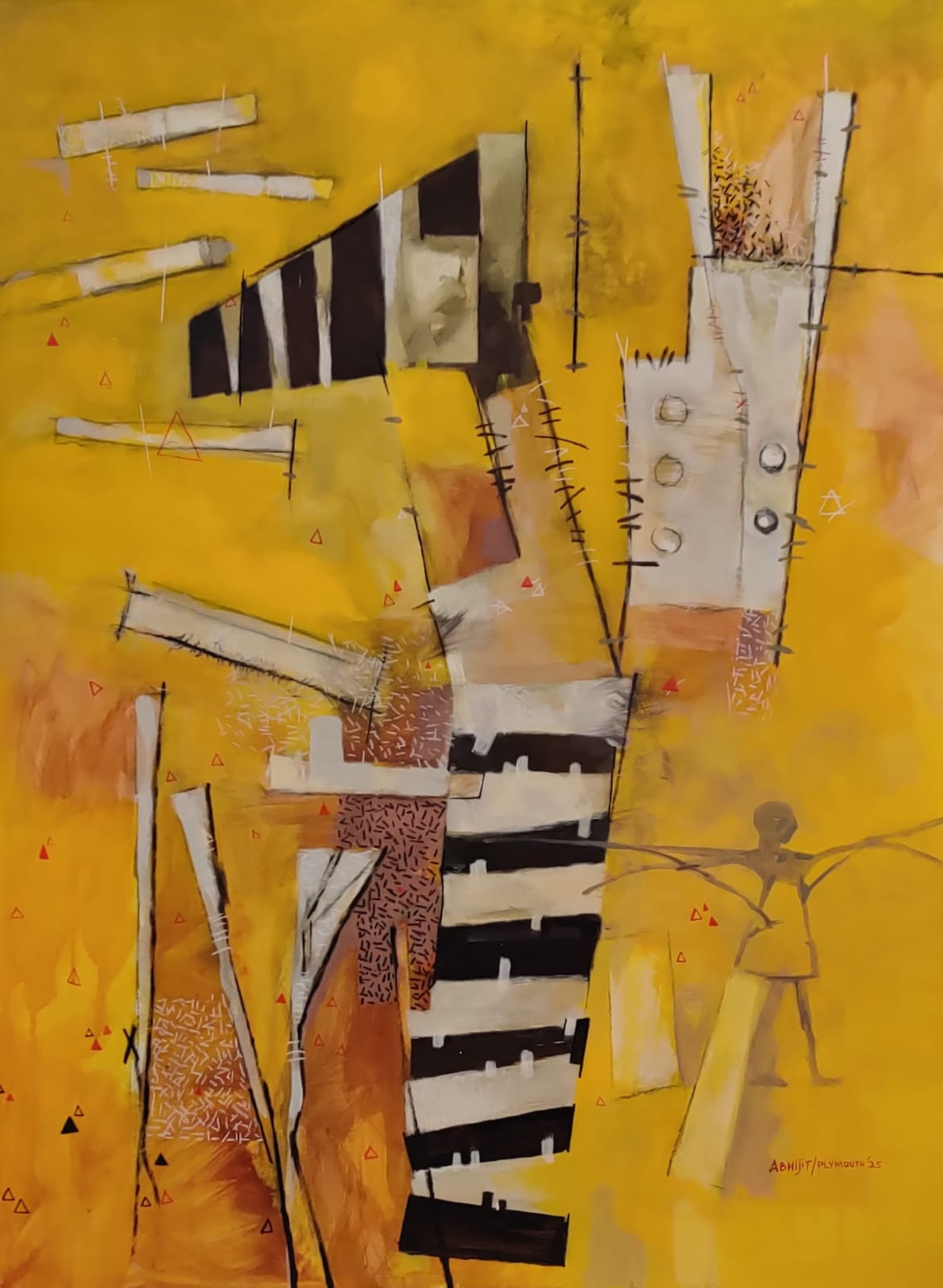
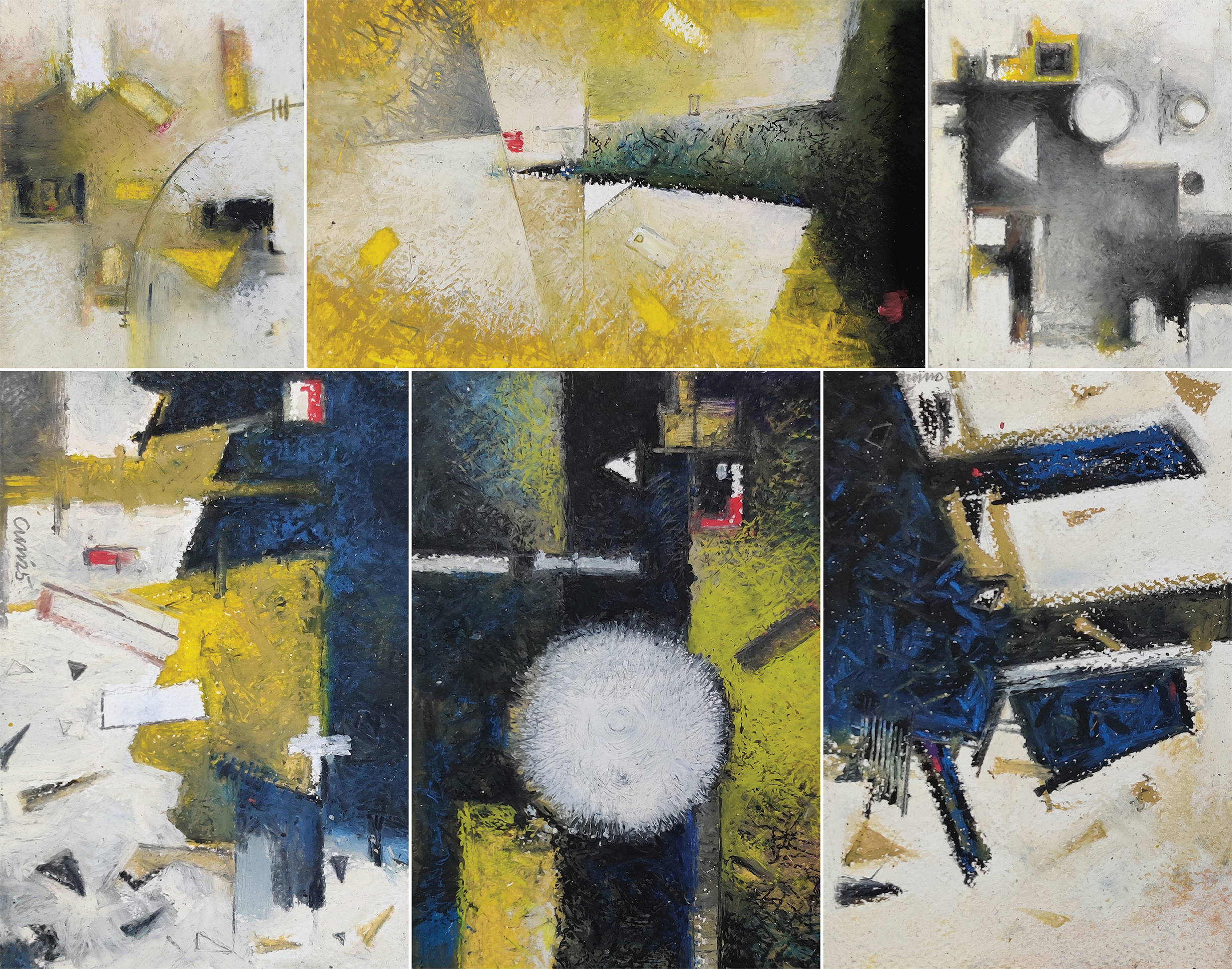
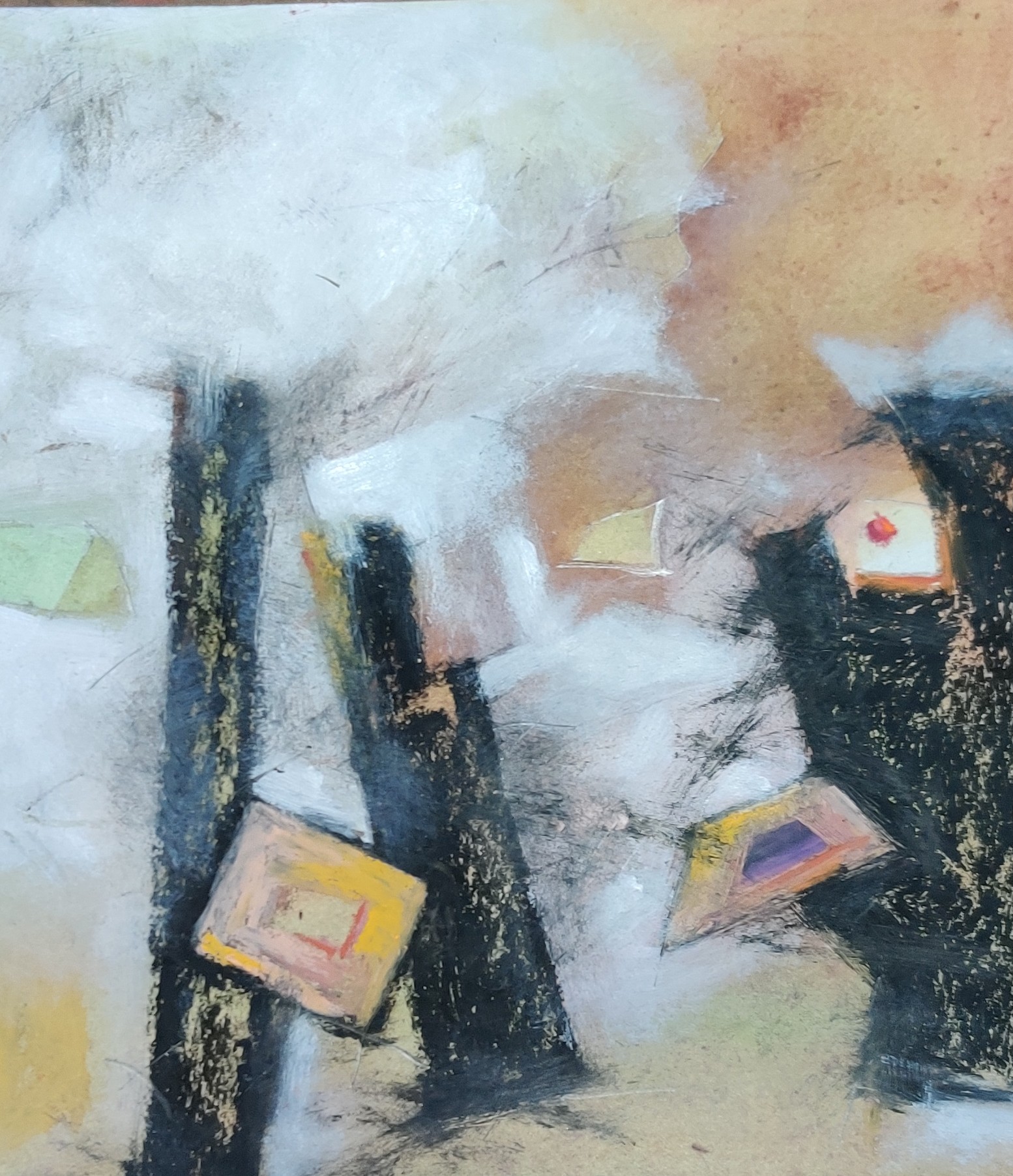
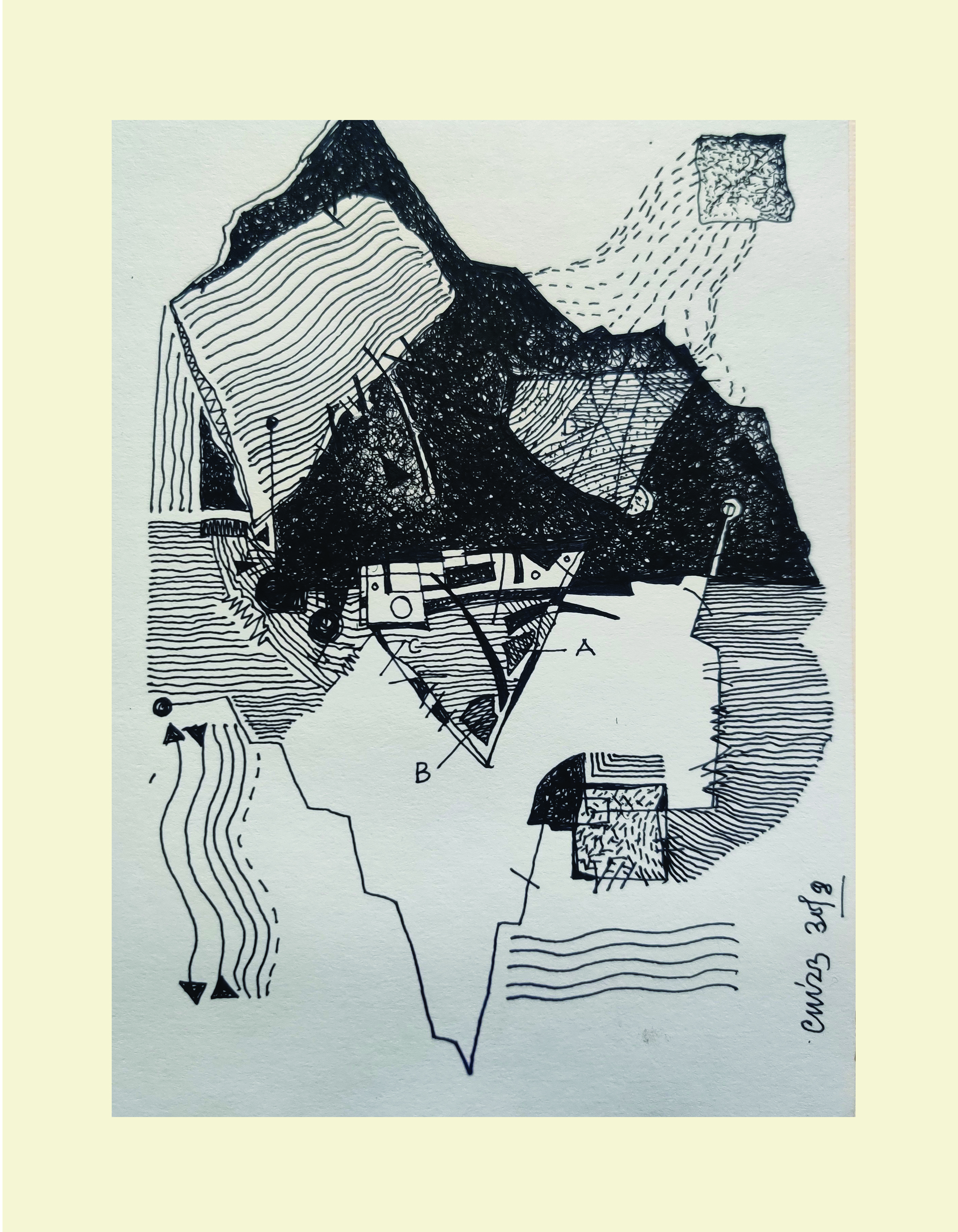
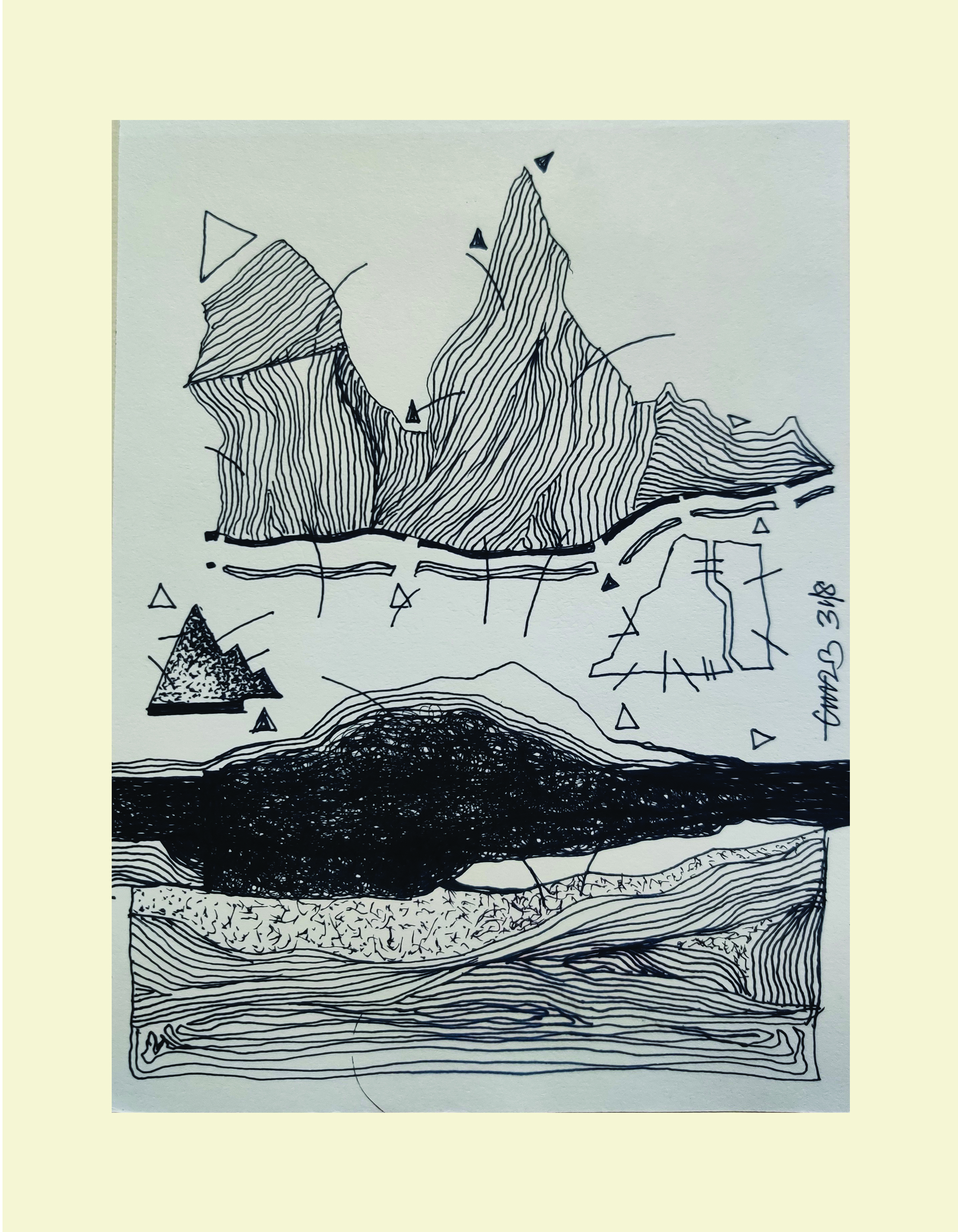
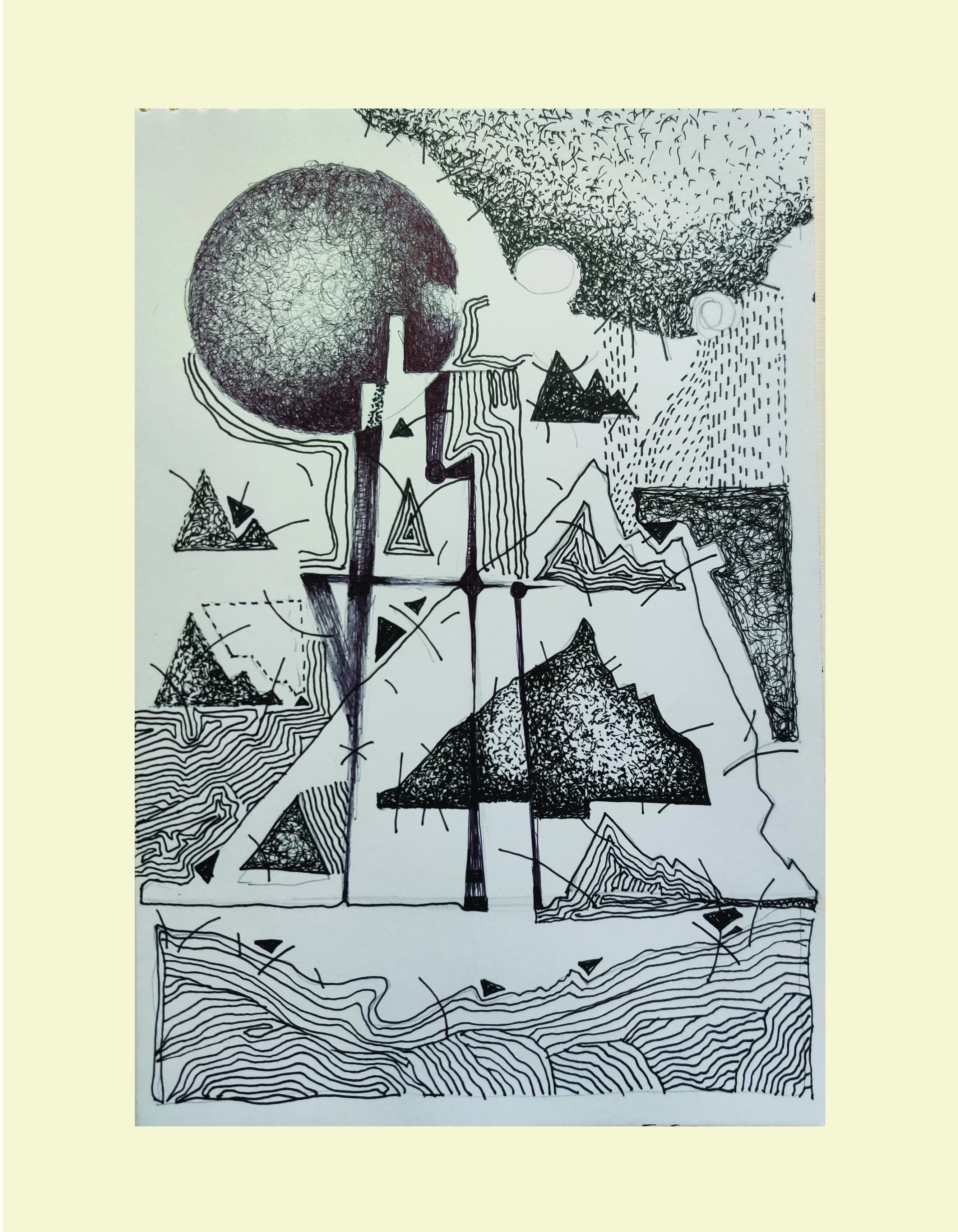
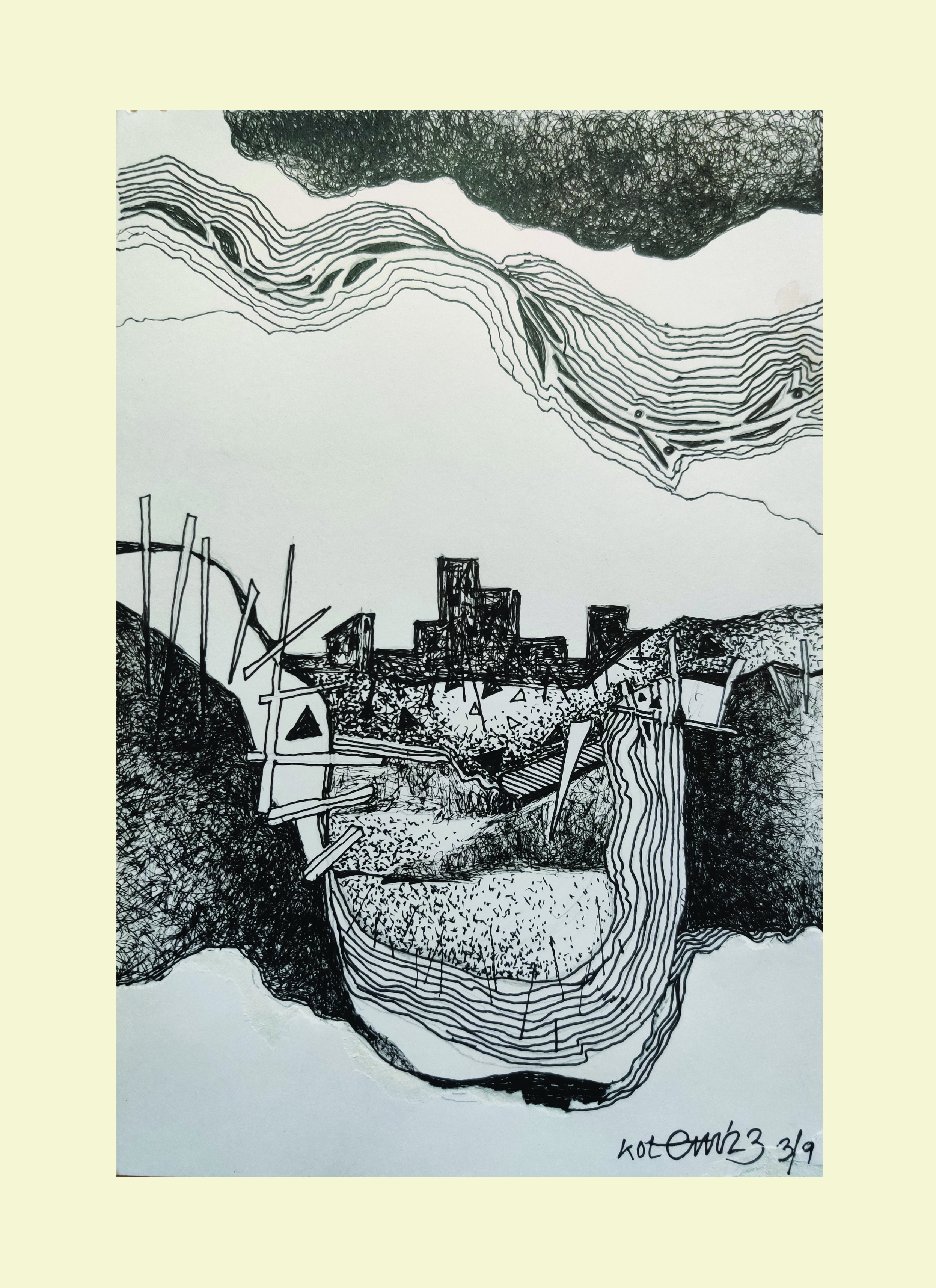
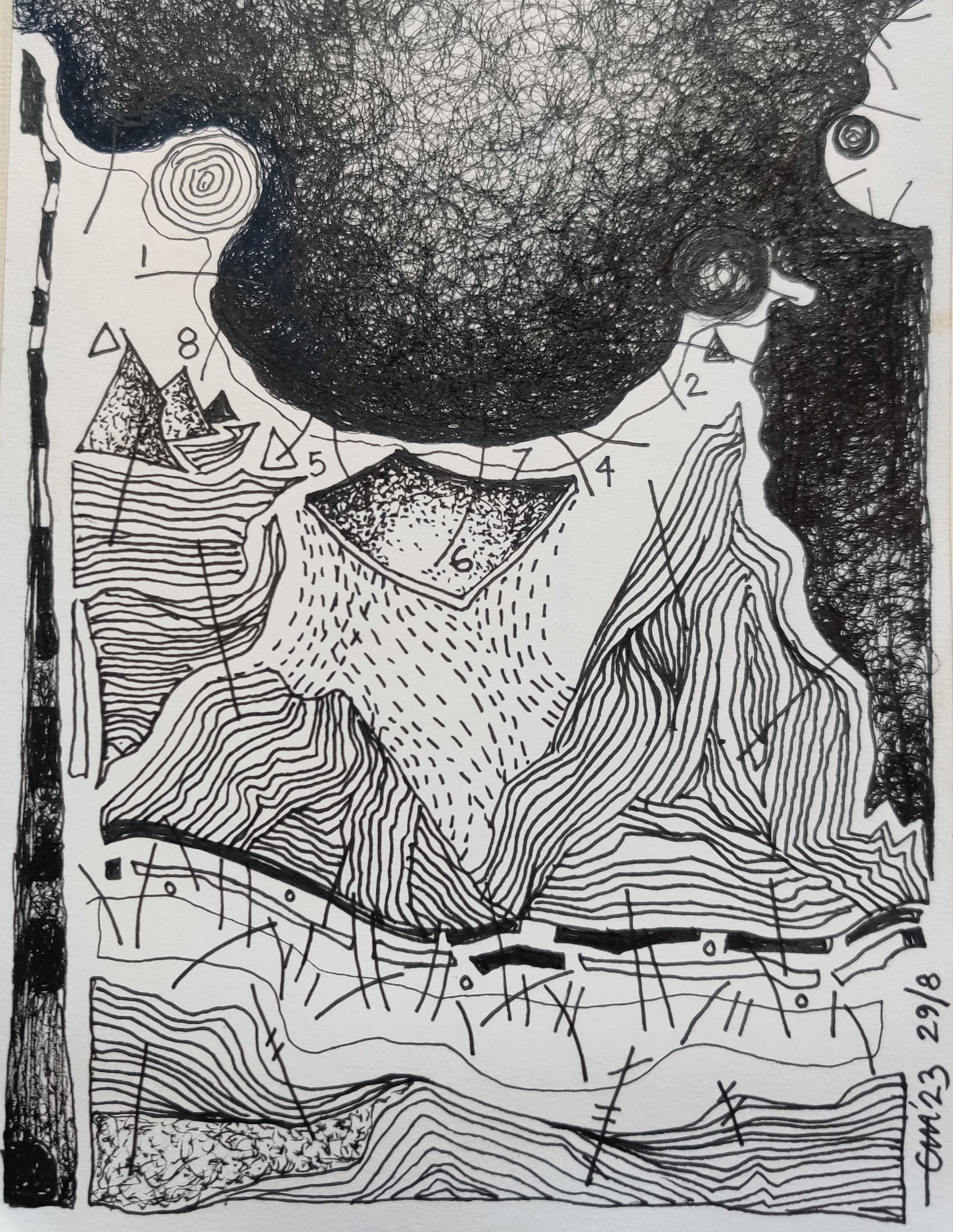
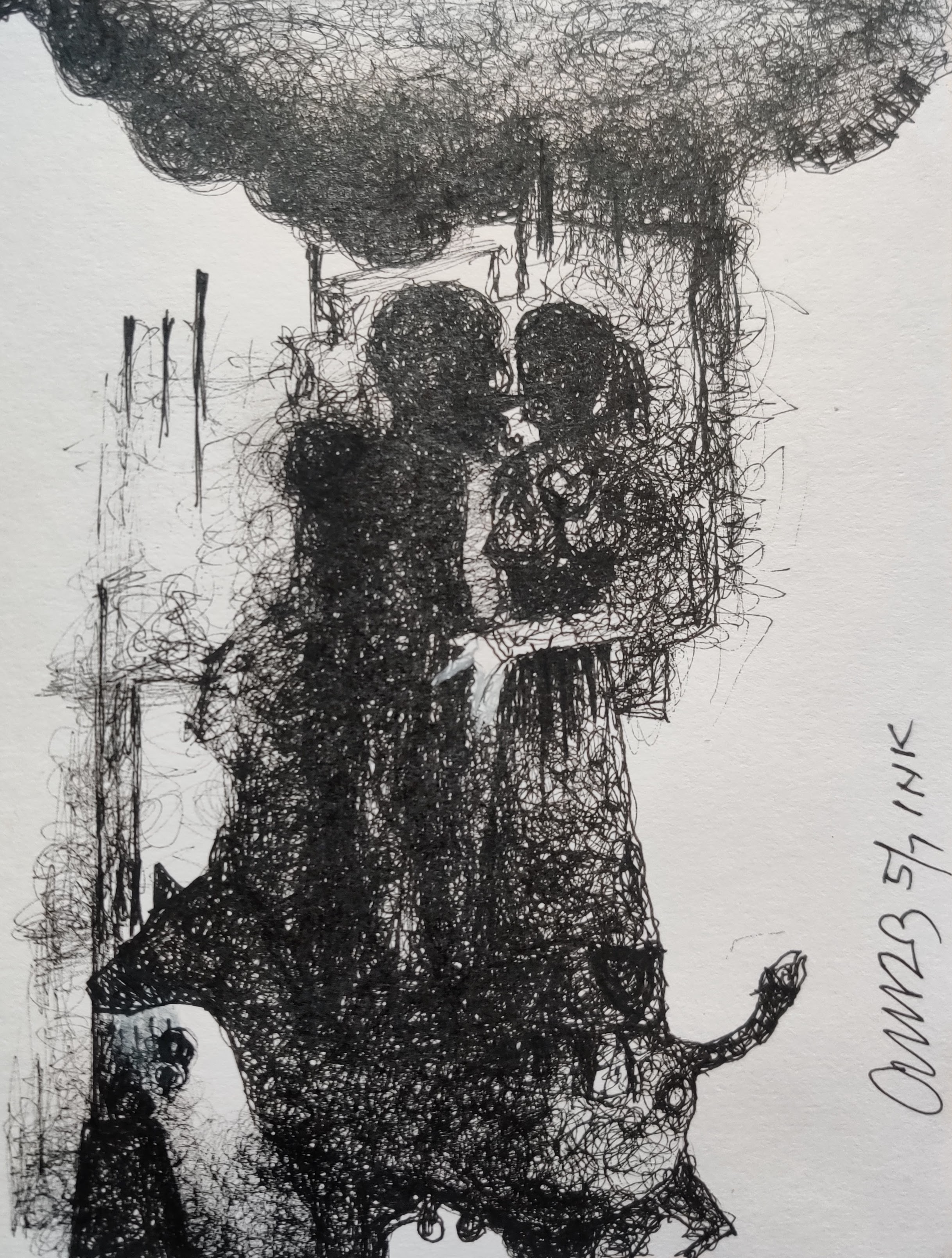
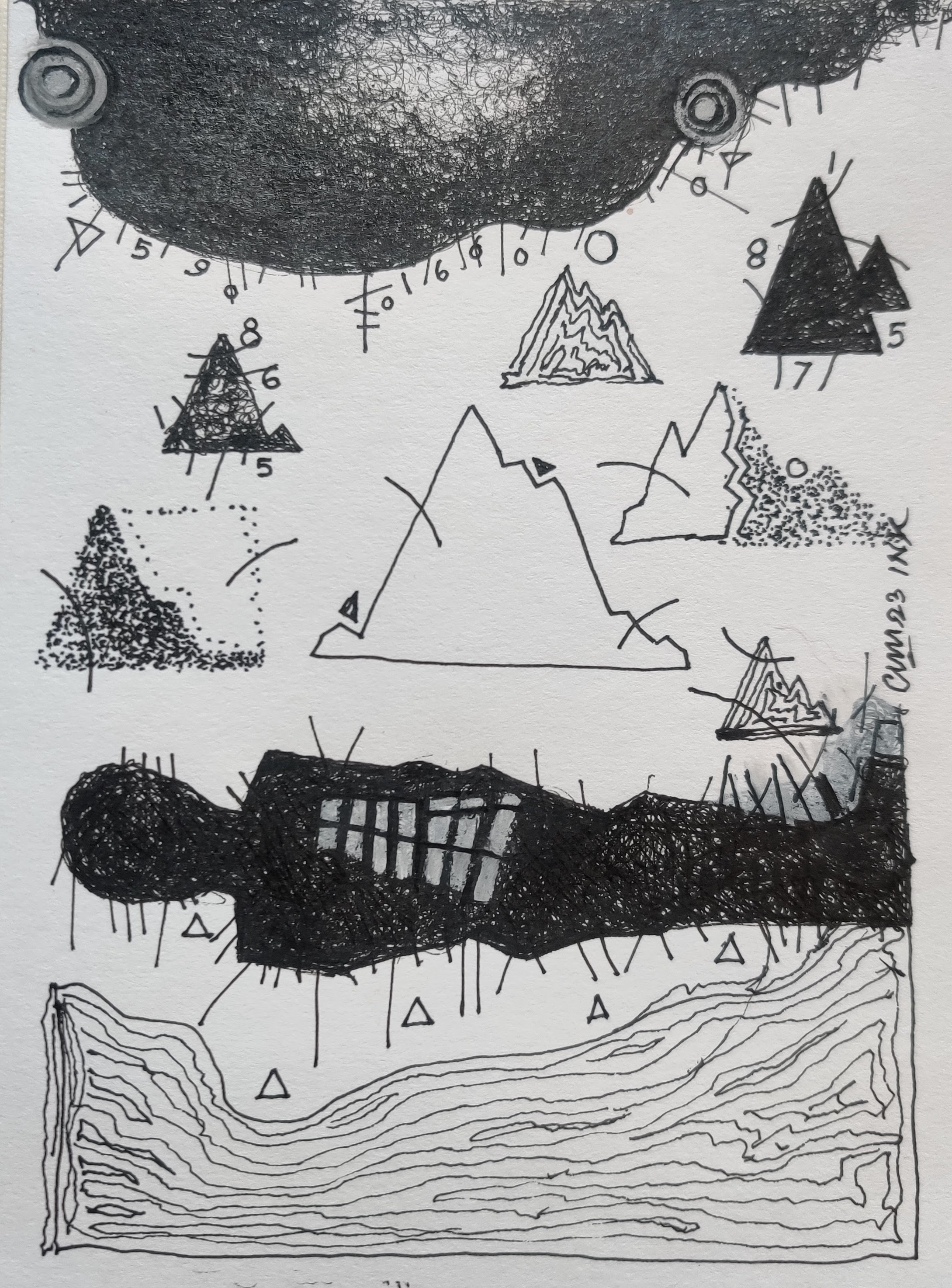
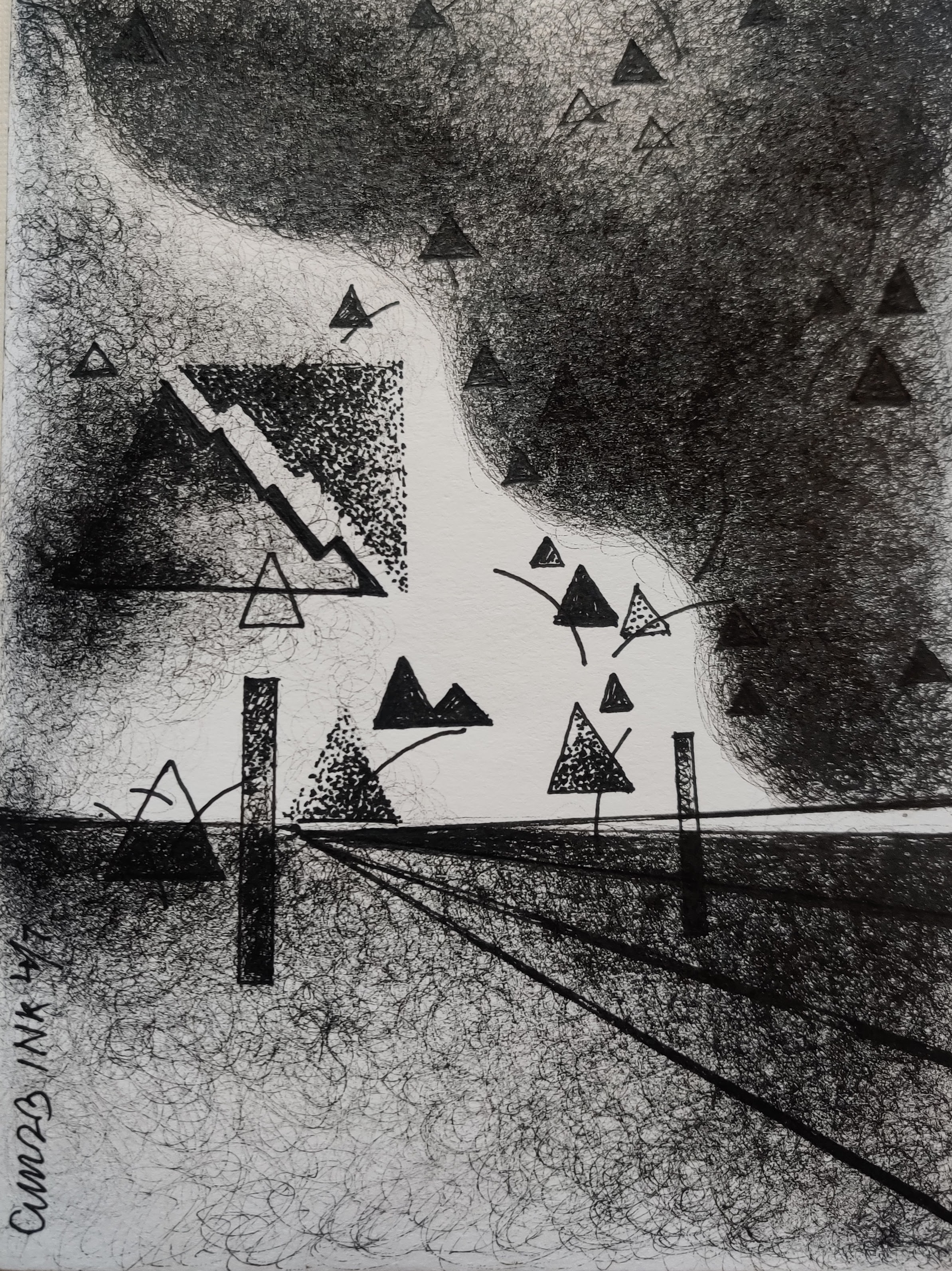
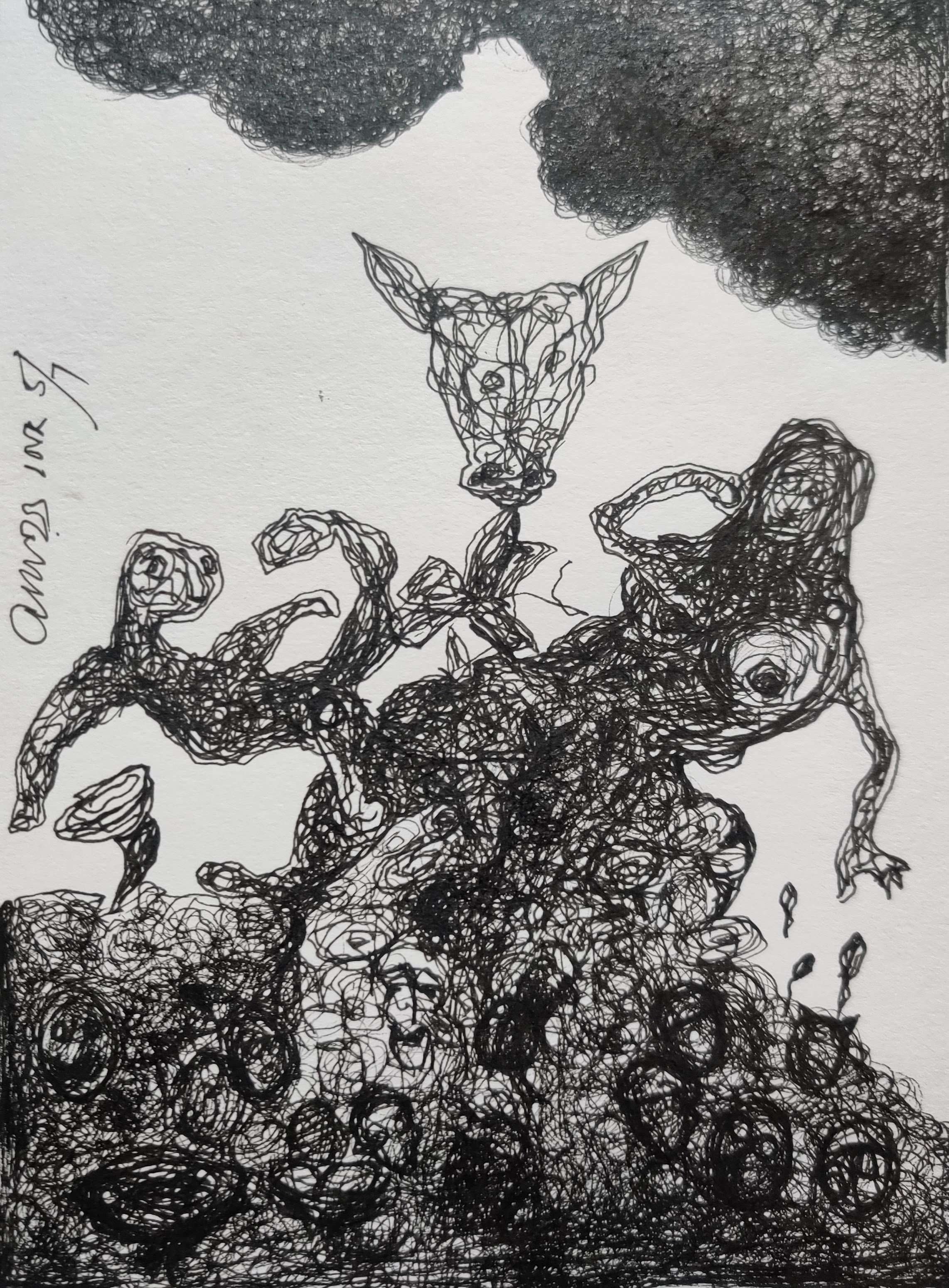
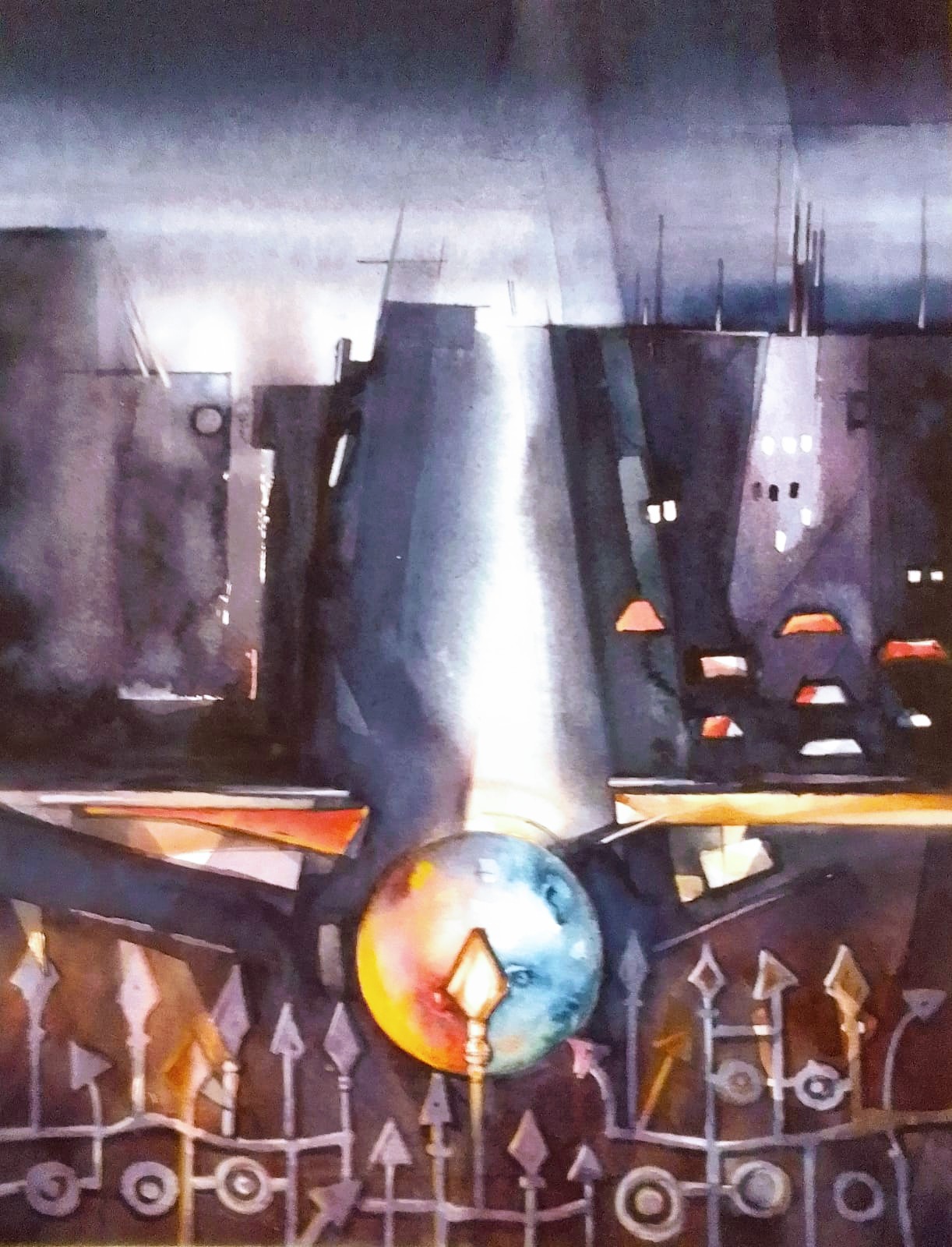
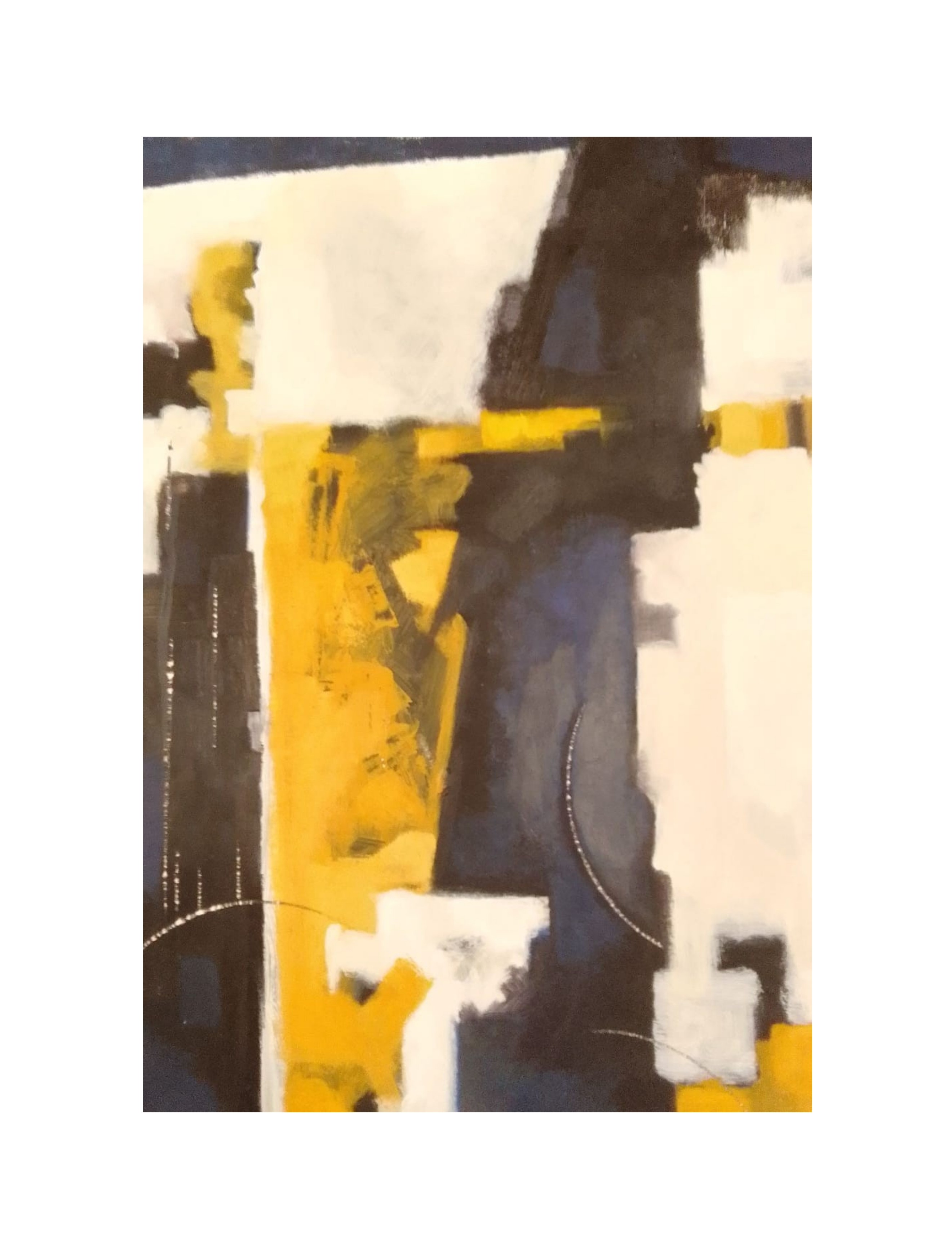
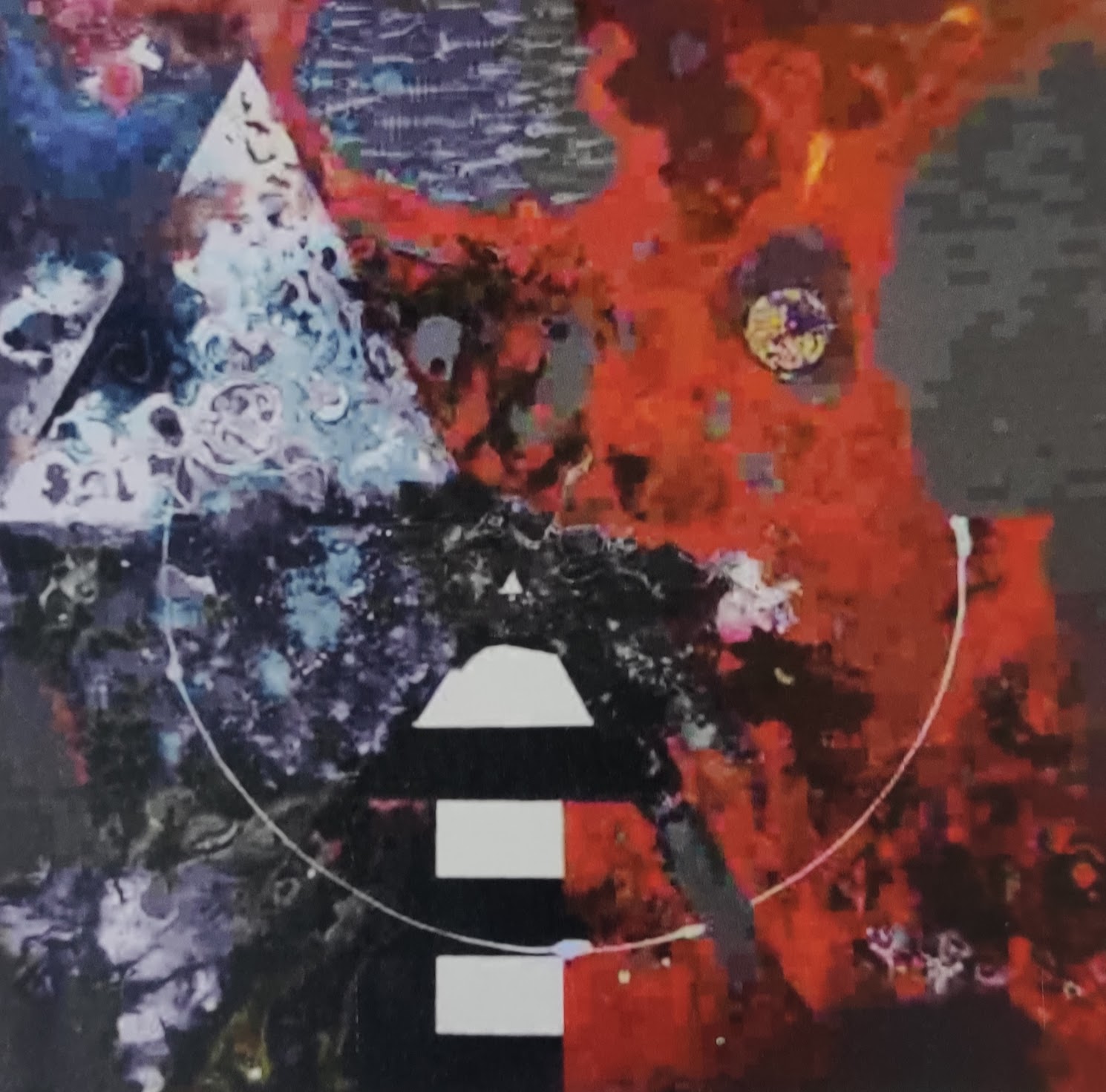
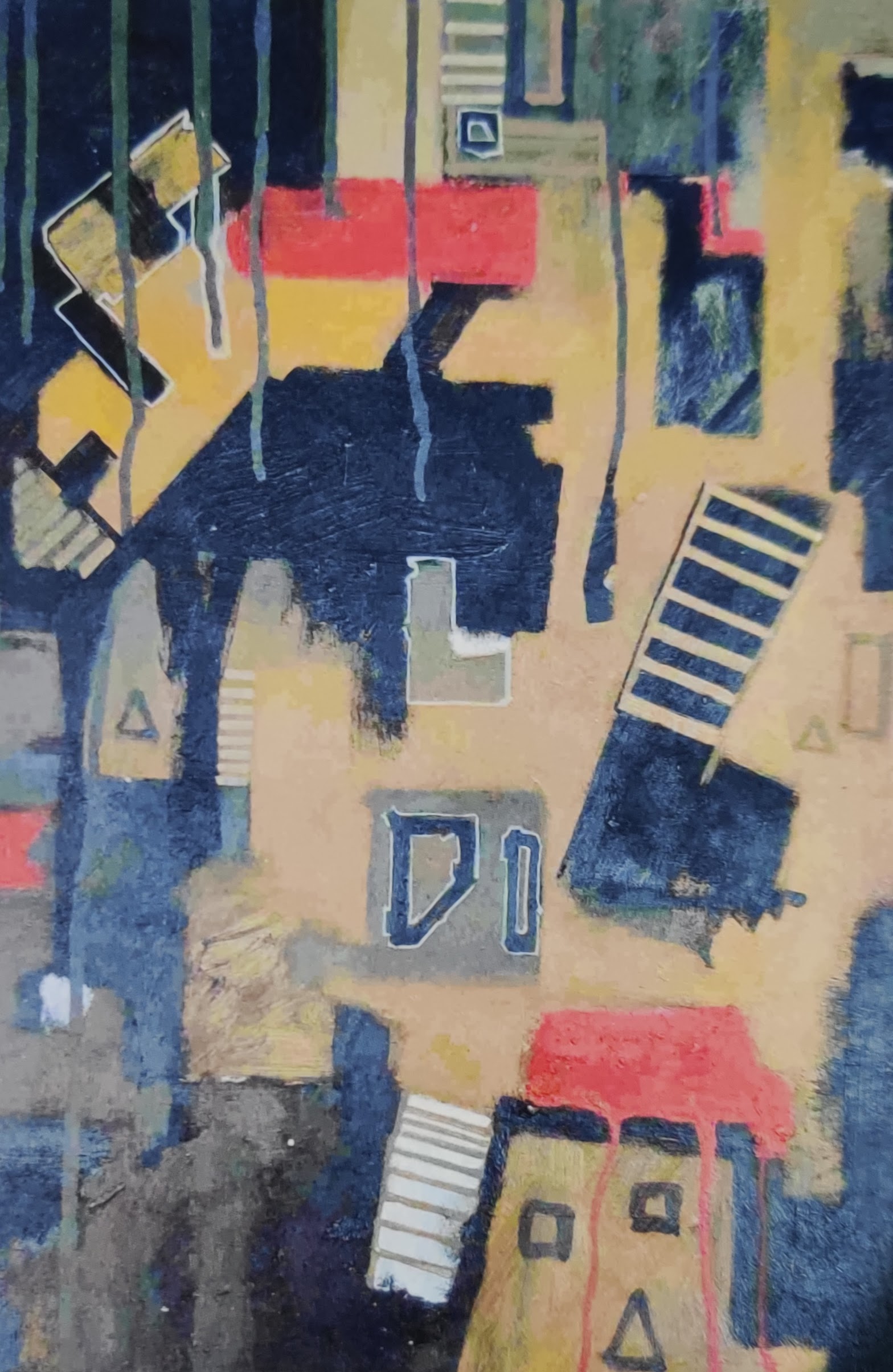
Chaos and ConflictIn the ‘Chaos and Conflict’ series, Abhijit does a series of abstract works, barring two with recognizable figures. These black and white drawings are largely made of lines, arrows, geometric shapes creating forces and movements. They are stark images reminding one of drawings of brutalist architecture. Like in brutalist architecture there are no facades hiding the skeleton of the building. This makes arrows and lines conjure an atmosphere of war and mayhem. There are two drawings with figures, one of dead children wrapped up like mummies. The cruelty of deliberately killing children is starkly represented in outline figures and lines. Finally, we find a man, seemingly dead, lying on a bed of arrows much like Bhishma in the war in Kurukshetra.
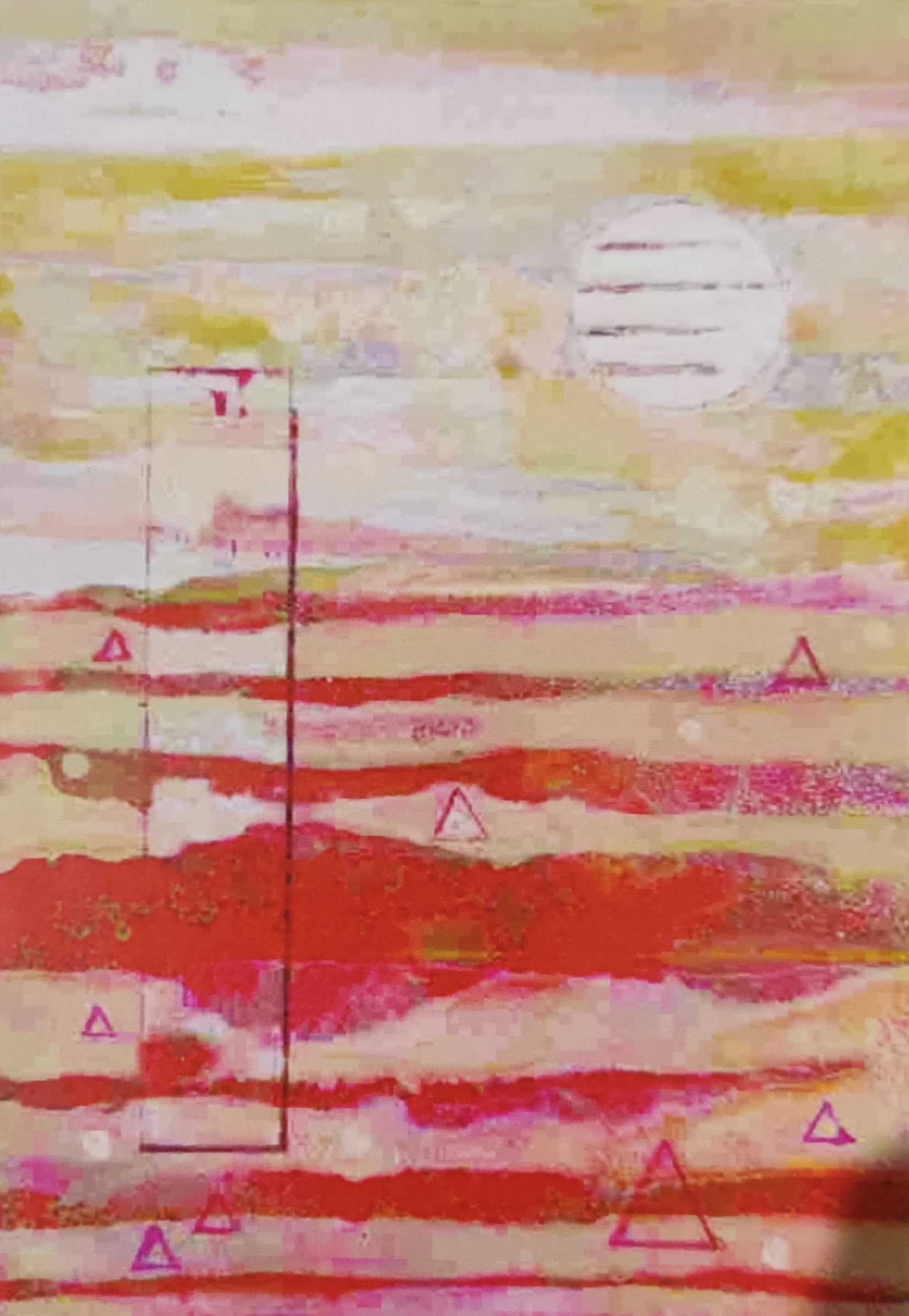
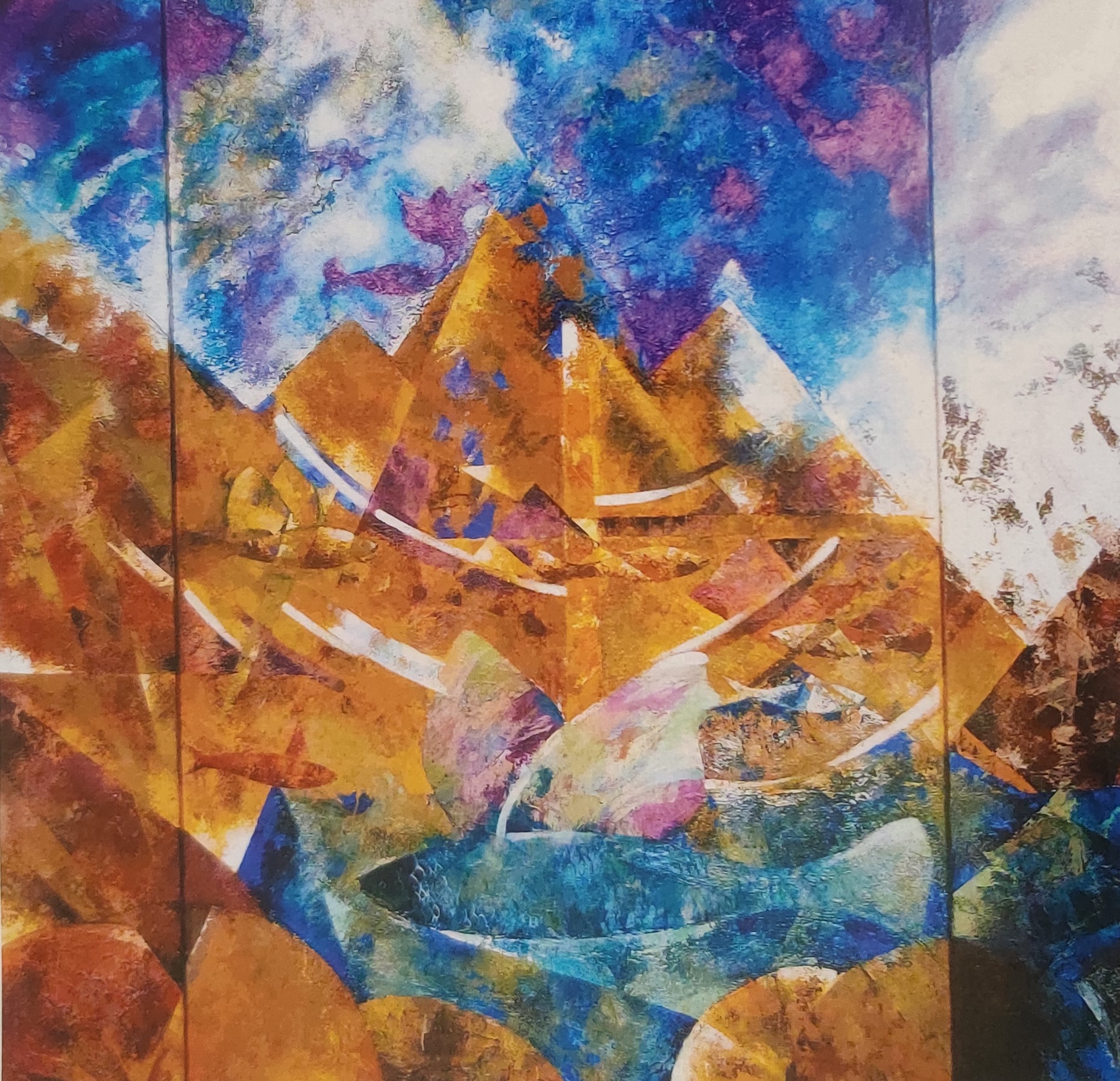
There is a lone work of abstraction done in colour which is packed with an intensity and movement of violent forces, which only happens in a war zone.
Art and ways of seeing the world.We had earlier seen that following Emily Carr, Richard Brettell looks at art as a way of seeing the world. Great art offers us new ways of seeing the world or aspects of it. Artists’ ways of seeing the world is not merely a sensual activity, nor is it an exercise in the unbounded play of imagination; it, of course, includes both, but there is more to a simple sight. Marina Warner has, of late, forcefully argued that both reason and imagination work together in art and in knowledge. Thus writing on art has to evocatively bring out the allegories, symbols, ideas and meanings through interpretation and reflection. It is an occasion for serious thinking. Such interpretation is not limited to evoking aesthetic pleasure. It makes art discursive, where thinking is expressed in a visual language. Of course, it gives aesthetic pleasure, but one mediated through intellectual reflection. Critics have to engage with this visual language, which has the possibility of new ways of thinking.
There is also a deep moral perspective in serious art. It arises from the sense of being responsible or taking responsibility for what is happening in the world. There is considerable talk of the responsibility of intellectuals and the importance of pubic intellectuals as the conscience of an age. This role extends to artists as well. However, exercising such responsibility often turns art into propaganda. Thus it is a very difficult path for artists to tread and it is to Abhijit’s credit that he has been successful in this endeavour.
Abhijit has evocatively written a visual language history of the contemporary world bringing to light the other side of the great story of universal human progress – the advances in knowledge, science and technology and a global economy driven by knowledge and power; the march of reason; the glory of the nation state and the supremacy of the rational and atomic individual. The world offers us many sights like, progress and the plight of the lonely and alienated individual, which is often the subject of art. The major critique of this worldview was argued by Marxists; their perspective was also grounded in the idea of progress, but unfettered by the limits imposed by capitalism, individualism and the nation state. There has been two other critiques of progress, one launched by ecologists who have shown how our knowledge, power and greed has led to human induced geological changes popularised by the idea of global warming and climate change. It has resulted in the extinction of a large number of life forms and is even threatening human existence. Wars, national power and capitalism is central to the making of this global disaster. A large body of empirical and theoretical literature has emerged to bring to our notice the other side of progress. The other moral critique is by Gandhi who prioritised love and care over self- interest and upheld the virtue of non-violence.
There is very little work by artists, especially in India, to address the destruction imposed by genocidal wars backed by the forces constituting progress. Abhijit Mitra is one such pioneer who has ventured to engage with this contemporary history through his visual language and various representational devices. Gaza is a tiny patch of land where Abhijit finds these forces of violence and evil compressed, offering us the essence of the global genocidal present. The problem with most scientific studies, including the social sciences, is their silence on moral issues, especially the central question of justice.
Human beings are not only sensual beings who are rational; humans also have a strong intuitive moral sense, which enables even a child to react to obvious acts of injustice and violence. Even the greatest moral philosopher of justice, John Rawls fails to address the injustice and acute scarcity existing in most parts of the non-western world; yet he claims his theory to be universal. The pathos and tragedy invoked in Abhijit’s art initially shocks us, but soon evokes in us the grave injustice in this all out destruction of a people and its civilisation. This ethical dimension of his art springs from his way of seeing and understanding the world. Thus his landscapes or cityscapes of total destruction are more in the nature of mindscapes, involving a conceptual cognition of the world. This novel kind of conceptual art is very different from the standard examples, starting with Duchamp’s Fountain or Rene Magritte’s This is not a Pipe. Almost all conceptual art is done in a style and medium having no connection with modern art. Abhijit’s conceptual and ethical representation of the world is done in a modernist language, making it distinctive. The primal themes of death, suffering and destruction is evoked without figures of dying or suffering human beings.
Abhijit is a passionately committed moral witness of what he sees is happening in the world today, which is shaping human destiny. It warns us of the consequences of unbridled greed for wealth and power using science and knowledge as their handmaiden. Genocidal instincts are a primal force, based not only on power, but hatred for the other. Modernity was founded on genocides of continental proportions under colonialism first seen in the Americas. Real and mythical genocidal violence can be traced to pre-historic times powerfully depicted by Arun Kolhatkar in his epic poem, Sarpa Satra. These art works not only act as a witness but also calls us to take responsibility for what is happening in this globally connected world. It reminds us of the relevance of Gandhi’s politics and philosophy.
We usually think of war happening between two nation states and their allies; this of course, is an important form of warfare, but genocidal wars against a people and its civilisation have not been wars of this type. Guernica or the Holocaust in Germany involved the killing of one’s own countrymen by building an atmosphere of fear and hate. It is a standard strategy used by fascist dictators all over the world. Civil wars and genocides in Bangladesh or Sri Lanka or Cambodia, again involved killing one’s own brethren. This impending fear of genocide is looming over the horizon of many countries in the world today. Abhijit’s way of seeing and representing the symbolic state of the world expressed in Gaza is not only moving but evokes serious thinking joining the arts and the social sciences and philosophy.
We are passing through a time of unprecedented challenges. A time marred by war,
conflict, disease, death, and chaos. Both Nature and Humanity is under threat. The Free
Spirit is under threat! Man's irrational hunger for complete control over the earth's
resources and his lust for absolute power over his fellow beings are, slowly but surely,
pushing our civilization to the brink of despair, destruction, and eventual extinction. In
every possible way, greed and power politics have subverted the rationale for sustainable
progress and democratic ideals.
The situation is, no doubt, a very complex one.
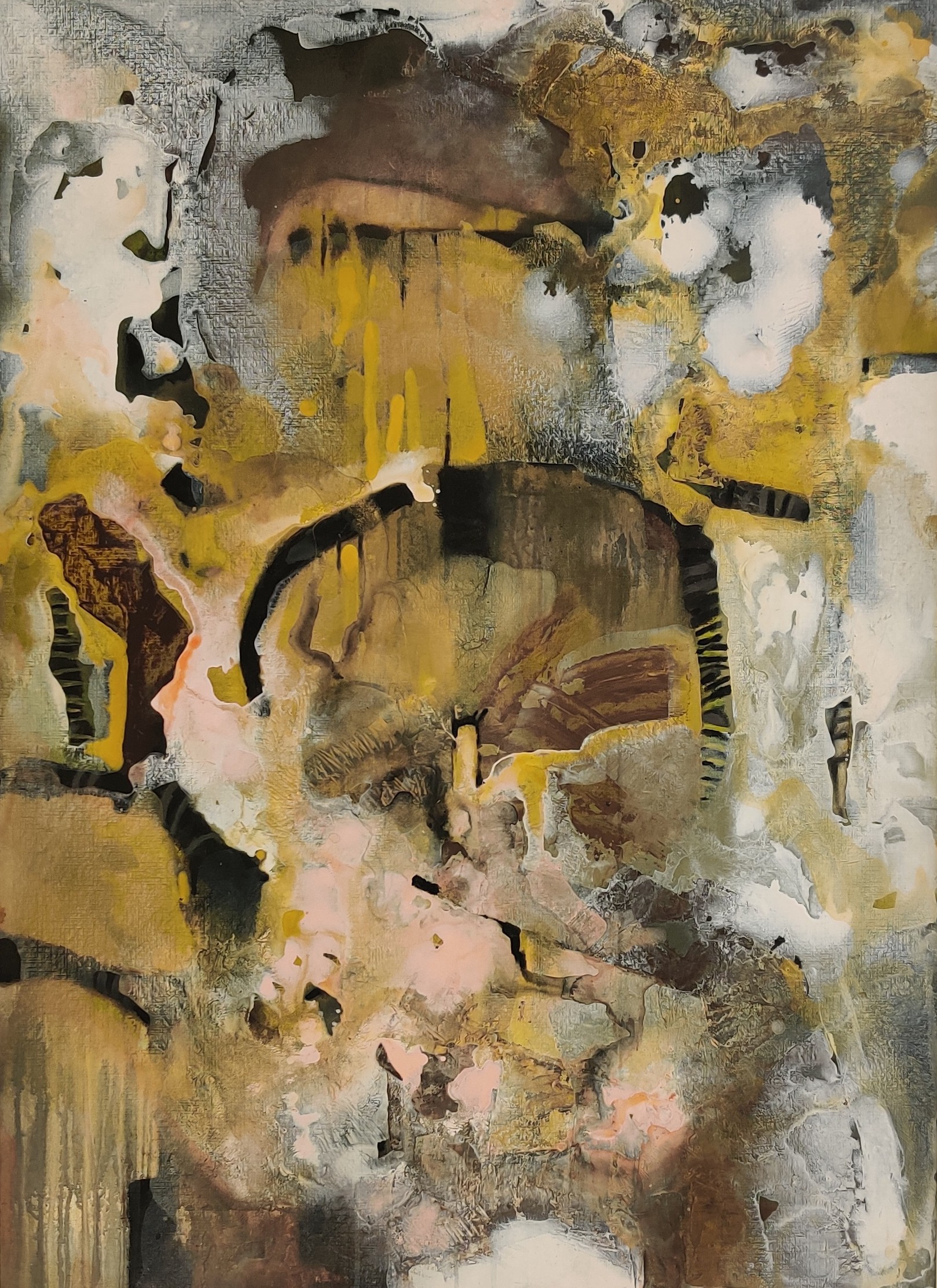
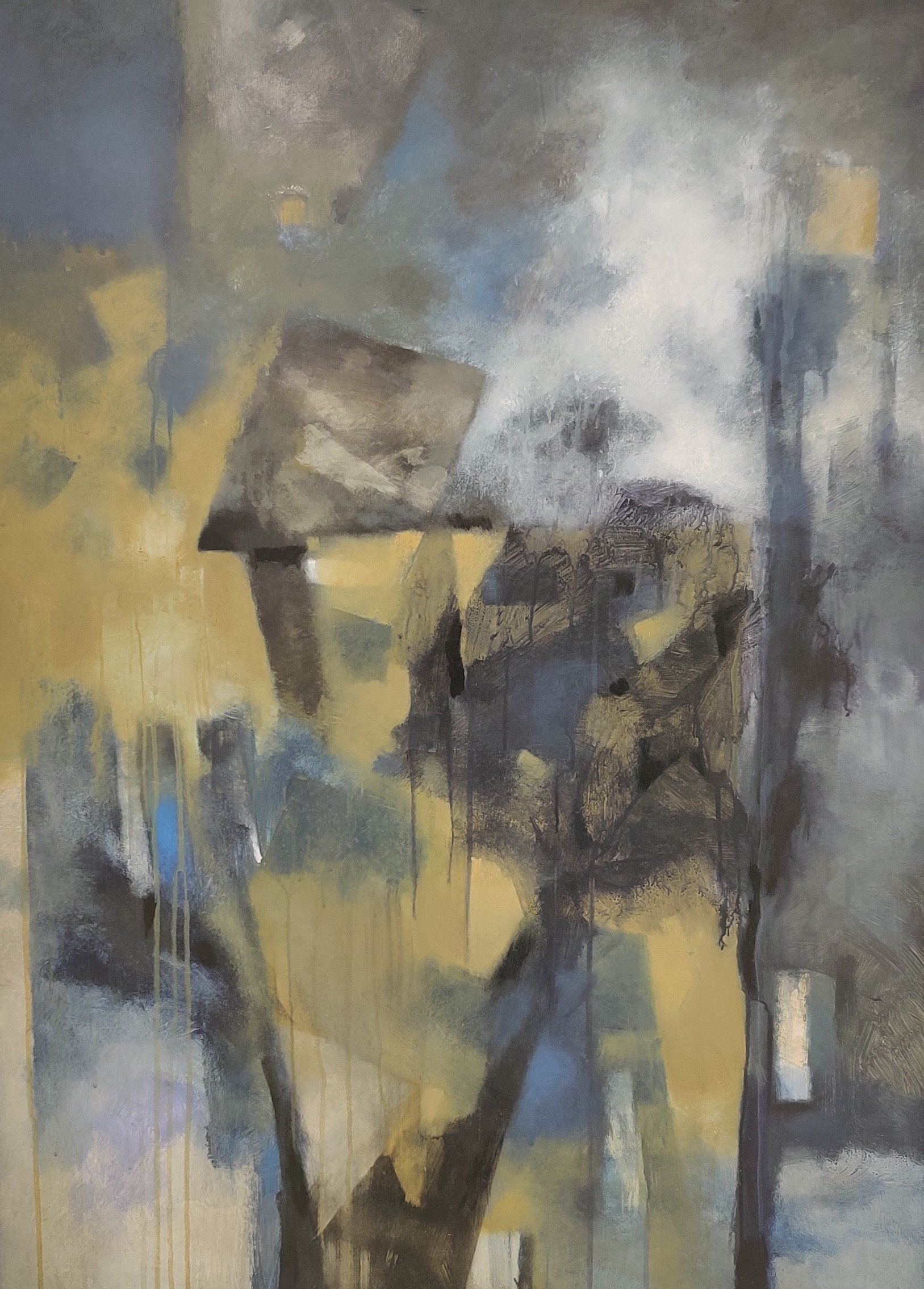
From the perspective of a painter, I view these complexities echoing chaos and conflict, as
rich sources of inspiration. The interplay of disorder and tension serves as themes of
personal expressions for me. It enables me to explore the emotional and societal dimensions
of chaos which essentially is a manifestation of the indomitable soul that exists in Nature
and in every human being, who refuses to be shackled.
However, I continuously try to practice physically and mentally to interpret structural
violence in my work through visual metaphors and symbols to convey the systematic injustice.
Through symbolic images the work space becomes a reflection of societal inequality,
capturing the essence of unequal power of dynamics. I try to create a sharp contrast,
fractured compositions or muted colors to evoke the harsh realities. Integrating elements of
resistance and resilience within the artwork which convey hope amid adversity. Translating
the complexities of structural violence into a visual language.
Born in 1961
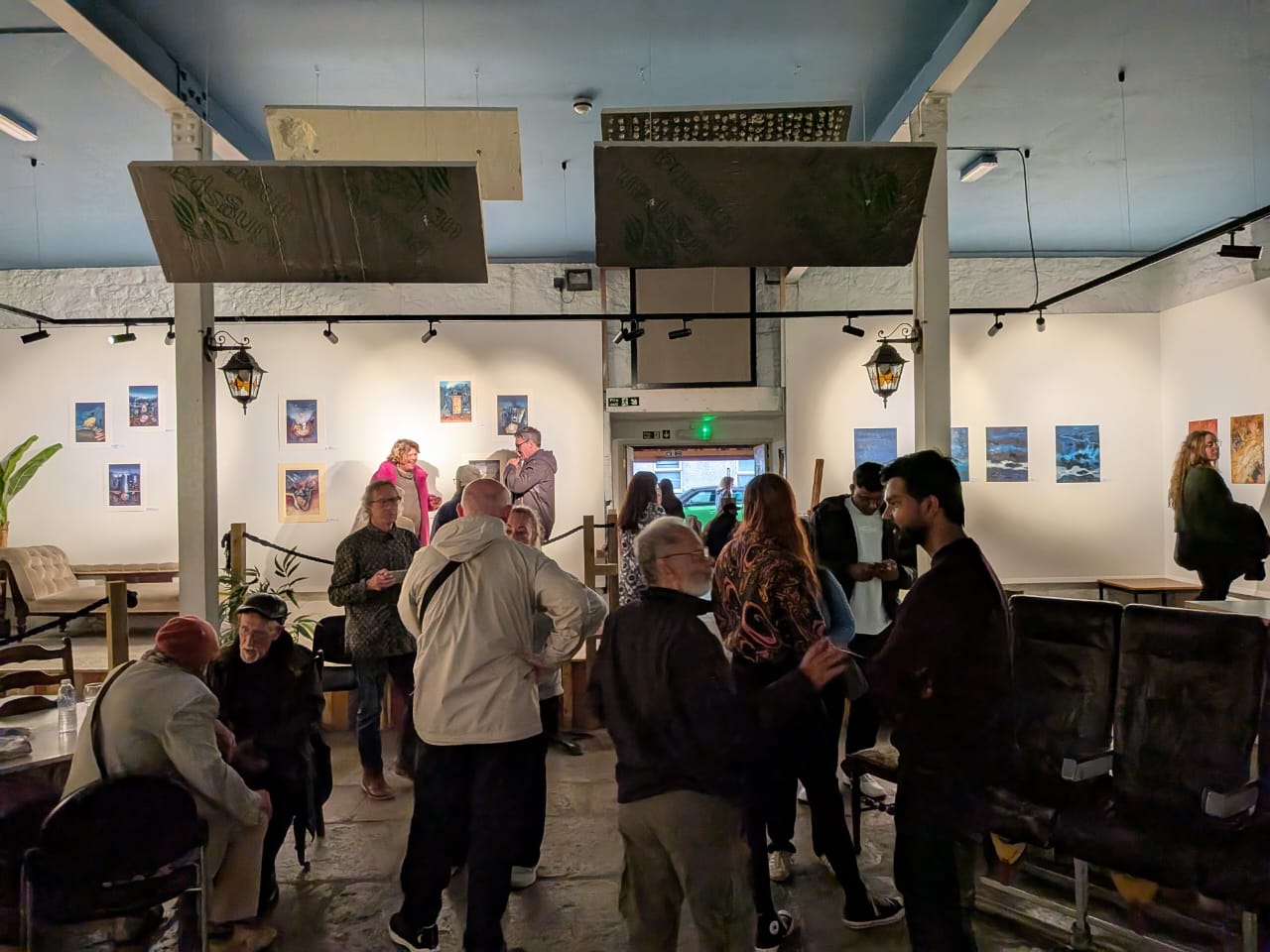
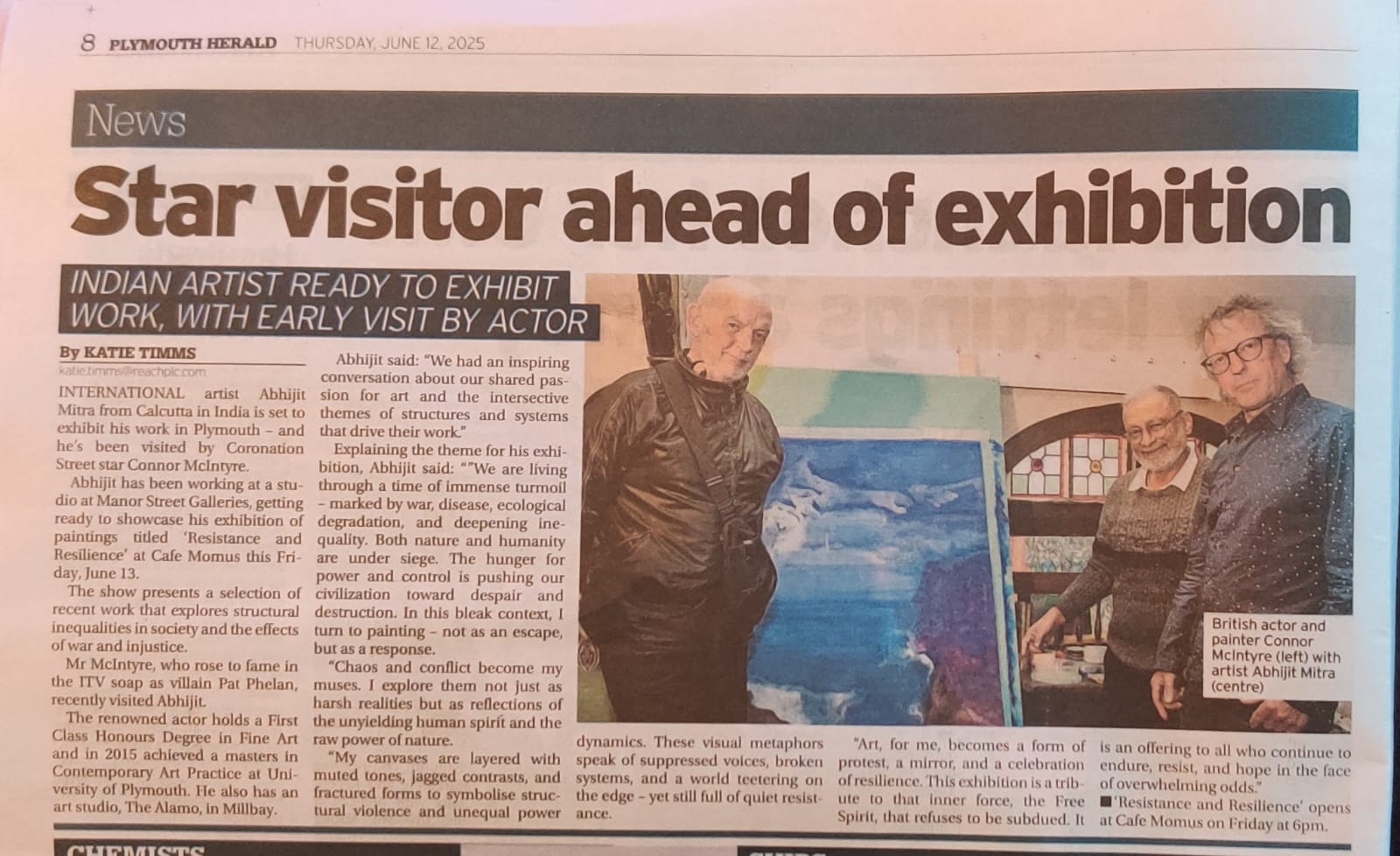
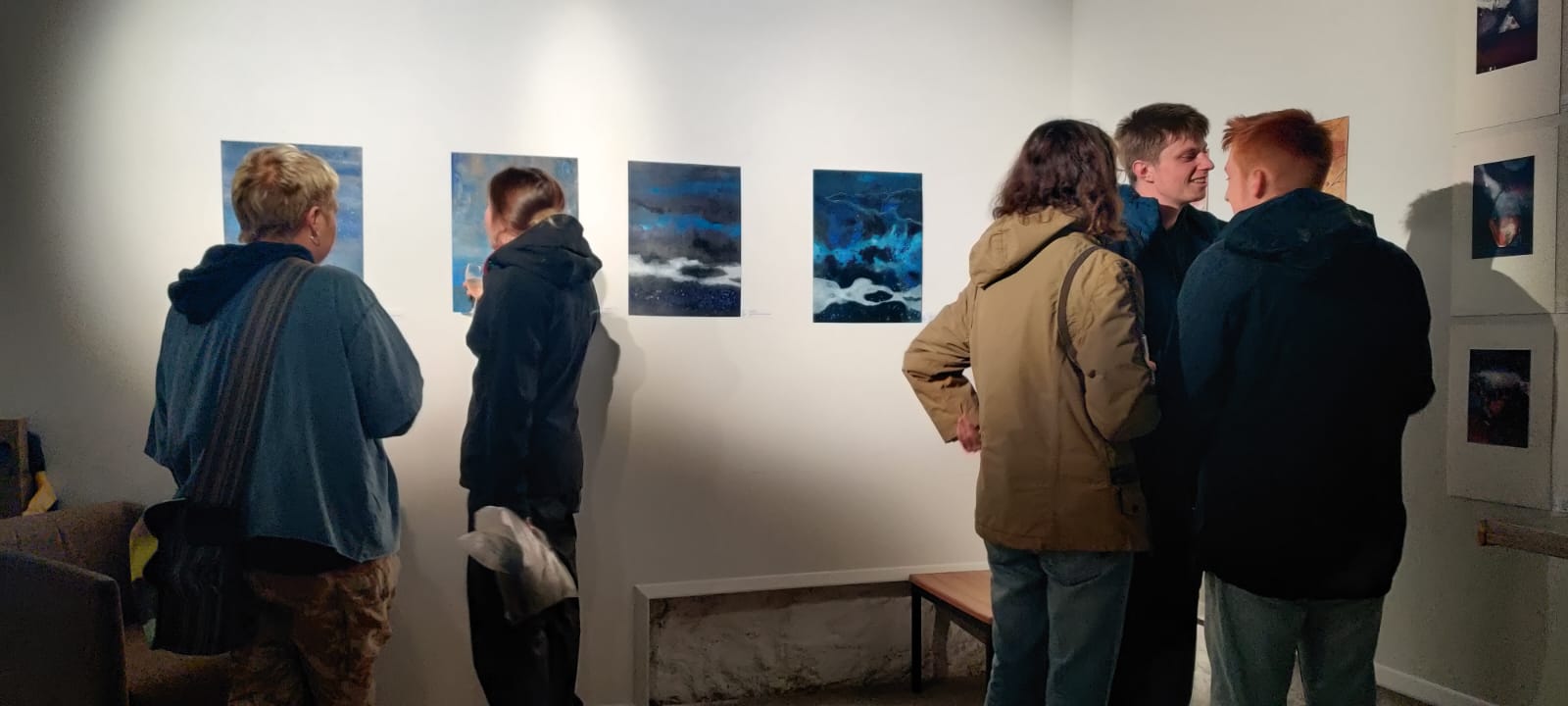
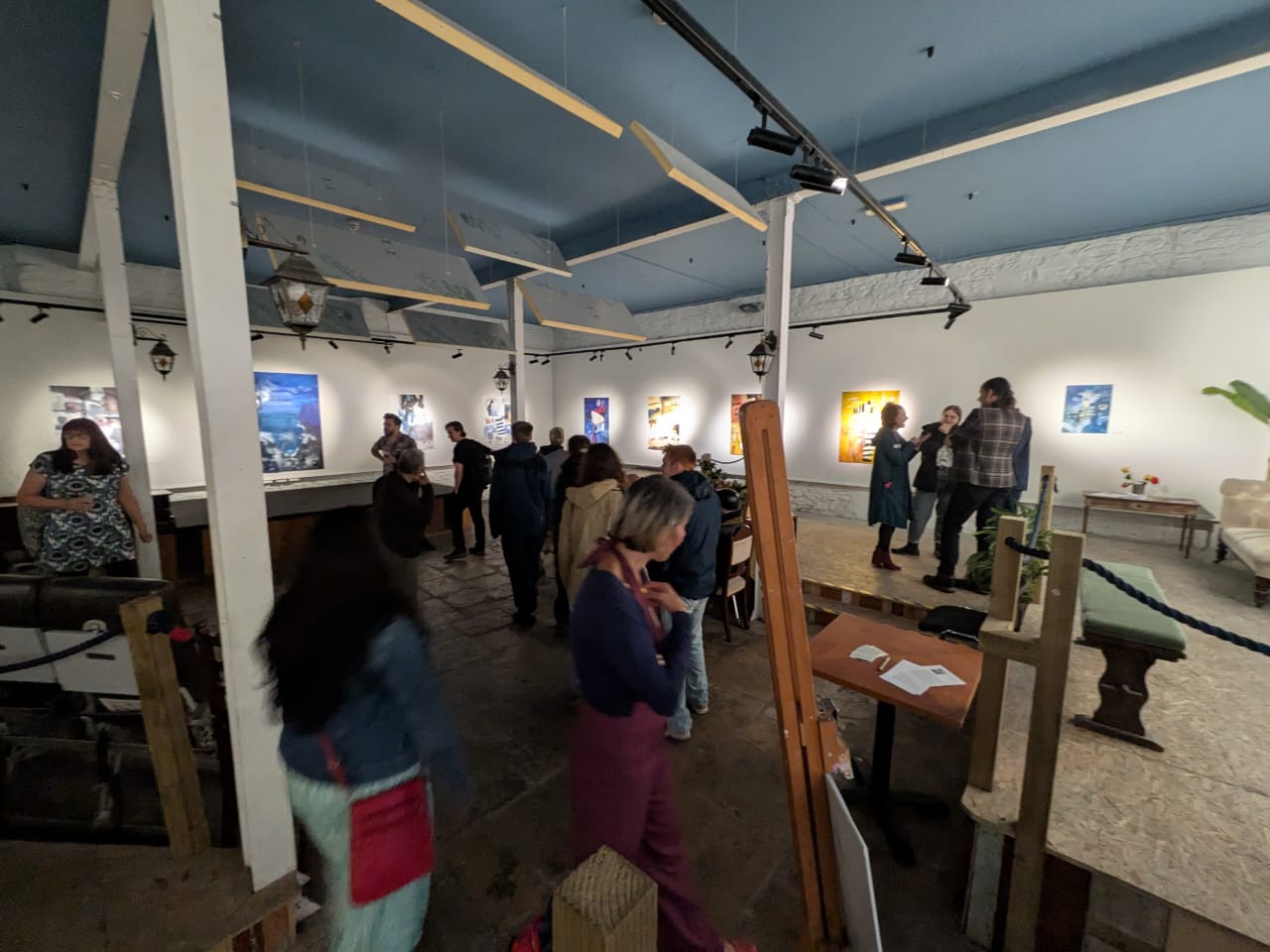
Plymouth, United Kingdom, 2025, Manor Street Gallery- “Resistance & Resilience”.
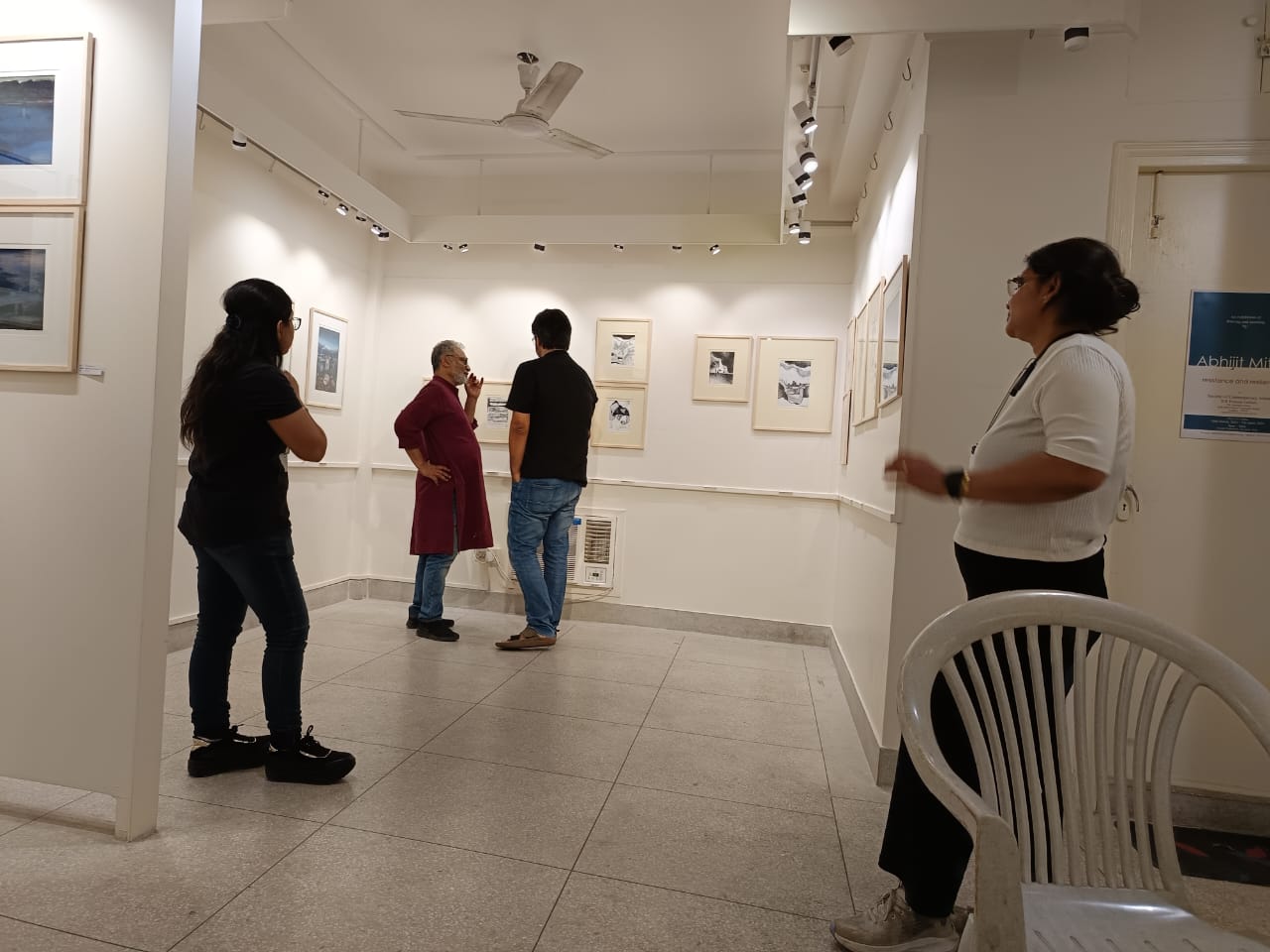
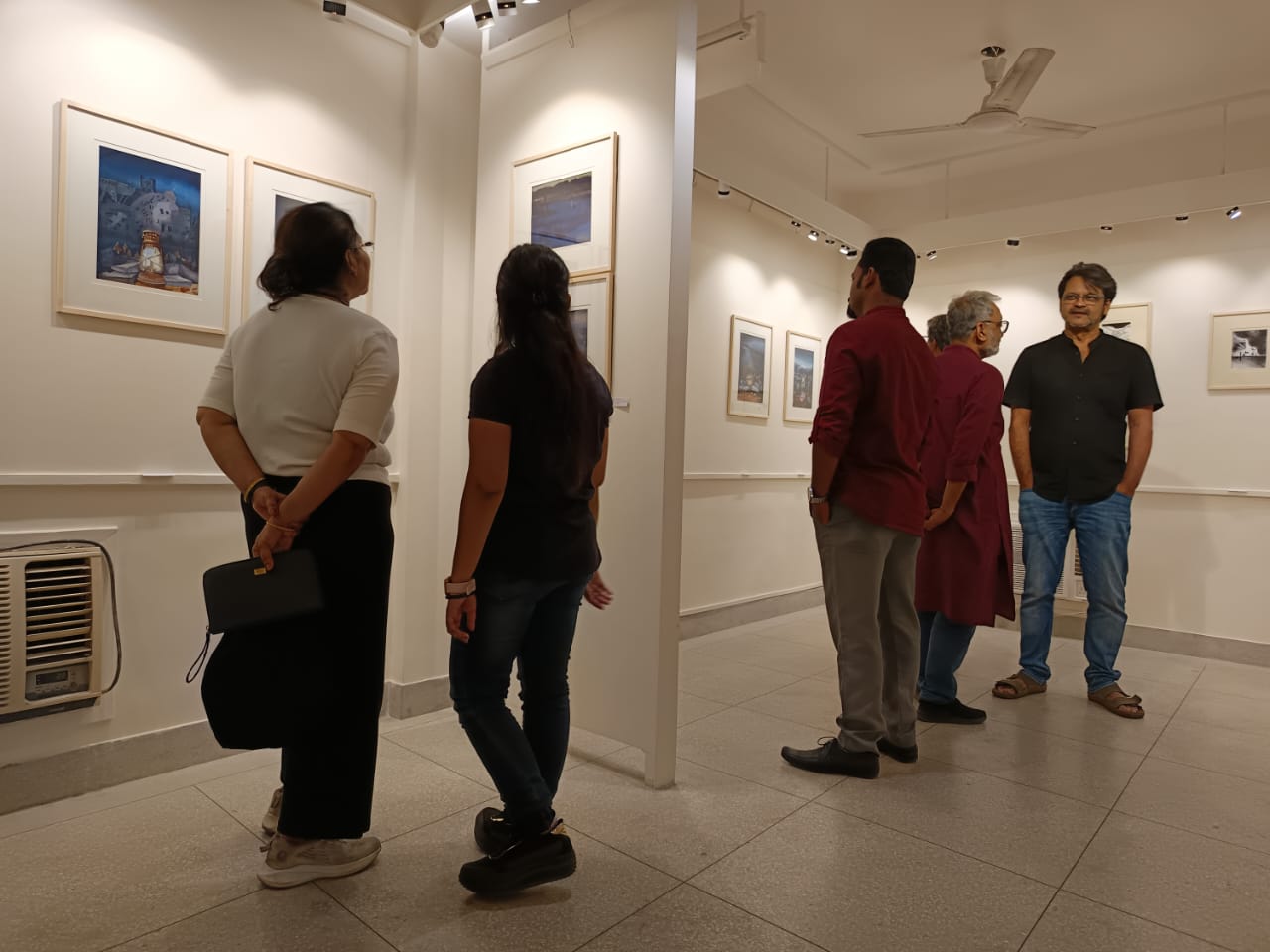
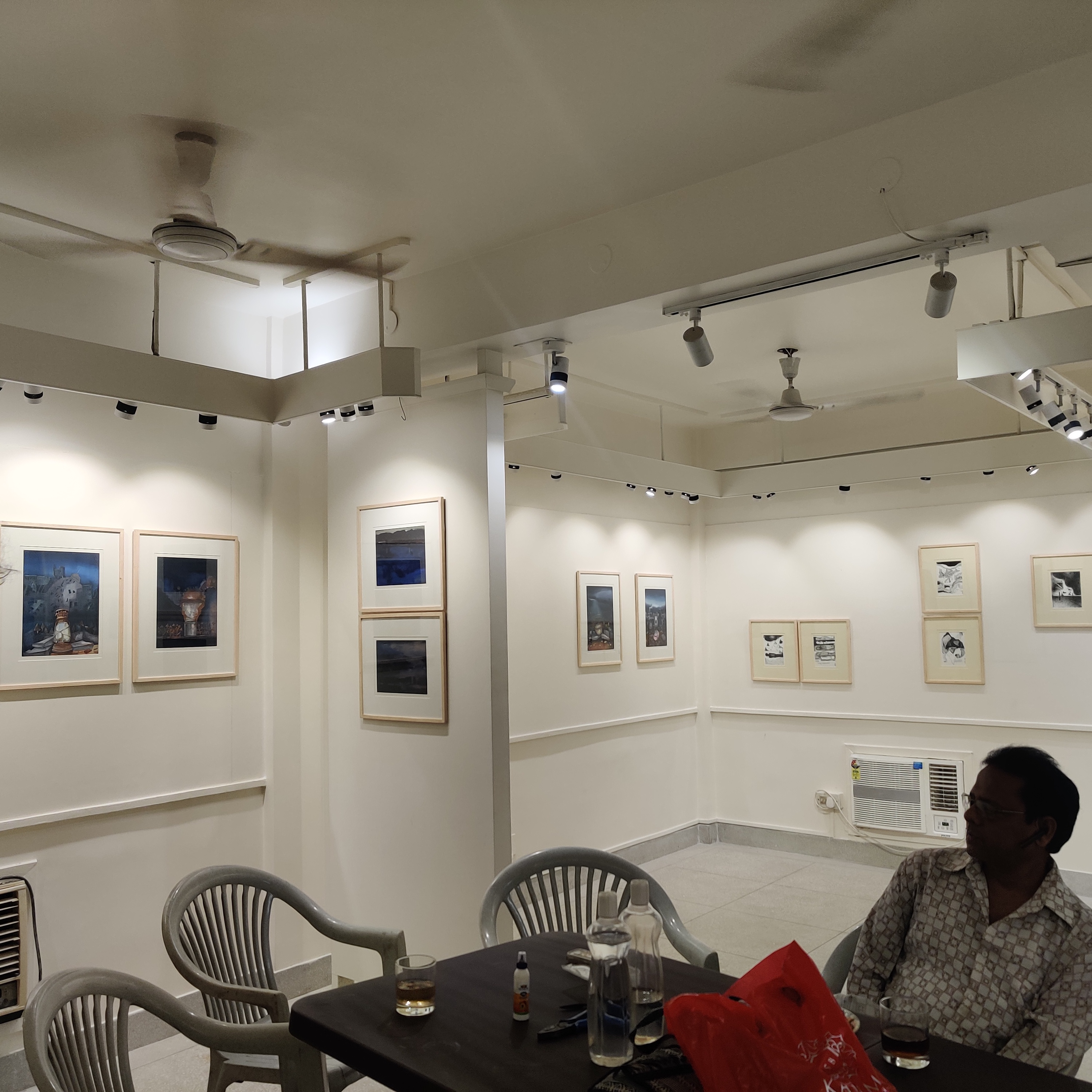
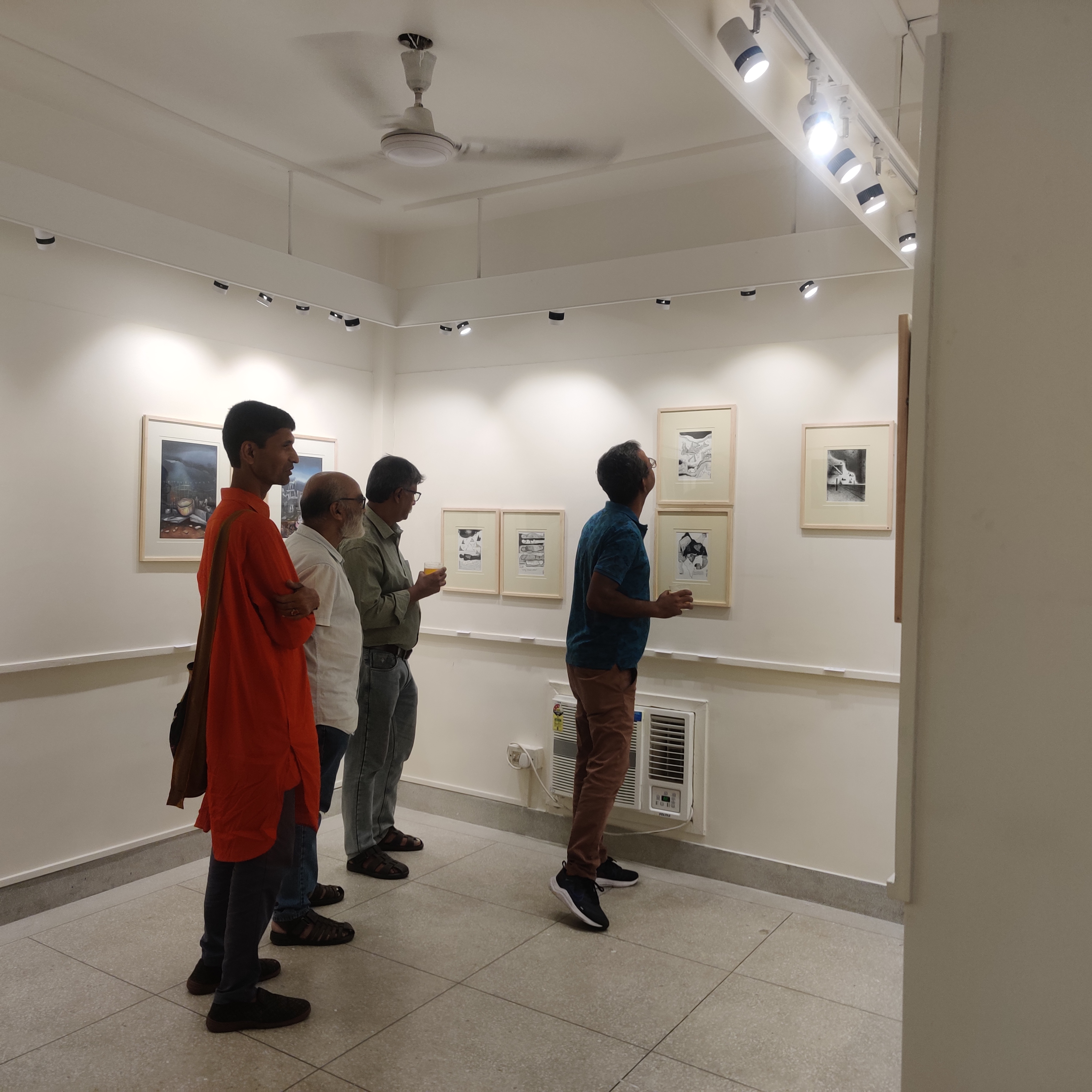
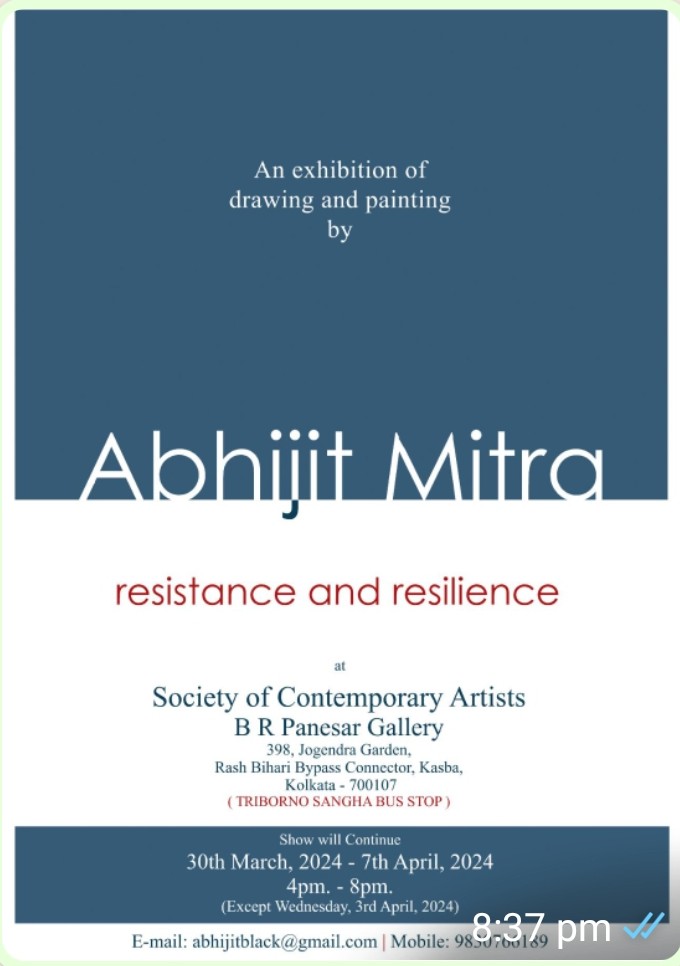
Kolkata, 2024, B. R. Panesar Gallery, (Society of Contemporary Artists) - “Resistance & Resilience”.
Kolkata, 2009, Birla Academy – “Walk in Sleep”.
Kolkata, 2008, Akar Prakar - “Unending Procession of Life” “Creativity” organized by Jagriti Art Initiative at Birla Academy, Kolkata, 2007 & 2008
Bahrain 2007, Bahrain Arts Society - “Face to Face”
New Delhi, 2007, The Alliance Francaise - Group 51
New Delhi, 2006, AIFACS -“Essence of Bengal Art” at AIFACS
Kolkata, 2006, Master's Collection Art Gallery -“Xpressions” at Master’s Collection Art Gallery
New Delhi, 2005, State Academy organized by Lalitkala Academy
Kolkata, 2004, Rotary Club, Akar Prakar - “Compassionate Compassions”
Jagriti Art Initiative – An exhibition of drawings and paintings, 2006 & 2009, Kolkata
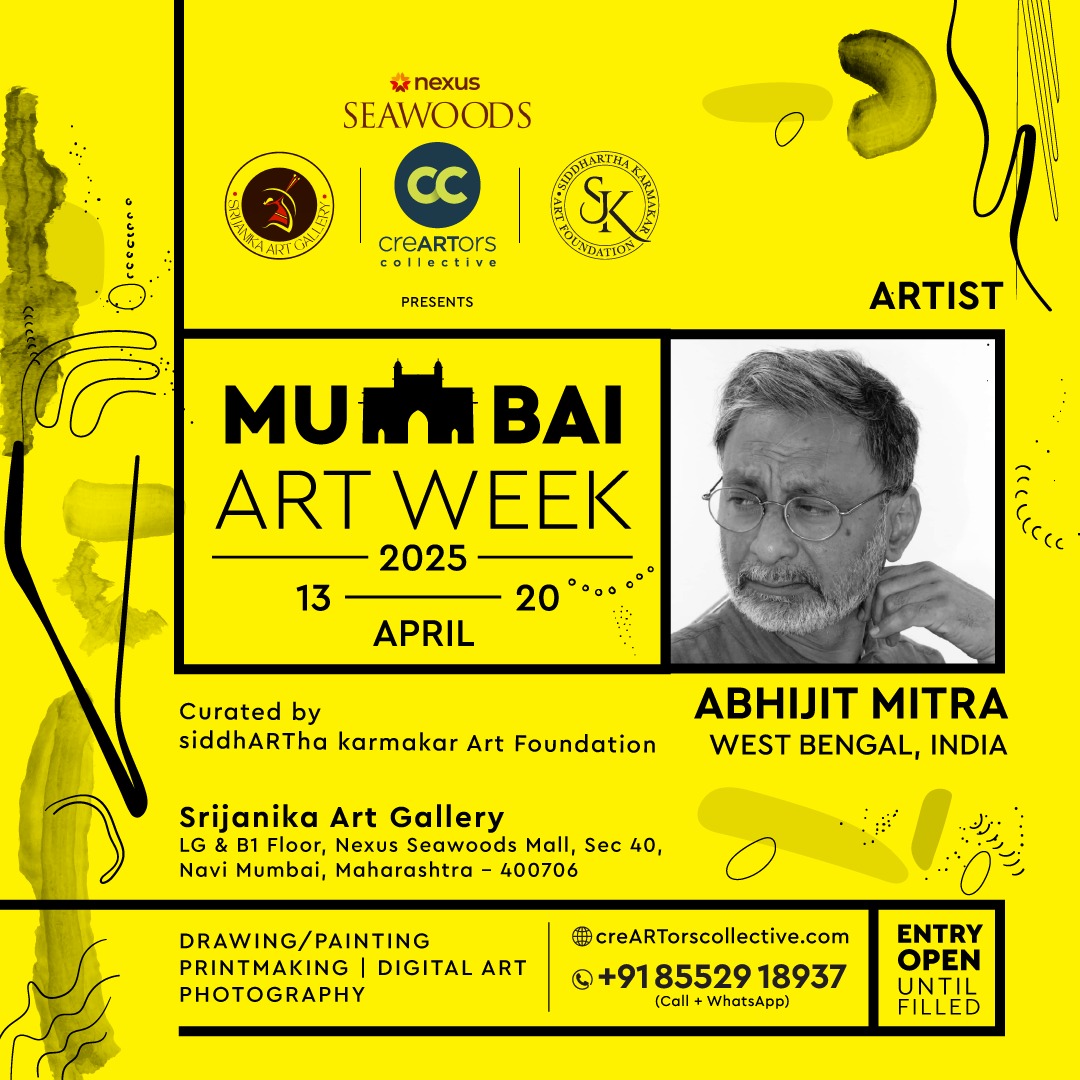
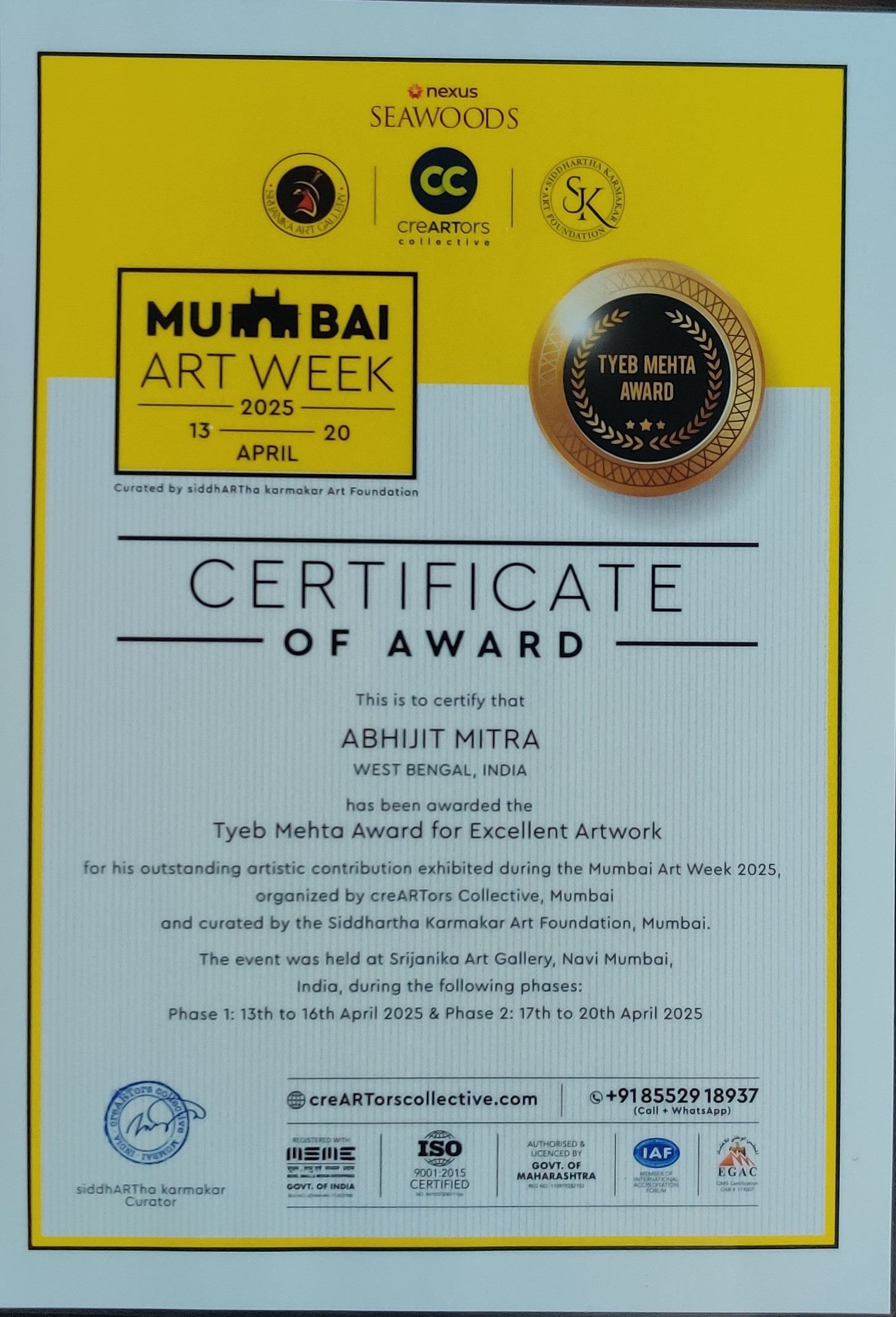
Mumbai Art Week, 2025 - Organized by Creators Collective, Mumbai
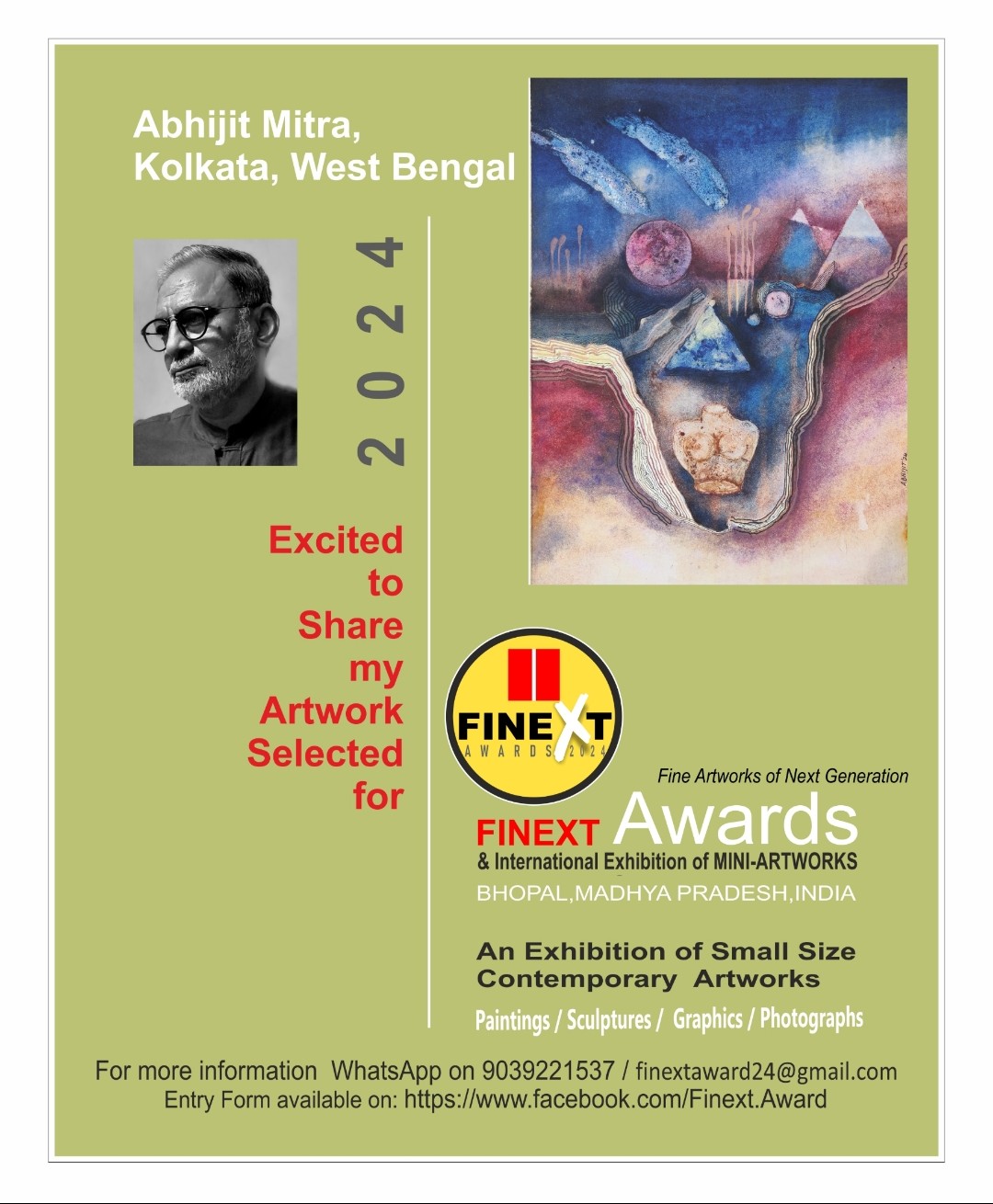
Bhopal, Madhya Pradesh, 2025 - FINEXT Awards & International Exhibition of MINI-ARTWORKS
Kolkata, 1986, 1990, 2004, 2005, 2007 - Academy of Fine Arts
Kolkata, 1983, 1985, 1986, 1990, 2005, 2009, - Birla Academy of Art & Culture
Kolkata 2005- Gaganendra Pradarshanshala
2025, Brooklyn International Culture Century Award
Kolkata, 1988 & 1990, Gallery AH-56, Water Colour Paintings
Thailand, 2008
Bahrain, 2007
Nagarkot, Nepal, 2006
EZCC, Kolkata, 2007 & 2006
To commemorate the 150th birth anniversary of Mahatma Gandhi an exhibition organized by Department of Information & Culture, Government of West Bengal – Kolkata Guest Speaker at Rotary Club of Calcutta to speak on “We lead the way to serve the society as an Artist”
Museum of Bengal Modern Art, Art Center, Kolkata Canara Bank, Head Office, Bangalore
India, United Kingdom, Malaysia, Singapore, Dubai, Bahrain, Paris & New York
Tyeb Mehta Award for Excellent Artwork
.jpg)
.jpeg)